WIPO杂志,2016年第3期(6月)
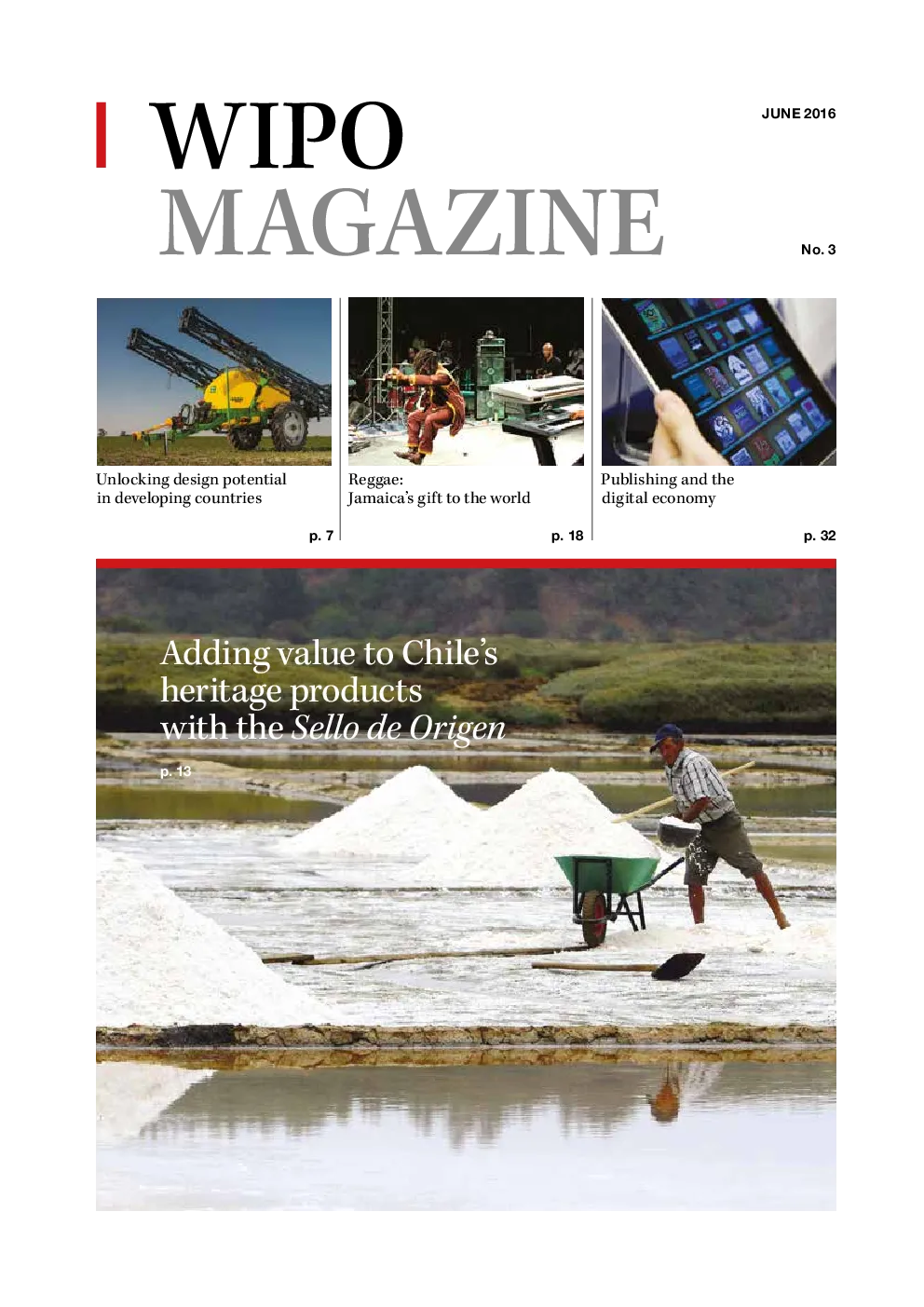
No. 3 Publishing and thedigital economy Unlocking design potentialin developing countries Reggae:Jamaica’s gift to the world p. 7 p. 18 p. 32 Adding value to Chile’sheritage productswith theSello de Origen Table of Contents 2China’s trademark activity continues to soar7Unlocking design potential in developing countries13Adding value to Chile’s heritage products with theSellode Origen18Reggae: Jamaica’s gift to the world25Copyright and museums in the digital age29Getting a handle on Twitter32Publishing and the digital economy37Patenting catalyst technology: activating changeand overcoming challenges Editor:Catherine JewellGraphic Design:Annick Demierre Cover images:Left to Right: Caiman, Argentina;International Reggae Day;© David Levenson / Alamy Stock Photo(BK99M4)Main image:Agencía Uno – Imagen de Chile Acknowledgements:2Binying Wang, Deputy Director General,Brands and Designs Sector, WIPO7, 13 & 29Marcus Höpperger, Law and Legislative Advice Division, WIPO18Carol Simpson, Regional Bureau for Latin Americaand the Caribbean, WIPO26Michele Woods,Miyuki Monroig,Copyright Law Division, WIPO32Geidy Lung, Copyright Law Division, WIPO37Matthew Bryan, PCT Legal Division andTomoko Miyamoto,Patent Law Division, WIPO © World IntellectualProperty Organization China’s trademarkactivity continuesto soarByCatherine Jewell, CommunicationsDivision, WIPO China’s Commissioner of the State Administrationfor Industry and Commerce (SAIC), Minister ZhangMao, is responsible for overseeing the world’s largesttrademark office. Mr. Zhang explains why Chinesetrademark activity has shot up in recent years and isset for further growth. Fifth, extensive IP outreach efforts have boosted publicand business awareness of the value of trademarks. Are foreign applicants protecting theirtrademarks in China? In 2015, there were 176,893 trademark applicationsfiled by foreign applicants, including those filed underthe Madrid System for the International Registration ofMarks, that is, 6.15 percent of all applications receivedby the Chinese Trademark Office (CTMO). By April 2016,valid foreign trademark registrations accounted for10.68 percent of all valid CMTO trademark registrations. What is the status of trademark activity inChina? Trademark applications filed in China over the lastdecade have soared from 766,319 in 2006 to 2,876,048in 2015. This trend is continuing despite sluggish globaleconomic growth. Are Chinese applicants using WIPO’sMadrid System? Five factors account for this rapid growth. First, theChinese Government’s drive to boost “mass entrepre-neurship and innovation”. This has helped maintainstrong economic growth, promoted market developmentand lowered market entry barriers. It has also resulted inthe formation of many new companies which are boost-ing entrepreneurship, innovation and trademark activity. China joined the Madrid System in October 1989 andbecame its seventh-largest user in 2015, when Chineseapplicants filed 2,321 international applications. This isless than 0.1 percent of all applications filed with theCTMO, so there is huge potential to expand use of theSystem by Chinese enterprises. Second, the implementation of the 2014 TrademarkLaw has helped create a sound legal environment fortrademarks to thrive. Intellectual property (IP) laws andregulations are constantly improving. The Madrid System is a convenient way for Chineseenterprises to register and protect their trademarksabroad, and for foreign companies to do so in China.It can support the long-term business goals of Chinesecompanies and help strengthen international recogni-tion of Chinese brands, which is our long-term goal.For over 25 years, the Madrid System has underpinnedChina’s impressive record in foreign trade and is anintegral part of China’s “Go Global” Strategy. Third, the industry and commerce authorities andmarket regulators at all levels are working to create alevel playing field for the protection and use of trade-mark rights. Fourth, SAIC is actively improving its trademark regis-tration procedures to ensure applicants have accessto efficient, high-quality services. At present about 70percent of all trademark applications are filed onlineand that number is growing every month. How would you like the Madrid System to evolve? We would like the System to expand its membershipand to become the preferred option for companies seeking international trademark protection. We wouldlike to see it further simplified and automated to betterserve users, including national IP offices, and to boostuse. Measures to strengthen cooperation between thenational offices and WIPO would also be welcome,along with more support in processing work relatingto the System. 31 influential brands compared to the top-ranking USwith 228 and the UK with 44. Third, we need to boost international trademark filingactivity by Chinese companies. In developed coun-tries, such applications account for between 35 and75 percent of all trademark applications