WIPO杂志,2016年第2期(4月)
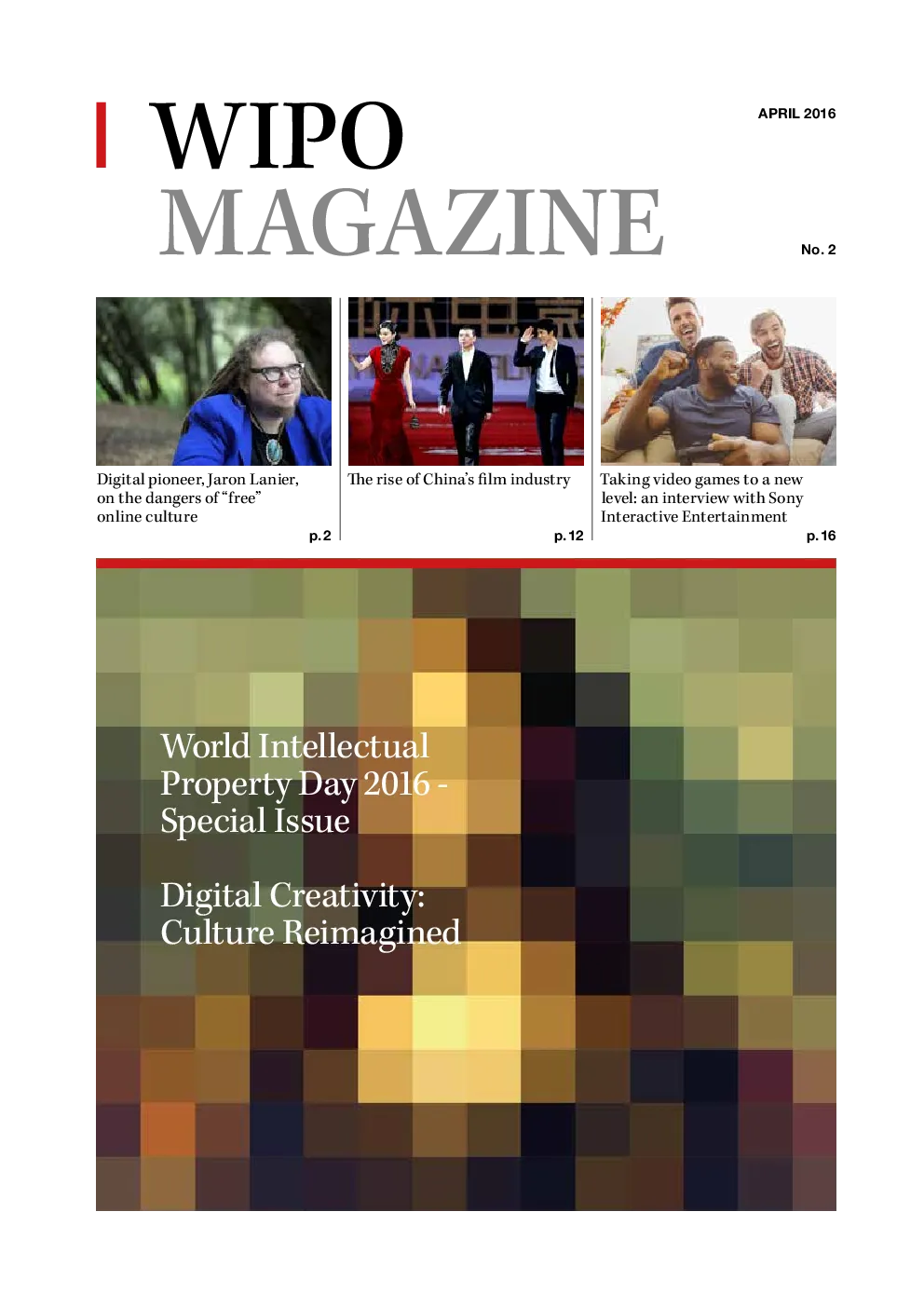
No. 2 Digital pioneer, Jaron Lanier,on the dangers of “free”online culture The rise of China’s film industry p.12 p.2 The creative economy is seeing radical change to access and business modelsas digital technologies transform the way culture is created, financed,distributed and consumed. ForWorld Intellectual Property Daythisyear, we look atDigital Creativity: Culture Reimagined, and explore whatdigital creativity means for consumers as well as for the talented individ-uals who produce the wealth of digital content we have at our fingertips. This special issue of the WIPO Magazine offers a range of perspectives onthe opportunities, the challenges, and the role of intellectual property inthe rapidly evolving digital marketplace. It opens with an interview withfuturist Jaron Lanier, a keynote speaker at the majorWIPO Conferenceon the Global Digital Content Market(April 20 to 22). For more on World IP Day, join us on Twitter (#worldipday)and Facebook (www.facebook.com/worldipday). Table of Contents 2Digital pioneer, Jaron Lanier, on the dangersof “free” online culture6Mycelia: shaping a new landscape for music10From pirates to privateers:a musician’s take on the digital market16The rise of China’s film industry20Taking video games to a new level:an interview with Sony Interactive Entertainment26Google on what is driving creativity and innovationin the digital economy29UK’s Copyright Hub: a license to create33Building an African digital content industry37Collaboration is the key to access:a scientific publisher’s view Editor:Catherine JewellGraphic Design:Annick Demierre Cover images:Left to Right: Doug Menuez, StocklandMartel; Izabela Habur; Zhang ZihongMain image: World IntellectualProperty Day 2016 Digital Creativity:Culture Reimagined Acknowledgements:2Kevin Fitzgerald, Consultant,Geidy LungandMiyuki Monroig,Copyright Law Division, WIPO10Paolo Lanteri, Copyright Law Division, WIPO16Binying Wang, Deputy Director General, andHongbing Chen,WIPO Office in China20Yuji Okuma, Director, WIPO Japan Office26Michele WoodsandPaolo Lanteri, Copyright Law Division, WIPO29Kevin Fitzgerald,Consultant, WIPO33Carole Croella,Copyright Law Division, WIPO37Geidy LungandMiyuki Monroig, Copyright Law Division, WIPO © World IntellectualProperty Organization Digital pioneer,Jaron Lanier, onthe dangers of “free”online cultureByCatherine Jewell, CommunicationsDivision, WIPO Jaron Lanier, a keynote speaker at the WIPO Conference on the GlobalDigital Content Market, from April 20 to 22, 2016, is a Silicon Valley insider,a virtual reality pioneer and one of the most celebrated technology writersin the world. But he is increasingly concerned about today’s online universe.He explains why and what it will take to turn things around. Jaron Lanier is a computer scientist,visual artist, composer of classical musicand a celebrated technology writer.He would like “to see more systems whereordinary people can get paid when theycontribute value to digital networks.” Has the digital revolution been a good thing for culture? There are good and bad things. It’s like asking if cameras are good forculture. Culture has become digitally obsessed. It’s just what culture isabout today to an incredible degree. But have digital tools had a positive impact on creativity? I don’t know if anyone really has the perspective to say for sure. In mybookYou Are Not a Gadget, I did an experiment. Whenever I was around people and there was music playing, I asked them ifthey could tell me in which decade the music they werelistening to was made. I was quite taken aback by howpeople can’t tell this decade from the previous one,whereas all the other decades seemed very distinctto them, including very young people. It is as if somekind of cultural stasis has happened, but it’s hard tosay whether that is down to the Internet. All these systems that throw people out of work createan illusion that a machine is doing the work, but in realitythey are actually taking data from people – we call it bigdata – to make the work possible. If we found a way tostart paying people for their actual valuable contributionsto these big computer resources, we could avoid theemployment crisis that otherwise we will create. You say free culture is dangerous. Why? Sadly, the online universe has become very segmentedand mean-spirited. It also has an increasingly isola-tionist quality about it. The algorithms used by socialmedia platforms end up feeding us things they thinkwe are already interested in, so we find ourselves in amirror chamber with a narrower and narrower experi-ence of the world. I actually helped make the argument that music shouldbe free and would ultimately benefit culture and musi-cians, so it’s not that I am unwilling to accept this newthing. I helped make it. And it does have some pluspoints. For one, people like feeling generous and it feelsgood to share and to be open. That is precious and weshould find designs in society that celebrate that. But