WIPO杂志,2018年第2期(4月)
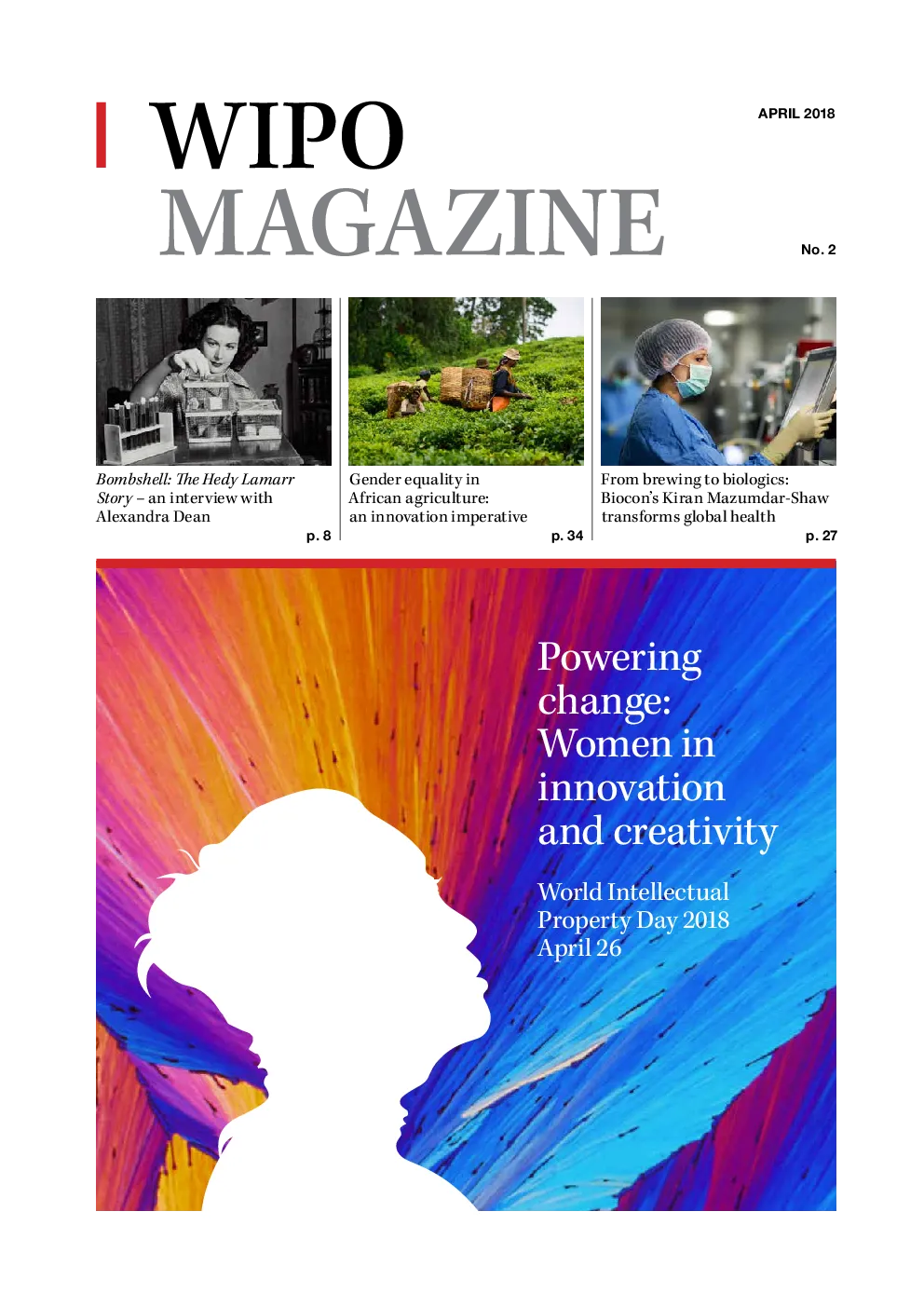
No. 2 Bombshell: The Hedy LamarrStory– an interview withAlexandra Dean Gender equality inAfrican agriculture:an innovation imperative From brewing to biologics:Biocon’s Kiran Mazumdar-Shawtransforms global healthp. 27 p. 8 p. 34 Poweringchange:Women ininnovationand creativity World IntellectualProperty Day 2018April 26 Poweringchange:Women ininnovationand creativity World IntellectualProperty Day 2018April 26 Every day women come up with game-changing inven-tions and life-enhancing creations that transform livesand advance human understanding from astrophysicsto nanotechnology and from medicine to artificial in-telligence and robotics. world. Their “can do” attitude is an inspiration to us all.And their remarkable achievements are an invaluablelegacy for young girls today with aspirations to becomethe inventors and creators of tomorrow. This special focus issue of the WIPO Magazine exploreswhy it is important to encourage women in innovationand creativity and presents the views and experiencesof just a few of the many remarkable women who arepowering change in our world every day. And in the creative sphere, whether in the movies, anima-tion, music, fashion, design, sculpture, dance, literature,art and more, women are re-imagining culture, testingthe limits of artistry and creative expression, drawing usinto new worlds of experience and understanding. For more on World Intellectual Property Day, join us onTwitter (#worldipday) and Facebook (www.facebook.com/worldipday). The important and inspiring contributions of countlesswomen around the globe are powering change in our Table of Contents Bridging the gender gap in intellectual property Editor:Catherine JewellLayout:Ewa Przybyłowicz Bombshell: The Hedy Lamarr Story– an interviewwith Alexandra Dean © WIPO, 2018 Raging Bull and Fearless Girl – moral rights in copyright Attribution 3.0 IGOlicense (CC BY 3.0 IGO) Women in Arab cinema: an interview with Hend Sabry The user is allowed to reproduce, distrib-ute, adapt, translate and publicly performthis publication, including for commercialpurposes, without explicit permission,provided that the content is accompa-nied by an acknowledgement that WIPOis the source and that it is clearly indi-cated if changes were made to the orig-inal content. From brewing to biologics: Biocon’s Kiran Mazumdar-Shawtransforms global health Gender equality in African agriculture: an innovation imperative Nursery feeding made easy 47Women and the international patent system:encouraging trends Adaptation/translation/derivatives shouldnot carry any official emblem or logo,unless they have been approved and val-idated by WIPO. Please contact us viathe WIPO website to obtain permission. When content published by WIPO, suchas images, graphics, trademarks orlogos, is attributed to a third party, theuser of such content is solely responsi-ble for clearing the rights with the rightholder(s). To view a copy of this license, please visithttps://creativecommons.org/licenses/by/3.0/igo Cover images:Left to right: Courtesy of ReframedPictures; Novarc Images / Alamy StockPhoto; Courtesy of BioconMain image:© Alfred Pasieka / Science Photo Library Acknowledgements:2Kaori Saito, Human Resources Management Department, WIPO16Geidy Lung, Copyright Law Division, WIPO21Ola Zahran, Copyright Development Division, WIPO34Marc Sery-KoréandLoretta Asiedu, Regional Bureau for Africa, WIPO Bridging the gender gapin intellectual property ByDan L. Burk, Chancellor’s Professor of Law,University of California, Irvine, USA IP AND GENDER: AN HISTORICAL PERSPECTIVE Intellectual property (IP) law is generally recognized asa means to celebrate and reward the contributions ofcreative individuals by giving them legal exclusivity overtheir creations for a period of time during which theymay determine who may exploit their work – possiblyin return for a fee. For much of modern history, and certainly in the earlydays of legal grants in IP, the formal roles from which IPmight arise were closed to women. The creative occu-pations of artist, engineer, writer, scientist and musicianwere dominated by men, if not exclusive to men. At thattime, social convention frowned on female activity in suchprofessions. IP law, as it developed, followed such socialprohibitions. For example, as noted by Professor ShellyWright, copyright historically encompassed the “fine arts”such as sculpture, painting, literature and music – fieldsthat were male dominated if not exclusively masculine, This is believed to generate incentives for creativity not onlyfor the benefit of creators, but also for the general benefitof society. It therefore follows that to the extent that IP lawfails to engage or recognize creators, it fails in its essentialpurpose. Unfortunately, there is growing evidence that ithas dramatically failed a large group of creators. with “crafts” such as needlework, knitting, quilting and other “domestic” fiber arts untilrelatively recently excluded