WIPO杂志,2014年第2期(4月)
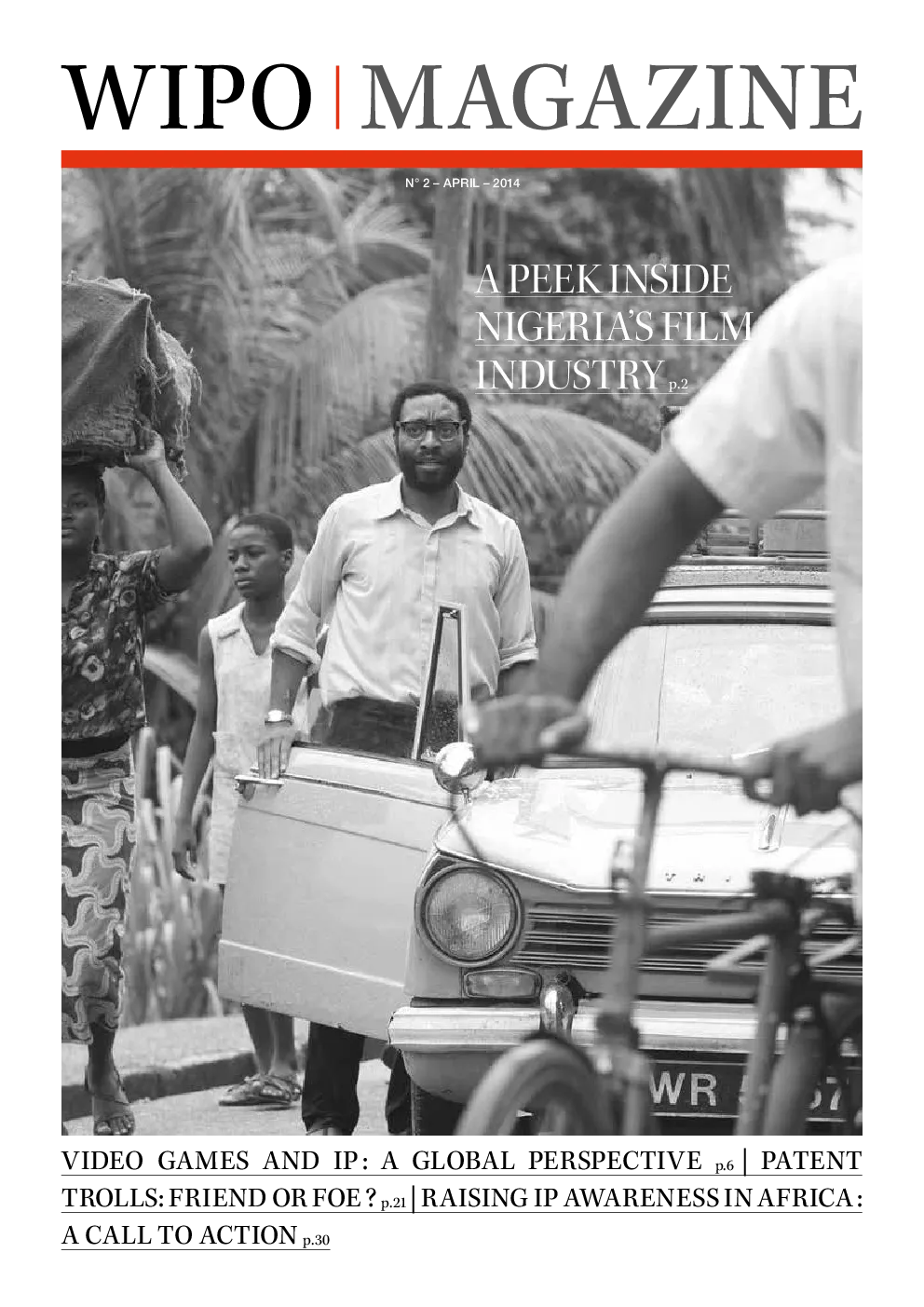
VIDEO GAMES AND IP: A GLOBAL PERSPECTIVE p.6| PATENTTROLLS: FRIEND OR FOE?p.21| RAISING IP AWARENESS IN AFRICA:A CALL TO ACTIONp.30 WORLD IP DAYMessage fromDirector GeneralFrancis Gurry Each year we celebrate World Intellectual Property Day on April 26 as an opportunityto discuss the role of intellectual property in relation to innovation and creativity. Thisyear, our theme is Movies: a global passion. Movies have always attracted global audiences. From the very first silent moviesthey were watched across the whole world with fascination, and with passion. Morerecently, we have witnessed the growth not only of global audiences, but also ofglobal production. Where Hollywood was once the dominant player worldwide, nowwe see film industries flourishing across the world, be it Bollywood in India, Nollywoodin Nigeria, or in Scandinavia, North Africa, China or other parts of Asia. So moviesreally are a global passion. Movies are also a direct product of intellectual property (IP). Think about how a filmis made. You start with a script, which is the intellectual property of an author orscreenwriter. Then there are the actors, whose performances are their intellectualproperty. Then there is music, in which the composers and the performers have IP.Numerous players contribute to creating a film, and to enabling us to watch it as aseamless performance, woven from a multiplicity of intellectual property. IP underliesthe whole film industry. All these players who contribute to making and distributing movies are protectedby an international legal framework. This started with the Berne Convention backin the 19thCentury. Together with our member states, WIPO seeks to ensure thatthis legal framework keeps pace with our changing world, and continues to serveits fundamental purpose of making IP work for creativity and innovation. Recentlywe added a new treaty, the Beijing Treaty on Audiovisual Performances, to protectthe performances of actors. On World IP Day this year, I invite movie lovers everywhere, when next you watcha movie, to think for a moment about all the creators and innovators who have hada part in making that movie. And I would urge you also to think about the digitalchallenge which the Internet presents for film. I believe it is the responsibility not justof policy-makers but of each of us to consider this challenge, and to ask ourselves:How can we take advantage of this extraordinary opportunity to democratize cultureand to make creative works available at the click of a mouse, while, at the same time,ensuring that the creators can keep on creating, earning their living, and making thefilms that so enrich our lives? CONTENTS p.2A peek inside Nigeria’s film industryp.6Video games and IP: a global perspectivep.12A fair deal for authorsp.14The case for authors’ rights: a view from withinp.16Joanne Harris and the voodoo of writingp.18Ibero-American broadcasters signal need for changep.21Patent trolls: friend or foe?p.24Exploring the scope of gene patents throughnew levels of transparencyp.30Raising IP awareness in Africa: a call to action Editor:Catherine JewellGraphic Designer:Annick Demierre Front cover:In just 20 years, Nigeria’s low-budgetfilm industry has become an increasinglyinfluential multi-billion dollar business.The recently released movie,Half of aYellow Sun, is Nigeria’s first internationalco-production.Photo: Courtesy of Metro International Acknowledgements:p.6Donna Hill, Counsellor,Copyright Infrastructure Divisionp.18Sergio Balibrea Sancho, Director, Assemblies Affairs and DocumentationDivision andCarole Croella, Senior Counsellor, Copyright Law Divisionp.21James Pooley, Deputy Director General, Innovation and TechnologySector andMatthew Bryan, PCT Legal Divisionp.24Anatole Krattiger,Director, Global Challenges Divisionp.30Geoffrey Onyeama,Deputy Director General, Development Sector ©World IntellectualProperty Organization A PEEK INSIDENIGERIA’S FILMINDUSTRY BySandra Oyewole,Partner, Olajide Oyewole LLP In April 2012, it was reported that the US hedge fund, TigerGlobal Management, had invested US$8 million in iROKOtv,the world’s largest online distributor of licensed Nollywood films.This substantial injection of funds to scale-up iROKOtv’s videostreaming operations was testimony to the growing internationalprominence of Nigeria’s film industry. Nollywood, as Nigeria’sfilm industry is popularly known, produces on average 1500films per year. This makes it the largest film industry in Africa andglobally, second only to Bollywood. The industry’s phenomenalgrowth in the last two decades is nothing short of incredible. filmmakers made films without a formal script, with actorssimply making up their lines as they went along. In recent yearshowever, filmmakers are working hard to shed amateur prac-tices and placing greater emphasis on enhancing the qualityof films produced. AN INFORMAL STRUCTURE To a large extent, the Nigerian film industry remains informalwith a structure that is unders