WIPO杂志,2014年第3期(6月)
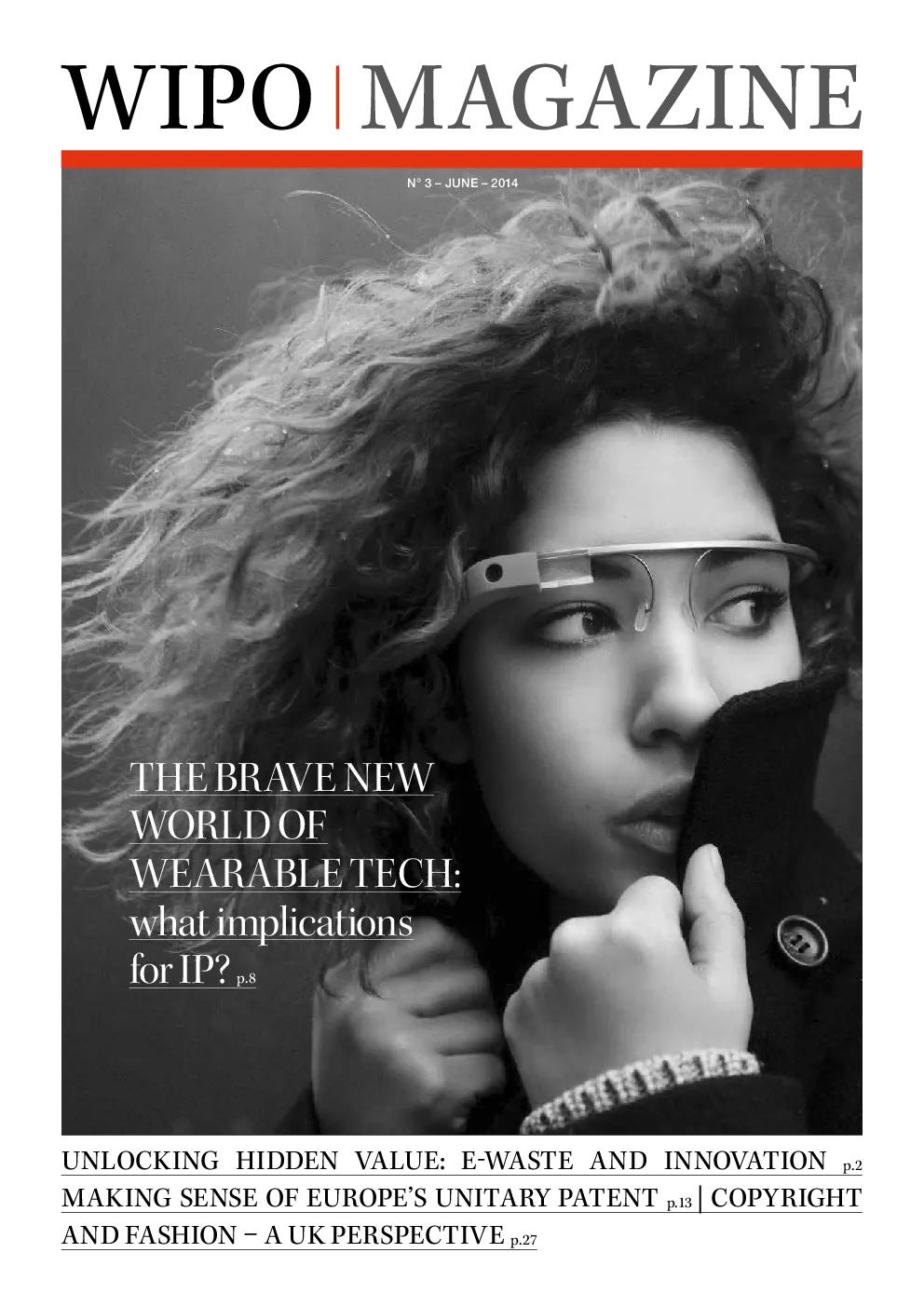
UNLOCKING HIDDEN VALUE: E-WASTE AND INNOVATIONp.2MAKING SENSE OF EUROPE’S UNITARY PATENTp.13| COPYRIGHTAND FASHION – A UK PERSPECTIVEp.27 CONTENTS p.2Unlocking hidden value: e-waste and innovationp.8The brave new world of wearable tech:what implications for IP?p.13Making sense of Europe’s unitary patentp.17Facilitating generic drug manufacturing:Bolar exemptions worldwidep.21IP litigation: What place for patent drawings?p.24Independent movie-making: an interviewwith Sarah Lotfip.27Copyright and fashion: A UK perspectivep.35One Year On: IP Australia’s Regional PatentExamination Training Program Editor:Catherine JewellGraphic Designer:Annick Demierre Front cover:Some estimate wearable technology couldbe worth US$42 million within 5 years.What are the IP implications of this newtechnology trend?Photo: Google ©World IntellectualProperty Organization E-WASTE ANDINNOVATION:unlocking hidden value ByIrene Kitsara,Access to Informationand Knowledge Division,WIPO Electronic WasteRecycling Discarded end-of-life electrical and electronic devices – es-sentially every office or household good with a cable – arethe world’s fastest growing waste stream. By 2017 the annualvolume of e-waste will increase by some 33 percent to an es-timated 65.4 million tons – the equivalent in weight to 11 GreatPyramids of Giza – according to the UN-led public-privateSolving the E-Waste Problem (StEP) initiative. The rapid devel-opment of electronics has brought with it many life-enhancingadvantages and opportunities. The downside, however, is thatthe scale and speed of technical innovation in this area, fuelledby our limitless appetite for next generation technologies, as wellas the global uptake of these low-cost devices – with mobilecellular penetration rates alone at 96 percent – are creating anexpanding mountain of e-waste. Of the 50 million tons (includingfridges, computers, laptops, mobile phones, game consoles,musical equipment and televisions) generated globally eachyear, only between 15 to 20 percent is recycled. Much of theremaining e-waste ends up in developing countries where it isoften recycled by the informal sector using rudimentary methodsthat present significant risks to the environment and the healthof local populations. noble metals such as silver (Ag), gold (Au), palladium (Pd) andplatinum (Pt). Although the quantities used in each individualdevice are small, for example, 250 mg of silver are used in eachmobile phone, when you consider the global sales of mobilephones are in the hundreds of millions the economic benefits ofrecovering and recycling discarded or obsolete mobile phonesand other electronic devices are clear. TRACKING E-WASTE-RELATED INNOVATION In order to gain a better understanding of available technologiesfor e-waste recycling and recovery, and as part of its effortsto promote environmentally sound disposal and recyclingof e-waste, the Secretariat of the Basel Convention on theControl of Transboundary Movements of Hazardous Wastesand their Disposal (SBC) (www.basel.int), recently requestedWIPO’s support in preparing an e-waste technologies patentlandscape report. The report (www.wipo.int/patentscope/en/programs/patent_landscapes/index.html), provides a comprehensive overviewof available technologies for e-waste recycling and recoveryas far as they are described in patent documents focusing onend-of-life mobile phones and computer equipment. It offers asnapshot of innovation in this field, identifies observable trendsin patenting activity and provides insights about the technologydevelopment cycle, the geographic distribution of innovation,research topics and primary actors, including case studies,within e-waste and related research and development. E-WASTE: A COMPLEX COCKTAIL Unlike other types of municipal waste, e-waste involves a com-plex mix of hazardous, highly toxic materials and economicallyvaluable, noble metals. As up to 60 elements from the periodictable can be found in complex electronic equipment, sophis-ticated processing technologies are required to maximize therecovery of these valuable resources while minimizing anynegative social or environmental impact. This presents bothchallenges and opportunities for recyclers. The report analyses patent applications relating to e-wasterecycling in three main categories, namely: technologies forrecycling or recovering materials such as plastics or metals;sources of e-waste and their processing (e.g. batteries, cablingand printed circuit boards); and processes and logistics involvedin e-waste treatment, such as magnetic sorting of e-waste. The list of toxic substances includes cadmium (Cd) found incathode ray tube (CRT) computer monitors, mercury (Hg) usedin flat screen displays, lead (Pb), beryllium (Be), brominatedfire retardants, polychlorinated biphenyls (PCBs) and plastics,including polyvinyl chloride (PVC) used for covers, cablingand connectors. The negative environment and health risksassociated with disposing of e-waste, and its