WIPO杂志,2017年第3期(6月)
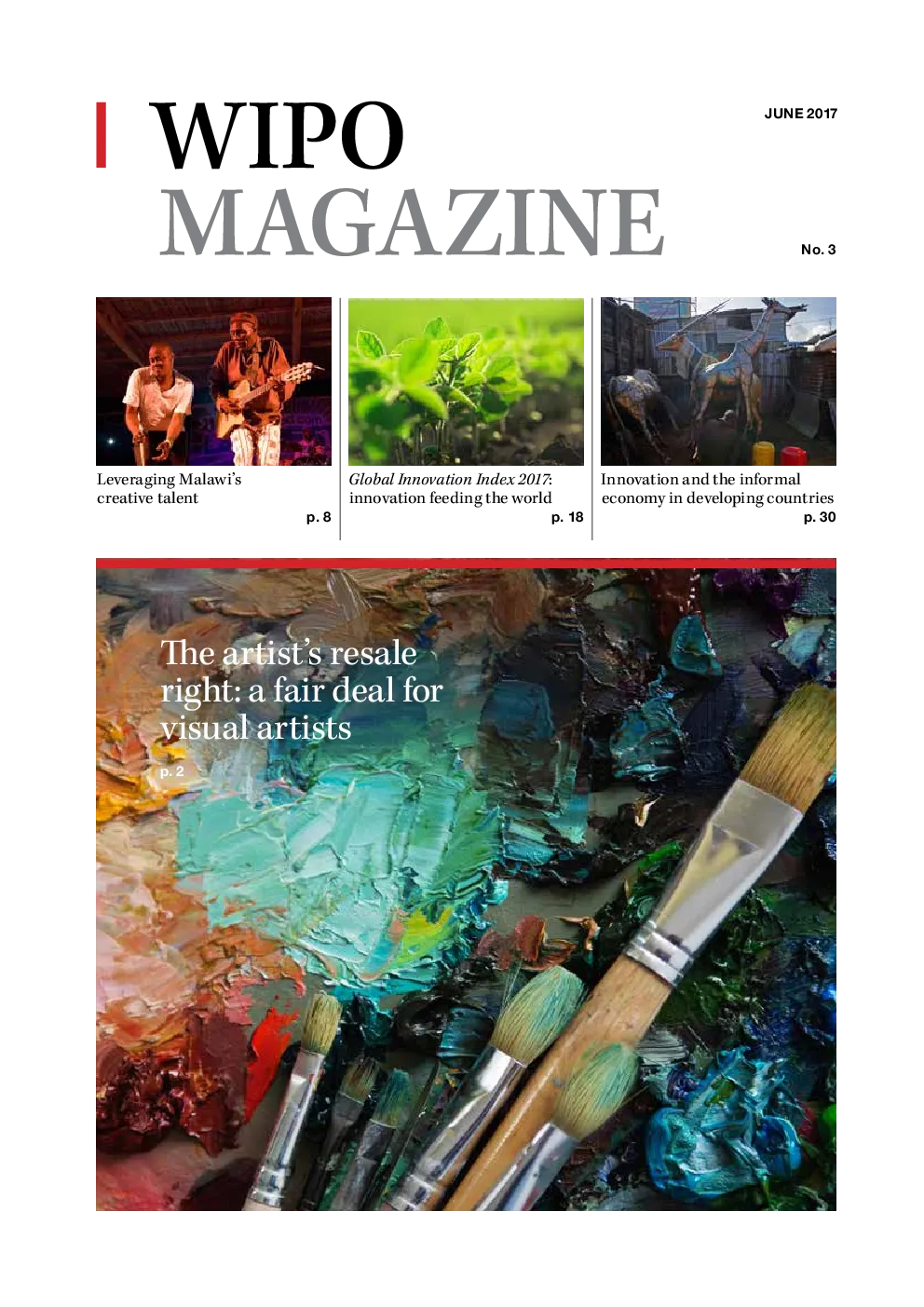
No. 3 Global Innovation Index 2017:innovation feeding the worldp. 18 Leveraging Malawi’screative talent Innovation and the informaleconomy in developing countriesp. 30 p. 8 The artist’s resaleright: a fair deal forvisual artists Table of Contents 2The artist’s resale right: a fair deal for visual artists8Leveraging Malawi’s creative talent13Innovation: history’s great free lunch18Global Innovation Index 2017: innovation feeding the world26Kenyans turn to drought-tolerant maize variety to fight poverty30The informal economy in developing nations:a hidden engine of growth37Supporting innovation in next-generation medicines44Yoga and copyright Editor:Catherine Jewell © WIPO, 2017 Attribution 3.0 IGOlicense (CC BY 3.0 IGO) The user is allowed to reproduce, distrib-ute, adapt, translate and publicly performthis publication, including for commercialpurposes, without explicit permission,provided that the content is accompa-nied by an acknowledgement that WIPOis the source and that it is clearly indi-cated if changes were made to the orig-inal content. Adaptation/translation/derivatives shouldnot carry any official emblem or logo,unless they have been approved and val-idated by WIPO. Please contact us viatheWIPO websiteto obtain permission. When content published by WIPO, suchas images, graphics, trademarks orlogos, is attributed to a third party, theuser of such content is solely respon-sible for clearing the rights with theright holder(s). To view a copy of this license, please visithttps://creativecommons.org/licenses/by/3.0/igo Cover images:Left to right: steve mcinerny/Alamy Stock Photo; iStock.com/©stevanovicigor; S. DanielsMain image:iStock.com/© nata_zhekova The artist’s resaleright: a fair dealfor visual artists ByCatherine Jewell,Communications Division, WIPO “Artists do not live on thin air.” This simple statement by the late interna-tionally acclaimed Senegalese sculptor Ousmane Sow is a stark reminderof the importance of the resale right for visual artists around the world. Since 2014, the International Confederation of Societies of Authors andComposers (CISAC) and others have been actively campaigning to push theissue of the artist’s resale right up the international copyright agenda, callingfor reform of the law so that visual artists benefit each time their work is resold. ABOUT THE ARTIST’S RESALE RIGHT “Artists shouldbe treatedequallywherever theirwork is sold.This is a pleafor artists’futures.” Unlike novelists and musicians, visual artists such as painters andsculptors do not directly benefit from downstream payments when theirworks change hands in global markets and do not generate significantincome from the reproduction and communication rights provided to othercreators under copyright law. The artist’s resale right seeks to correctthis imbalance by ensuring that artists receive a small percentage of thesale price of a work when it is resold. Just as the art market has becomeglobal, proponents argue, so the artist’s resale right should be global. Although the right is recognized in the Berne Convention for the Protec-tion of Literary and Artistic Works (Article 14ter), which sets minimuminternational copyright standards, it is optional. And while around 80countries recognize the right, many others, including major art marketslike the United States and China, do not. Visual artists want a new treaty that makes the right mandatory, and theirefforts are starting to pay off. With a mandate from WIPO’s StandingCommittee on Copyright and Related Rights, WIPO hosted an internationalconference on the artist’s resale right in April 2017. Key actors from acrossthe art market – artists, dealers, galleries, auction houses, academics andcollective management organizations (CMOs) – exchanged views andexperiences, shedding light on the various challenges associated withdeveloping and applying resale royalty schemes that both benefit artistsand support a robust and transparent global art market. Mark Stephens, Chairman of the UK’s Design andCopyright Society (DACS) WHY NOW? Opening the event, WIPO Director General Francis Gurry said: “The digitalenvironment and the globalization of markets present both vulnerabilitiesand opportunities, and it is appropriate that we consider how we mightaddress the gaps that exist in connection with the artist’s resale right.” The artist’s resale right does not always work as well as it should forartists, Mr. Gurry said, pointing to the need to support the developmentof CMOs in the smooth and efficient running of resale royalty schemes. The Minister of Culture and Communication from Senegal, Mr. MbagnickNdiaye, noted that while the value of the African art market has increasedmore than a thousand-fold since 2007, the artists responsible for theseworks rarely enjoy any of the benefits of their commercial success. What the BerneConvention says aboutthe Artist’s Resale Right The artist’s resale right is a question of equity, he said. It ensures that