WIPO杂志,2017年第4期(8月)
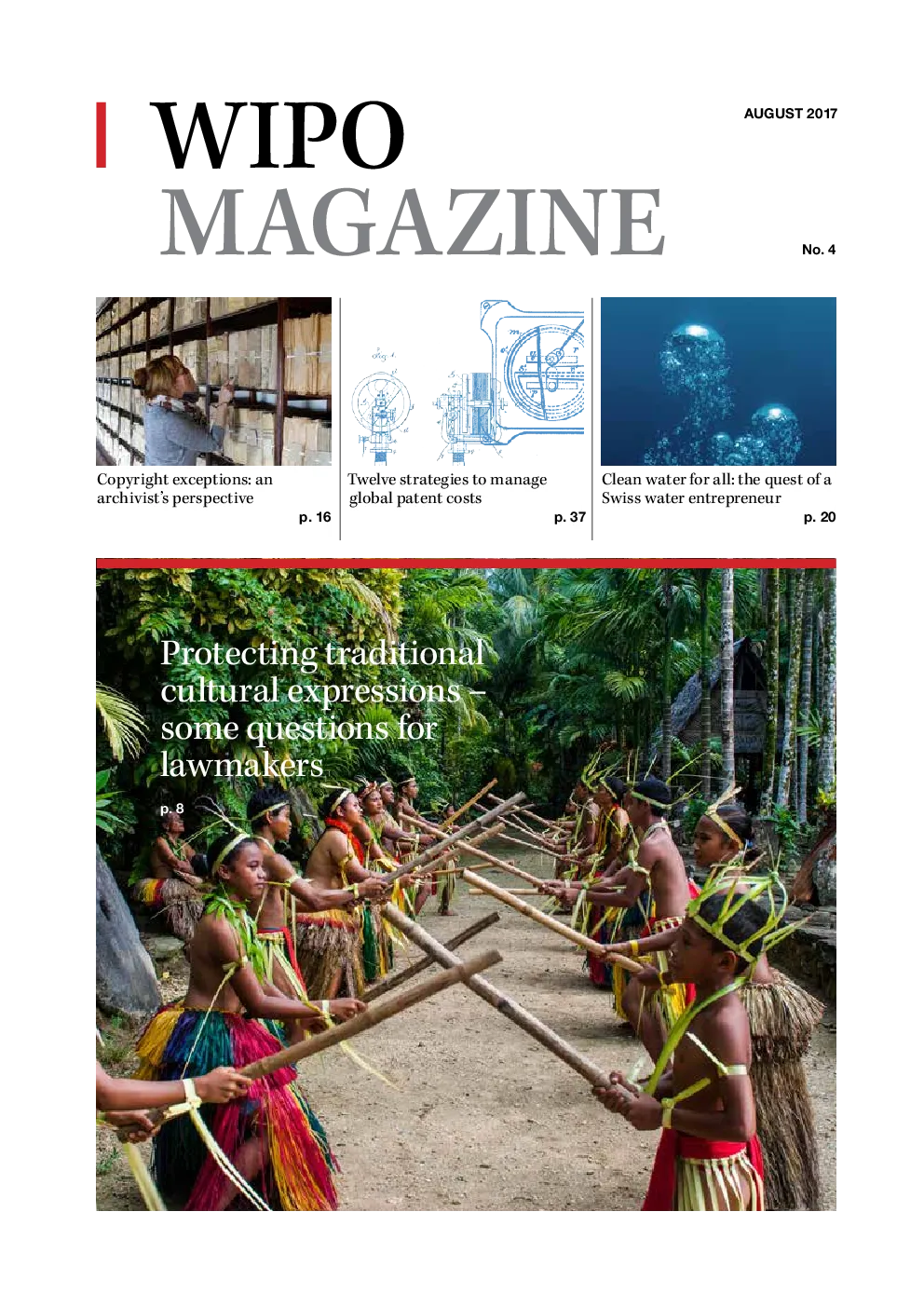
No. 4 Clean water for all: the quest of aSwiss water entrepreneurp. 20 Twelve strategies to manageglobal patent costs Copyright exceptions: anarchivist’s perspective p. 37 p. 16 Protecting traditionalcultural expressions –some questions forlawmakers Table of Contents Factoring gender into innovation for better outcomes Editor:Catherine Jewell Protecting traditional cultural expressions –some questions for lawmakers Copyright exceptions: an archivist’s perspective © WIPO, 2017 Clean water for all: the quest of a Swiss water entrepreneur Attribution 3.0 IGOlicense (CC BY 3.0 IGO) Trademarks and China’s business reform agenda The user is allowed to reproduce, distrib-ute, adapt, translate and publicly performthis publication, including for commercialpurposes, without explicit permission,provided that the content is accompa-nied by an acknowledgement that WIPOis the source and that it is clearly indi-cated if changes were made to the orig-inal content. Intellectual property and development: the ASEAN story Twelve strategies to manage global patent costs 42In the courts:United States Supreme Court rewrites rules onpatent exhaustion Adaptation/translation/derivatives shouldnot carry any official emblem or logo,unless they have been approved and val-idated by WIPO. Please contact us viatheWIPO websiteto obtain permission. When content published by WIPO, suchas images, graphics, trademarks orlogos, is attributed to a third party, theuser of such content is solely respon-sible for clearing the rights with theright holder(s). To view a copy of this license, please visithttps://creativecommons.org/licenses/by/3.0/igo Acknowledgements:2Julio Raffo, Economics and Statistics Division, WIPO8Daphné Zografos Johnsson, Traditional Knowledge Division, WIPO20Anja von der Ropp,Global Challenges Division, andChristine Bonvallet, PCT Legal Division, WIPO26Hongbing Chen, WIPO Office in China30Andrew Michael Ong, Regional Bureau for Asia and the Pacific, WIPO37Matthew Bryan, PCT Legal Division, WIPO42Marco Aleman, Patent Law Division, WIPO Cover images:Left to right: David Bagnall / AlamyStock Photo; patent drawing image CC0;iStock.com/© DJMattaarMain image:imageBROKER / Alamy Stock Photo Factoring gender intoinnovation for betteroutcomes ByEleanor Khonje,freelance writer Heart disease is a leading cause of death among womenin the United States and Europe. Yet for many years itwas considered a male condition, and clinical researchfocused almost exclusively on the functional changesthat occur in male patients. As a consequence, manywomen were wrongly diagnosed. Similarly, osteoporosis is considered a predominantlyfemale condition. Men are rarely evaluated or treated forit. But after age 75, men suffer nearly one-third of hipfractures related to the condition in the United Statesand Europe. These examples illustrate why it is important for scientists,engineers and other researchers to factor sex and gen-der – and the differential impact that research may haveon both women and men – into their research protocolsand development work. WIPO Magazinerecently sat down with Professor LondaSchiebinger, John L. Hinds Professor of History ofScience and Director of Gendered Innovations in Science,Health and Medicine, Engineering and Environment atStanford University in the United States, to find out moreabout why sex and gender need to be taken seriouslyby researchers, engineers and inventors. What prompted you to start the GenderedInnovations project? I have always been interested in the role that gender playsin the cultural production of knowledge. And I wanted todevelop a practical tool that demonstrates that by inte-grating sex and gender analysis into scientific, medicaland environmental research, you create new knowledge and bring about positive change. Gendered Innovationsis all about discovery and innovation, and focuses onimproving research and making it more inclusive. Tell us more about the project. Gendered Innovations is an analytical framework devel-oped by an international collaboration of experts includ-ing over 80 scientists, humanists and gender experts. Itsaim is to demonstrate how we can harness the creativepower of sex and gender analysis for innovation anddiscovery. Gender analysis adds a valuable dimension toresearch and can take it in new directions. It generatesvaluable insights and outcomes for women and men. Gender in a nutshell Gender is all about what is means to bea man and what it means to be a womanor a gender-diverse person. It exploreshow men and women experience lifedifferently, not because of biology butbecause of the social and cultural mean-ings developed around each. For decades,feminist research has underlined theneed to evaluate the influence of genderin order to effectively tackle develop-ment challenges and promote inclusivedevelopment – and with some success.Today, gender equality is one of the 17United Nations Sustainable DevelopmentGoals and is increasingly accep