WIPO杂志,第4/2014期(8月)
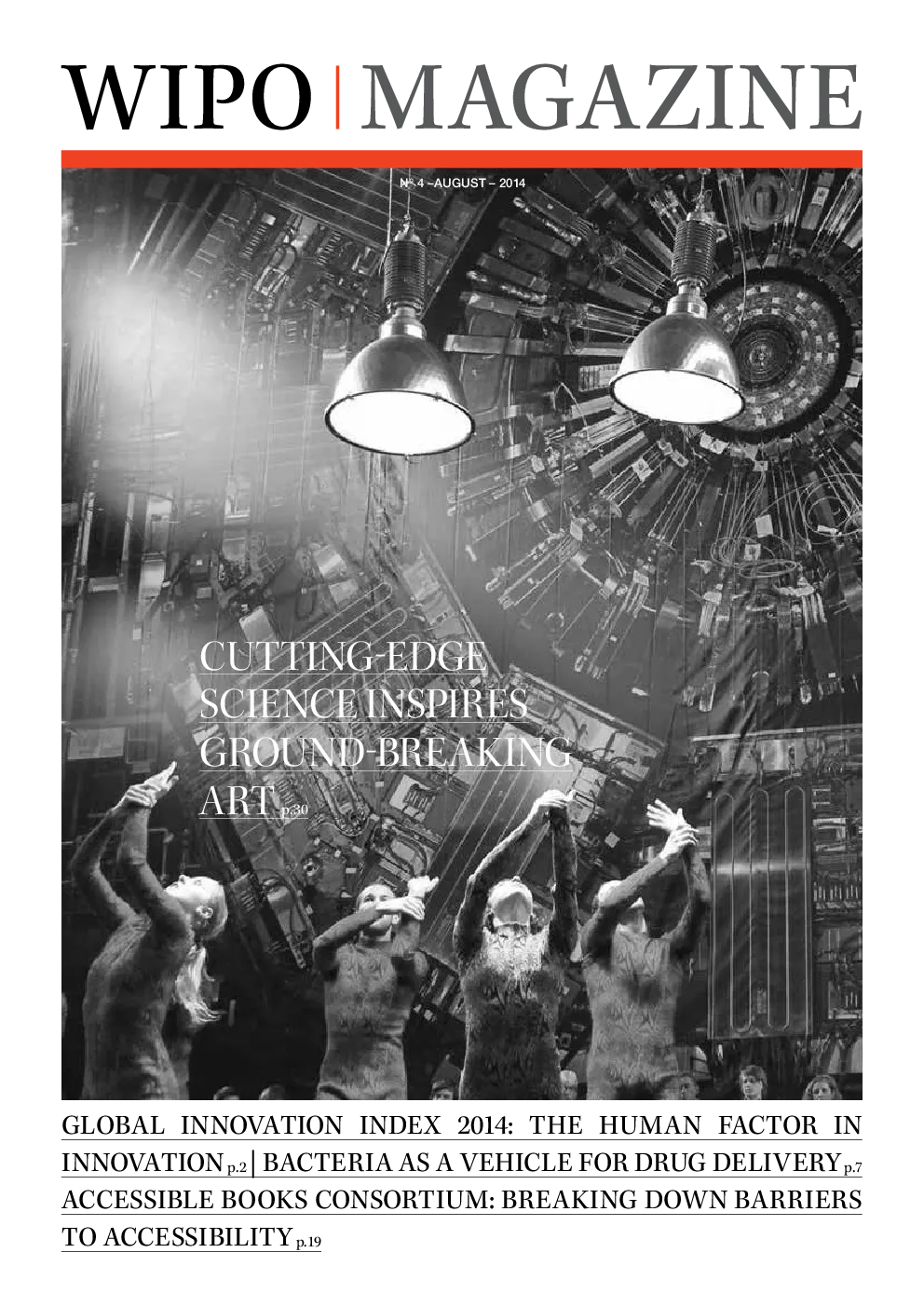
GLOBAL INNOVATION INDEX 2014: THE HUMAN FACTOR ININNOVATIONp.2| BACTERIA AS A VEHICLE FOR DRUG DELIVERYp.7ACCESSIBLE BOOKS CONSORTIUM: BREAKING DOWN BARRIERSTO ACCESSIBILITYp.19 CONTENTS p.2Global Innovation Index 2014:The human factor in innovationp.7Bacteria as a vehicle for drug deliveryp.11Innovation gathers pace in renewables sectorp.14In the Courts –Alice v CLS Bank:United States Supreme Courtestablishes general patentability testp.19Accessible Books Consortium:breaking down barriers to accessibilityp.25Video games: computer programsor creative works?p.30Cutting-edge science inspires ground-breaking artp.38Egypt and Tunisia underscore the importance of IP Editor:Catherine JewellGraphic Designer:Annick Demierre Front cover:The choreography in Gilles Jobin’s newcontemporary dance piece, QUANTUM,generates movements that reflect howparticles and their forces behave.Photo: Gregory Batardon ©World IntellectualProperty Organization ByCatherine Jewell,Communications Division andSacha Wunsch-Vincent, Economicsand Statistics Division, WIPOGLOBAL INNOVATIONINDEX 2014:The human factorin innovation As the global economic recovery gathers pace and becomes more broad-based,policy-makers are focusing on the search for sources of future growth and employ-ment. But despite growing optimism about the global economic outlook, govern-ments continue to face a basic dilemma: limited scope for fiscal stimulus and publicinvestment but a strong need for investment and future-oriented pro-growth policiesto sustain growth and employment. In this context innovation and entrepreneurshipare becoming ever-more important. But what needs to be done to stimulate these keydrivers of economic growth? How can policymakers track global innovation trends,assess progress and identify priorities? The Global Innovation Index (GII), now in its7thyear, offers decision-makers a practical “tool for action”. It provides a rich series ofmetrics that benchmark the innovation capabilities and performance of 143 countries.As firms and governments show growing interest in identifying and energizing creativeindividuals and teams to harness future growth, this year’s GII explores the critical roleof the human factor in innovation. GII 2014 was launched in Sydney on July 18, 2014, at the Business 20 (B20) meeting,a forum through which the private sector produces policy recommendations forthe annual meeting of the Group of 20 (G20) leaders, to be hosted by Australia inNovember 2014. This world leading report tells us about the progress we have made with our innovationpolicies and systems worldwide. Knowing how we are faring on the innovation front The Global Innovation Index 2014 IN A PERFECT WORLD FOR INNOVATION, WHO WOULD DO WHAT? is important because innovation is a key driver of economic growth and wellbeing inthis 21stCentury”, said Australia’s Minister for Industry, Mr. Ian Macfarlane at the GIIlaunch. “This is increasingly a central part of the trade and economic agenda which isthe focus of much of the B20 and G20 discussions,” he added. “Reports like the GIIprovide direction on how we can boost our innovative outcomes giving us a deeperunderstanding of the many factors that drive innovation.” The GII is “a comprehensive map of the capacity of countries to innovate and thuscompete on the world stage,” said WIPO Director General Francis Gurry. Noting thatsome US$1.6 trillion are invested in knowledge creation each year, he said, “innovationis the desired outcome of that investment and is the key to competitiveness in theknowledge and technology-intensive industries.” “Innovation is increasingly the basis of competition in the global economy,” he added,underlining its central role in improving productivity, new product development, newmarket opportunities, job creation and as the source of competitive advantage. “Beyondeconomics, innovation is also the means by which we achieve improvements in ourquality of life and address the major challenges facing society,” he said, highlightingissues such as food security, public health and climate change. “If we do things inexactly the same way as we do them now then we will make no impact on any ofthese challenges,” he added. RANKINGS For the fourth consecutive year, Switzerland topped the GII’s rankings, followed bythe United Kingdom and Sweden. For the first time, Luxembourg entered the top 10,ranking ninth. Among the top 20 rankings, “there is a very high degree of stability”noted Bruno Lanvin, Executive Director of INSEAD and co-author of the report. The top 25 countries consistently score high across most the Index’s 81 indicators,have well-linked innovation ecosystems and demonstrate strong capabilities in areassuch as innovation infrastructure (including information and communications technolo-gies), business sophistication (including innovation linkages, knowledge workers, andknowledge absorption); and innovation outputs (such as creative goods and servicesand online creativity). PERSIS