WIPO杂志,2016年第4期(8月)
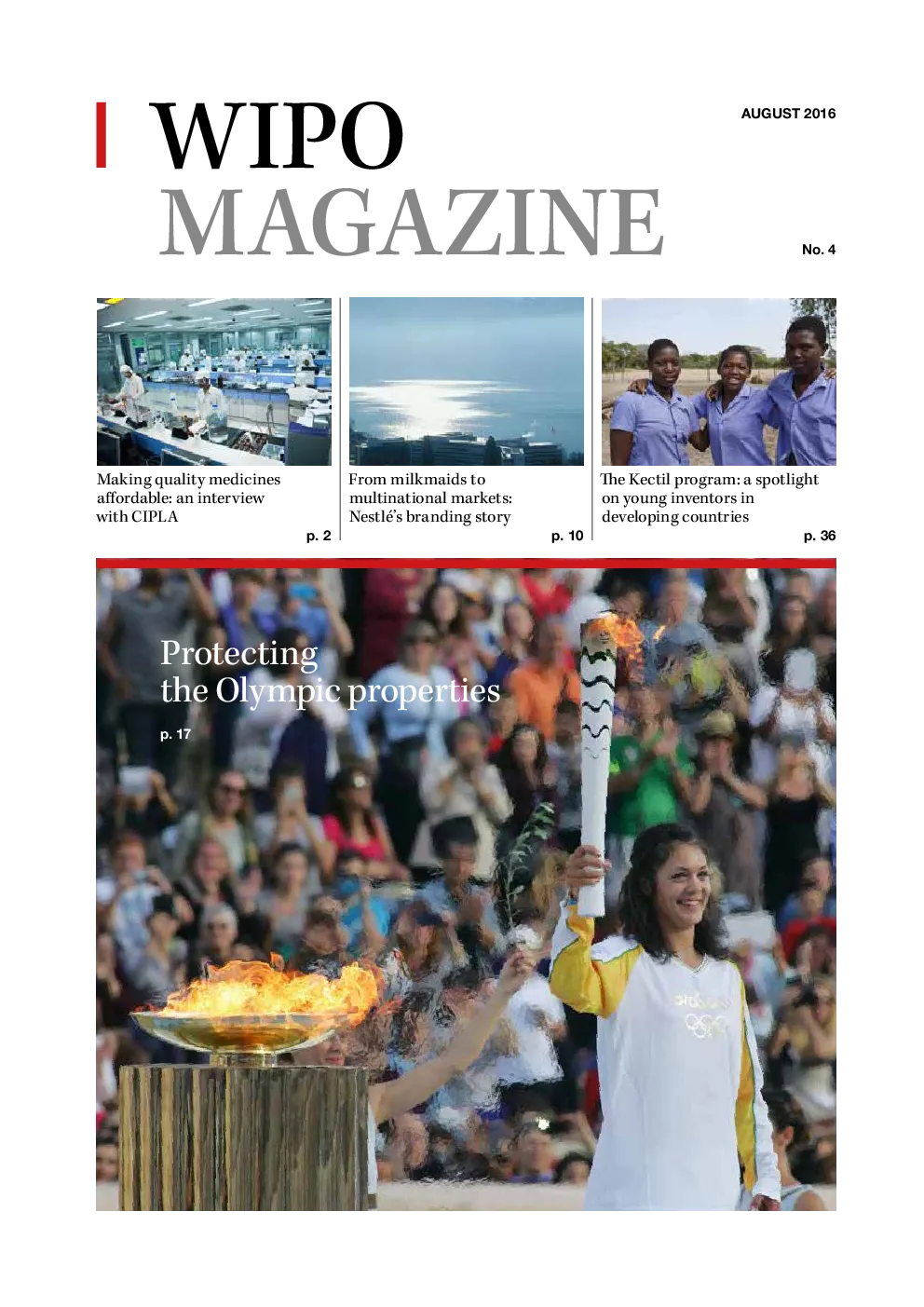
No. 4 Making quality medicinesaffordable: an interviewwith CIPLA From milkmaids tomultinational markets:Nestlé’s branding story The Kectil program: a spotlighton young inventors indeveloping countriesp. 36 p. 2 p. 10 Protectingthe Olympic properties p. 17 Table of Contents 2Making quality medicines affordable:an interview with CIPLA7The Madrid System turns 12510From milkmaids to multinational markets:Nestlé’s branding story17Protecting the Olympic properties22Publishing in the digital market26WIPO Lex: building the world’s IP law database30Strengthening Kenya’s IP landscape36The Kectil program: a spotlight on young inventorsin developing countries Editor:Catherine JewellGraphic Design:Annick Demierre Cover images:Left to Right: CIPLA; CC-BY-NC-ND2.0Nestlé; iStock.com/ArtushMain image: InternationalOlympic Committee © World IntellectualProperty Organization Making qualitymedicines affordable:an interviewwith CIPLAByCatherine Jewell, CommunicationsDivision, WIPO India’s CIPLA is a global pharmaceutical company anda champion of affordable medicines. As the first gener-ic producer of antiretroviral products, it has played apivotal role in expanding access to HIV/AIDS thera-pies in the past two decades. The company’s CEO,Subhanu Saxena, discusses how CIPLA innovates anduses intellectual property (IP) to help improve access tomedicines worldwide. What is CIPLA’s mission? True to our mantra “none shall be denied”, our mission isaffordable access to medicines for every patient every-where. We work with governments to bring affordableand sustainable access to all who need it. What role does CIPLA play within the drugdevelopment cycle? We focus on developing generic medicines after patentexpiry. In addition to plain “vanilla” generics, we alsodevelop more complex generic products by investingin, for example, combination products and novel deliv-ery methods (e.g., easier dosing regimens). We havea major presence in the area of respiratory health andafter GlaxoSmithKline (GSK) probably have the widestrange of drug devices in the world. CIPLA has formidableresearch and development (R&D) technology platformsto develop better, more effective versions of medicinesthat have already been on the market. “Healthcare cannot be reduced to a simplebusiness: it is humanitarian in nature andnone should be denied access because of highcosts,” says Subhanu Saxena, CEO of CIPLA. So what is the role of innovationin CIPLA’s business? Innovation is something that we take very seriously. It’sa myth that innovation only sits in Big Pharma. Innova-tion is central to everything we do – not just in R&D butalso in our commercial models and the partnershipswe establish to ensure affordable access to medicines. CIPLA produces generic drugs but also uses the intellectualproperty (IP) system. Is there not a contradiction in yourapproach? There is no contradiction at all. As a company with an important R&Dbudget and a large set of innovations, we file patents to recognize andsystematize those innovations, and as a matter of course, we also makelicensing available to other companies, and on reasonable terms. We respectscience and fully support recognizing and rewarding innovation. We seeno harm in paying royalties to innovators, but they have to be reasonable.Innovators also have to make their products available at prices that workfor the countries in which they operate. Healthcare cannot be reduced toa simple business: it is humanitarian in nature, and none should be deniedaccess because of high prices. Do you still consider CIPLA to be a generic pharma company? Given the amount of innovation we do today, we don’t really see ourselvesas a generics company. But we are dedicated to affordable access tohigh-quality medicines. We also have many programs in emerging marketsto help doctors and governments develop the right treatment protocolswhich lead to the more effective use of these medicines. So we also bringscience and education to the table. How do you see the debate about IP and access to medicines?Is IP an enabler or a barrier to access? If it is done right, IP is absolutely an enabler. Regardless of whether there ispatent protection, the core issue is whether a monopoly has been abused.For example, the recent scandal surrounding the hike in the price of pyri-methamine (Daraprim) in the United States was related not to abusive useof IP – the drug is old and off-patent – but to abuse of monopoly. Abuse ofmonopoly is the main barrier to access for patients whether the product ispatented or not. We are against monopolies that lead to abuse. Affordableaccess has to be central to pharmaceutical business strategies. Do you think that proprietary companies are doing enoughto put access first? I think some are, but it really comes down to whether the company under-stands that beyond profit we are in a business with a humanitarian missionand that 80 percent of the world does not have access to reasonablehealthcare. It is our