WIPO杂志,2016年第1期(2月)
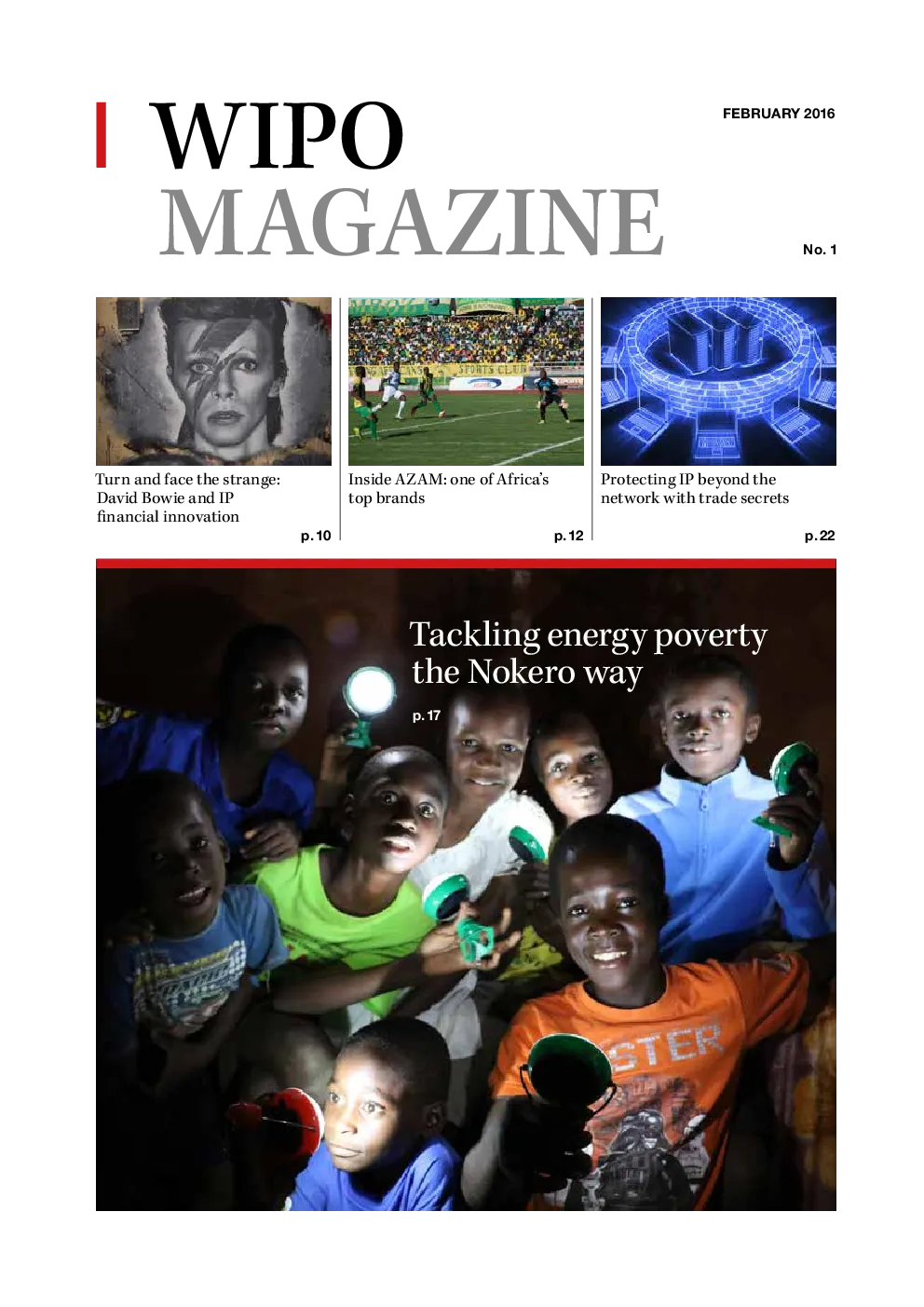
No. 1 Inside AZAM: one of Africa’stop brands Turn and face the strange:David Bowie and IPfinancial innovation Protecting IP beyond thenetwork with trade secrets p.12 p.10 p.22 Tackling energy povertythe Nokero way p.17 Table of Contents Changing global disease patterns and the needfor medical innovation Editor:Catherine JewellGraphic Design:Annick Demierre Intellectual property, finance and economic development Turn and face the strange: David Bowie andIP financial innovation Inside AZAM: one of Africa’s top brands Tackling energy poverty the Nokero way Eight steps to secure trade secrets 30Five tips for managing your patent assets 34In the courts:Court confirms legal status ofHappy Birthday to You! Cover images:Left to Right: Thierry Ehrmann,via Flickr WIPO/Edward Harris,iStockphoto/alexsl 2Anatole KrattigerandThomas Bombelles,Global Challenges Division, WIPO6Carsten Fink,Economics and Statistics Division, WIPO22 and 30Marco Aleman, Patent Law Division, WIPO34Miyuki MonroigandPaolo Lanteri,Copyright Law Division, WIPO © World IntellectualProperty Organization Changing globaldisease patterns andthe need for medicalinnovation ByCatherine Jewell,Communications Division, WIPO Dr. Peter Hotez is an internationally recognized expert inneglected tropical diseases (NTDs) and vaccine devel-opment. Among many roles, he is President of the SabinVaccine Institute in Houston, Texas, USA, (one of overa hundred members of WIPO’s global health initiative,WIPO Re:Search), and founding dean of the NationalSchool of Tropical Medicine. In 2015 he was appointedby the State Department as US Science Envoy. What progress has been madein treating NTDs? Over the last 15 years we have made a significant impactthrough the use of “rapid impact packages” of low-costgeneric drugs or drugs donated by multinational phar-maceutical companies, for example Zithromax (Pfizer),Ivermectin (MSD) and Praziquantel (Merck KGaA). Weestimate around one billion people in low and middle-income countries have received this treatment so far.In some cases, we have matched achievements record-ed for HIV/AIDS, malaria and TB and are on the point ofeliminating trachoma, lymphatic filariasis, onchocercia-sis and ascariasis. But similar progress has not yet beenachieved for other NTD drug targets such as hookwormand schistosomiasis. Dr. Hotez reveals how NTDs are a massive problemnot just in the developing world but also for developedcountries, and explains how scientists and policymakers – and WIPO – can work together to eliminatesome of the world’s most debilitating diseases. What are neglected tropical diseases? Despite these successes, the full impact of NTDs isstill seriously underestimated. For example, NTDs ac-count for a hidden burden of illness ordinarily attribut-ed to the non-communicable diseases (NCDs). TakeSchistosoma haematobiuminfection in Sub-SaharanAfrica. According to a paper published inActa Tropica,the eggs of the Schistosoma parasite are depositedin the bladder of 112 million people in Africa everyday, producing 70 million cases of blood appearing inurine, 18 million cases of major bladder wall pathology,9.6 million cases of hydronephrosis, 1.7 million non-functioning kidneys, one-third of all bladder cancersin Sub-Saharan Africa and 150,000 deaths from renalfailure or bladder cancer. These diseases, however, areoften classified as non-communicable renal diseasesand not as NTDs. The concept of NTDs was established after the launchof the 2000 Millennium Development Goals. At thetime, HIV/AIDs, malaria and tuberculosis were priorityaction areas, but given the huge health burden causedby parasitic diseases, my colleagues and I led globalefforts for a cluster of the most common, chronic anddebilitating conditions to be recognized as NTDs. Ouraim was to draw attention to the human suffering thesediseases cause and to attract funding for the devel-opment of new, more effective therapies to treat them. Today, the NTDs include at least 17 chronic parasiticand related infections recognized by the World HealthOrganization. Almost everyone living in poverty has atleast one of them. NTDs are diseases of poverty, ofsocial stigma and of conflict. I often say that they area reason why the bottom billion cannot escape poverty. Similarly, studies show that female genital schistoso-miasis – possibly Africa’s most common gynecologicalcondition, affecting tens of millions of girls and women– is one of the most important co-factors on the Africancontinent for HIV/AIDS, and yet it is almost completelyignored. new co-morbid states emerging. In India, for example,high rates of dengue superimposed on diabetes areproducing a unique co-morbid syndrome that requiresnew treatments. Another example is melioidosis andNCDs. Blue marble health has important policy implications.The prevalence of NTDs in wealthy countries meanstackling them is not a resource issue but an alloca-tion issue. It means these countries will need to takegreater