WIPO杂志,2015年第1期(2月)
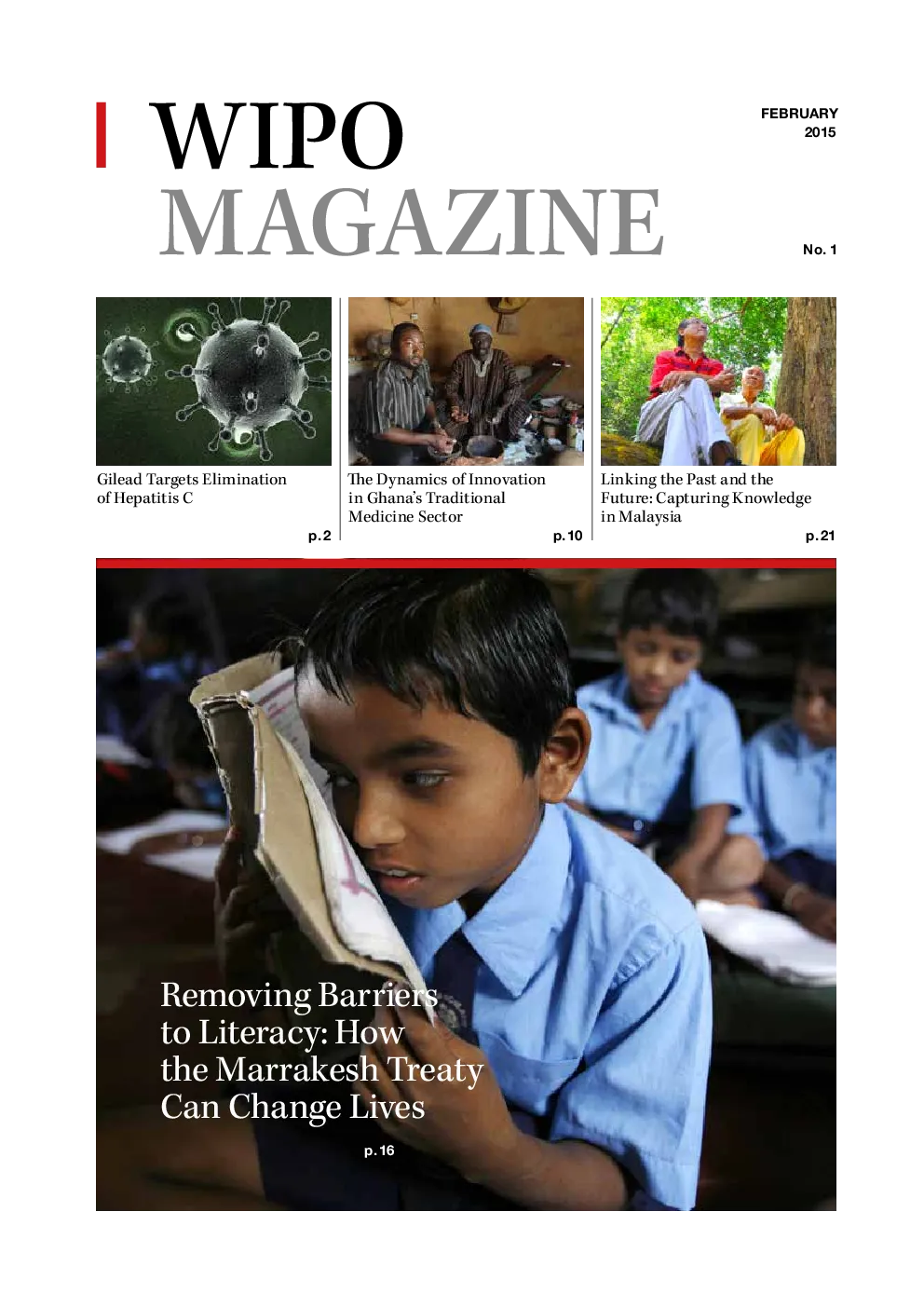
No. 1 The Dynamics of Innovationin Ghana’s TraditionalMedicine Sector Gilead Targets Eliminationof Hepatitis C Linking the Past and theFuture: Capturing Knowledgein Malaysiap.21 p.10 p.2 Removing Barriersto Literacy: Howthe Marrakesh TreatyCan Change Lives p.16 Table of Contents 2Gilead Targets Elimination of Hepatitis C6It’s Time to Stand Up to Patent Trolls10The Dynamics of Innovation in Ghana’s TraditionalMedicine Sector16Removing Barriers to Literacy:How the Marrakesh Treaty Can Change Lives21Linking the Past and the Future:Capturing Knowledge in Malaysia26Branding Cornish Tea28From the Bottom Up:LEANTranslates into Better Customer Service Editor:Catherine JewellGraphic Designer:Annick Demierre Cover images:Right to left: © istockphoto,sarathsasidharan; © CSIR, Accra,Ghana, © MACRI, Kuala Lumpur,Malaysia; main image: Amit Bhargava/ Philip Stevens, Global Challenges Division, WIPO Marco Aleman, Patent Law Division, WIPOSacha Wunsch-Vincent, Economics and Statistics Division, WIPOMonica Halil Lovblad, Copyright Infrastructure Division, WIPOBrigitte Vezina, Traditional Knowledge Division, WIPO © World IntellectualProperty Organization Gilead TargetsEliminationof Hepatitis C ByCatherine Jewell, CommunicationsDivision, WIPO An estimated 185 million people are infected with theHepatitis C virus (HCV), many of them in low and middleincome countries. Referred to as “the silent killer”, HCVoften remains undetected until serious liver damage(cirrhosis or liver cancer) has developed. Many livingwith the virus develop chronic infection and until recentlyrequired a complex regimen of antiviral therapy in com-bination with interferon and ribavirin; a treatment that iscomplex to administer and difficult for patients to tolerate.As such, it is not globally available and most patientsin need go untreated. Scientific innovations in antiviraldrugs, however, have led to simpler, safer and more ef-fective therapies with higher cure rates. The US-basedpharmaceutical research company, Gilead Sciences, Inc.,has recently gained regulatory approval in the US for twonew ground-breaking treatments. Gilead is now workingto broaden access to these new treatments. Gregg Alton,Executive Vice President, Corporate and Medical Affairsat Gilead, shares his views on the challenges associatedwith this endeavor. When we started work on a cure for HCV in 1986, wewere getting a 6 percent success rate; with thesenew products we are curing 94 to 100 percent of HCVpatients. Now, there really is an opportunity to eliminateHCV infection globally, but this will require innovativepolicy approaches to access. In September 2014, we signed licensing agreements withseven Indian-based generic pharmaceutical companies toexpand access to our HCV medicines. The 91 developingcountries covered in the agreements account for around54 percent of the total global infected population, that is,over 100 million people. Such licensing agreements madea big difference to our ability to expand global accessto our HIV treatments (seeInnovative licensing expandsaccess to HIV treatments – www.wipo.int/wipo_magazine/en/2012/06/article_0005.html). What are the key challenges you face inbroadening access to HCV medicines? Medically, treating HCV globally is a huge challengebecause it has six genotypes, each of which requirestailored treatment. A pan-genotypic option is particularlyimportant for resource-poor developing countries lackingthe diagnostic capacity for genotyping. Our investigationalpan-genotypic regimen (GS-5816), which we hope willbe available by 2016, can treat all six genotypes with thesame course of therapy at cure rates of over 90 percent ineach genotype. This product will specifically help to over-come the diagnostic challenge in developing countries. What is the significance of Gilead’s new HCVtreatments? Old HCV therapies are very toxic, difficult to administer,poorly tolerated by patients and, for the most part, notavailable to people in developing countries. With Gilead’snew products, which are real game changers, we candramatically alter the global HCV landscape. What are these new therapies and how do youplan to deliver them globally? The biggest policy challenge is funding. We can do alot at Gilead in terms of R&D, regulatory work, clinicaldevelopment and pricing, but at the end of the day weneed the commitment of national governments and inter-national donors to make this happen. It is going to takea lot more than low-cost drugs to get patients into care.Success in broadening access to treatment hinges onNGOs and patients advocating for funding and treatmentprogram implementation and on governments investingin developing national healthcare capacity. We are focusing on delivering innovative products thatare simple to use and with high cure rates. So far, wehave developed Sovaldi® (sofosbuvir) which is effectivein curing HCV genotypes 1 to 4, and Harvoni®, a fixed-dose combination of ledipasvir and sofosbuvir, which isparticul