WIPO杂志,2019年第4期(8月)
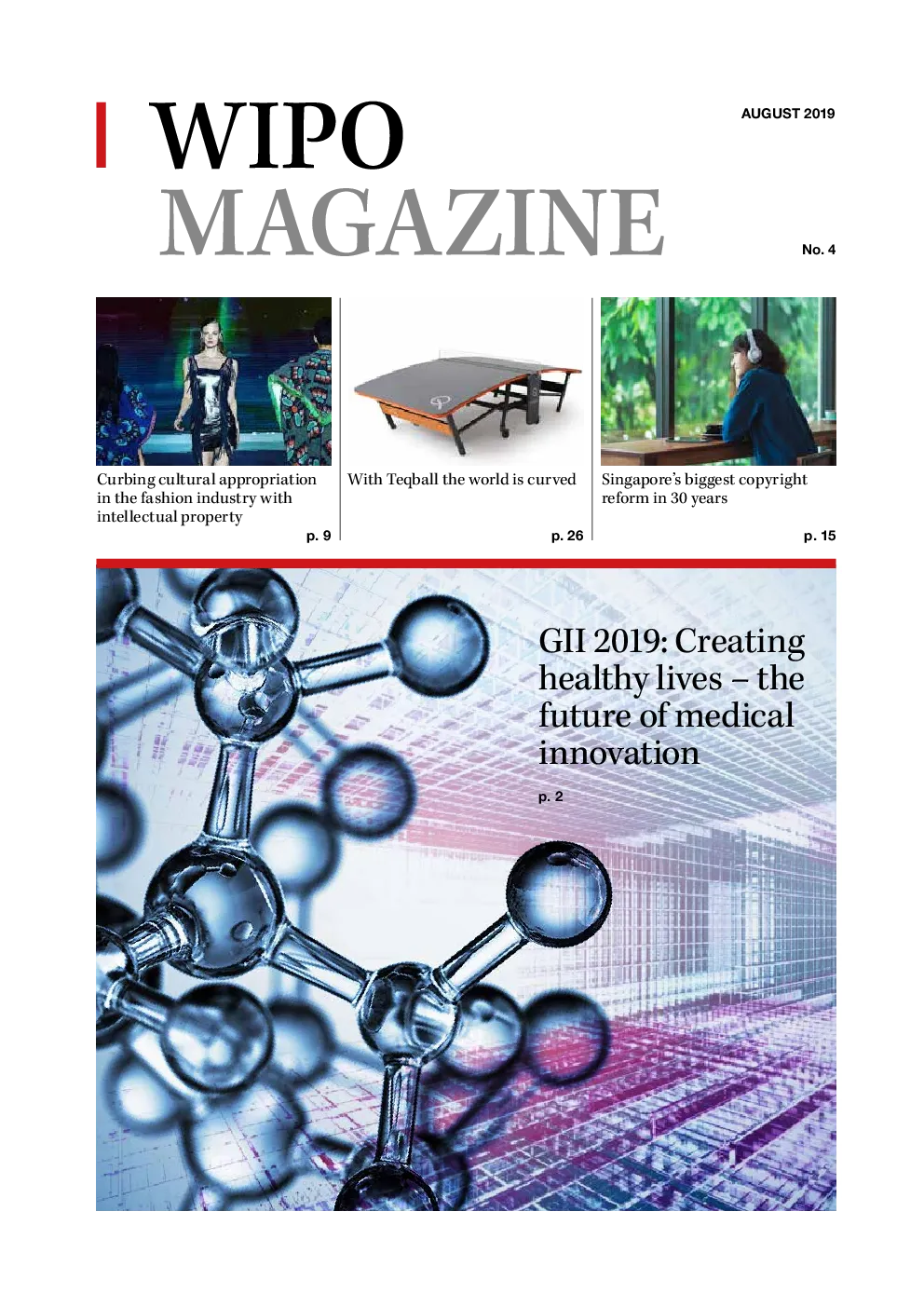
p. 9With Teqball the world is curved p. 26 p. 15 GII 2019: Creatinghealthy lives – thefuture of medicalinnovation p. 2 Table of Contents 2GII 2019: Creating healthy lives – the future of medicalinnovation9Curbing cultural appropriation in the fashion industry withintellectual property15Singapore’s biggest copyright reform in 30 years20The harsh reality of life as a musician: an interview withMiranda Mulholland26With Teqball the world is curved35In the CourtsFive years afterAlice: five lessons learned from thetreatment of software patents in litigation39A History of Intellectual Property in 50 Objects Editor:Catherine JewellLayout:Ewa Przybyłowicz © WIPO, 2019 Attribution 3.0 IGO(CC BY 3.0 IGO) The user is allowed to reproduce, dis-tribute, adapt, translate and publiclyperform this publication, including forcommercial purposes, without explicitpermission, provided that the content isaccompanied by an acknowledgementthat WIPO is the source and that it isclearly indicated if changes were madeto the original content. Adaptation/translation/derivatives shouldnot carry any official emblem or logo,unless they have been approved andvalidated by WIPO. Please contact us viathe WIPO website to obtain permission. When content published by WIPO, suchas images, graphics, trademarks or logos,is attributed to a third party, the user ofsuch content is solely responsible forclearing the rights with the right holder(s). To view a copy of this license, please visithttps://creativecommons.org/licenses/by/3.0/igo Acknowledgements:2Carsten Fink, Economics and Statistics Division, WIPO9Wend Wendland, Traditional Knowledge Division, WIPO15Anita Huss-Ekerhult, Copyright Management Division, WIPO20Michele Woods, Copyright Law Division, WIPO26Virag Halgand, Department for Transition and Developed Countries,WIPO35Tomoko MiyamotoandMarco Aleman, Patent Law Division, WIPO Cover images:Left to right: Courtesy of Marta Hewson /Angela DeMontigny; Courtesy of Teqball;iStock / Getty Images Plus / © Weedezign;Main image:Getty Images / E+ / © BlackJack3D; GettyImages / DigitalVision / © Jorg Greuel GLOBAL LEADERS ININNOVATION 2019 Every year, the Global Innovation Index ranks the innovationperformance of nearly 130 economies around the world. THE TOP 5 INNOVATION ECONOMIES BY REGION THE TOP5 GLOBALINNOVATIONLEADERS SWITZERLAND UNITED STATESOF AMERICA NETHERLANDS THE TOP 5 INNOVATION ECONOMIES BY INCOMEGROUP LOWINCOMERwandaSenegalUnited Republic of TanzaniaTajikistanUganda HIGHINCOMESwitzerlandSwedenUnited States of AmericaNetherlandsUnited Kingdom LOWER-MIDDLEINCOME UPPER-MIDDLEINCOME Viet NamUkraineGeorgiaIndiaMongolia ChinaMalaysiaBulgariaThailandMontenegro www.wipo.int/global_innovation_index/en/2019 WIPO.INT/GII#GII2019 GII 2019: Creatinghealthy lives – thefuture of medicalinnovation ByCatherine Jewell,Publications Division, WIPO The 2019 edition of the Global Innovation Index (GII), launched in New Delhi, India, in July, revealsthe latest global ranking of countries on their innovation performance. Now in its 12th edition,the GII supports policymakers’ understanding of how to foster and measure innovative activity,which is a key driver of social and economic development. GII 2019 also explores the future ofmedical innovation. Sacha Wunsch-Vincent, a senior economist at WIPO and one of the co-editors of the GII 2019, discusses some of the report’s key findings. What do GII 2019’s rankings reveal? Switzerland topped this year’s GII rankings, followed by Sweden, the USA, Netherlands andthe UK. China is now a firmly established world innovation leader and continues to improve itsranking. India too, maintains its top place in the Central and Asian region with top rankings inproductivity growth and ICT-related services. The Republic of Korea also edged ever closer tothe top ten GII countries, becoming the world leader in overall economy-wide investments andresearch and performing well in most R&D-related indicators. The Philippines and Viet Namalso improved in most indicators and achieved top ranks for high-technology imports andexports. For the seventh consecutive year, the innovation performance of more economies inSub-Saharan Africa than in any other region outperformed their level of economic development. How has the global innovation landscape evolved over the past 12 months? GII 2019 reveals that the global economy is losing momentum and that investment and productivitygrowth are sluggish. Global foreign direct investment has fallen. And public R&D expenditure insome high-income countries that drive technological advances is very slow. Such spending iscentral to funding basic and other forward-looking research. Protectionism is also on the rise.These uncertainties are slowing forward-looking investment in innovation and putting globalinnovation networks and the diffusion of innovation at risk. Innovation remains concentrated in a few wealthier economies and significant knowledge gapspersist between de