WIPO杂志,2019年第6期(12月)
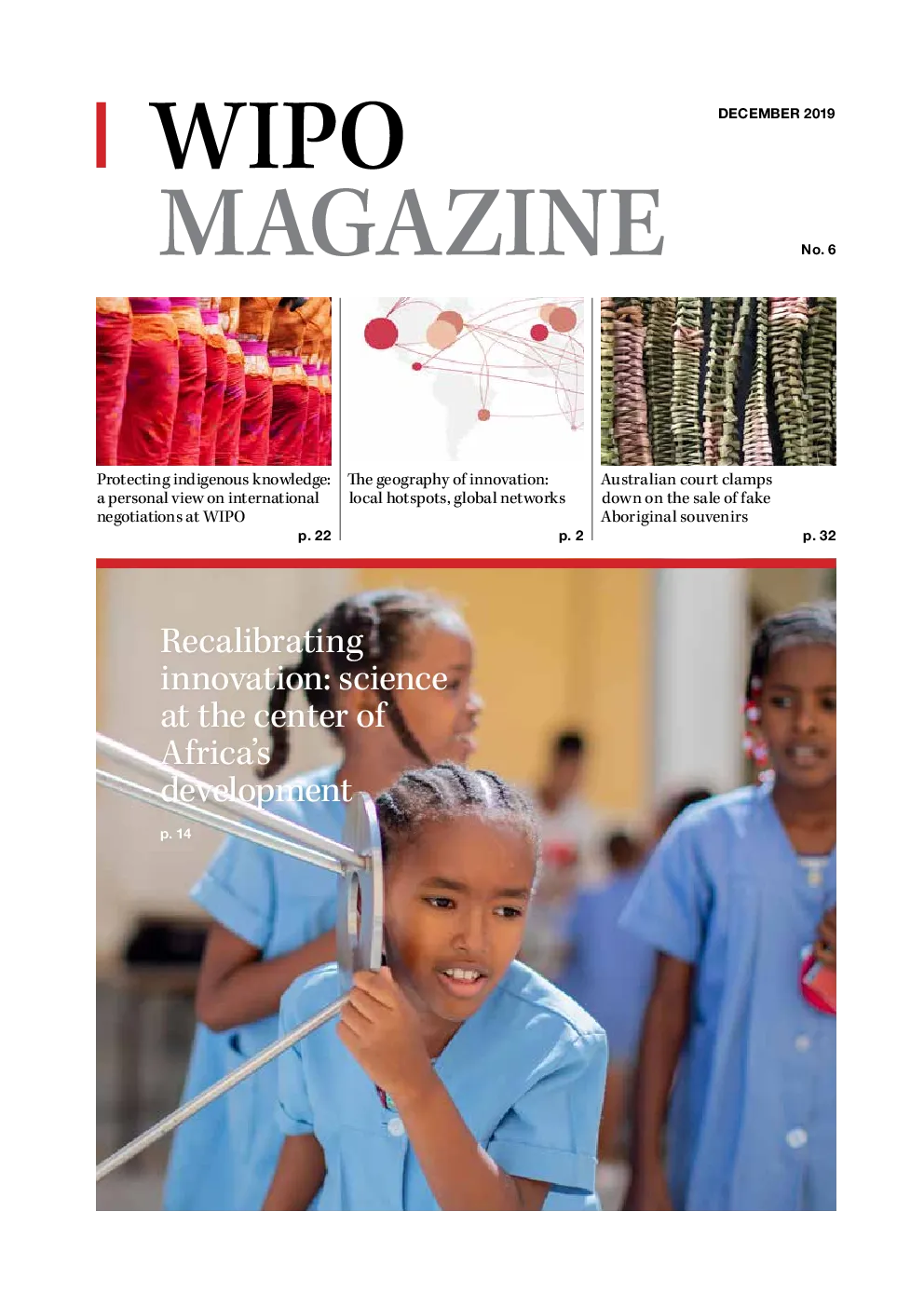
No. 6 The geography of innovation:local hotspots, global networks Protecting indigenous knowledge:a personal view on internationalnegotiations at WIPOp. 22 Australian court clampsdown on the sale of fakeAboriginal souvenirs p. 2 p. 32 Recalibratinginnovation: scienceat the center ofAfrica’sdevelopment p. 14 Table of Contents 2The geography of innovation: local hotspots, global networks8The Artificial Inventor Project14Recalibrating innovation: science at the center ofAfrica’s development22Protecting indigenous knowledge: a personal view oninternational negotiations at WIPO32In the CourtAustralian court clamps down on the sale of fakeAboriginal souvenirs39Tackling bad faith registration of domain names ina fast-changing landscape44When Private International Law Meets Intellectual PropertyLaw: A Guide for Judges Editor:Catherine Jewell © WIPO, 2019 Attribution 3.0 IGO(CC BY 3.0 IGO) The user is allowed to reproduce, distrib-ute, adapt, translate and publicly performthis publication, including for commercialpurposes, without explicit permission, pro-vided that the content is accompanied byan acknowledgement that WIPO is thesource and that it is clearly indicated ifchanges were made to the original content. For any derivative work, please includethe following disclaimer: “The Secretariatof WIPO assumes no liability or responsi-bility with regard to the transformation ortranslation of the original content.” Adaptation/translation/derivatives shouldnot carry any official emblem or logo,unless they have been approved andvalidated by WIPO. Please contact us viathe WIPO website to obtain permission. When content published by WIPO, suchas images, graphics, trademarks or logos,is attributed to a third party, the user ofsuch content is solely responsible forclearing the rights with the right holder(s). To view a copy of this license, please visithttps://creativecommons.org/licenses/by/3.0/igo Acknowledgements:8Yo Takagi,Global Infrastructure Sector,Alica Daly, Office of theDirector General,Marco Aleman, Patent Law Division, WIPO14Marc Sery-Koré, Regional Bureau for Africa, WIPO22 & 32Wend Wendland, Traditional Knowledge Division, WIPO39Brian Beckham, WIPO Arbitration and Mediation Center44Eun-Joo Min, WIPO Judicial Institute Cover images:Left to right: Bicho_raro / E+ / GettyImages; World Intellectual PropertyReport 2019; Julie Sisco, 2019Main image:Courtesy of The Next Einstein Forum The geography ofinnovation: localhotspots, globalnetworks ByCatherine Jewell, WIPO The 2019World Intellectual Property Report: The Geography of Innovation: LocalHotspots, Global Networkshighlights the increasingly collaborative and internationalnature of innovation. The report traces the evolution of the geography of innovationover the past few decades and reveals a growing concentration of innovation in afew large clusters located in a small number of countries. WIPO’s Chief Economist,Carsten Fink, discusses some of the report’s key findings. What aspect of the geography of innovation does the 2019 report focus on? Where the2011 World Intellectual Property Reportfocuses on the broad geographicalshifts that characterize global innovation, the 2019 Report explores why economicactivity tends to center around urban agglomerations or cities and how this gives riseto the global innovation networks that generate so much of the world’s innovation. Why is it that so much innovation takes place around cities? Economists have typically explained the distribution of economic activity across spaceby focusing on economies of scale and scope, transport costs and savings. Cities arewhere companies find skilled workers. People move to cities because they value theamenities metropolitan life offers and the well-paying jobs they find there. Cities arealso the most fertile places for ideas to flourish, as innovators work in close proximity. But in the innovation-driven economic models of the 21st century, other forces arealso at work. Technology, especially digital technology, has increasingly facilitatedknowledge flows over ever-longer distances – there is a long history of scientific col-laboration among researchers from different universities and countries. Multinationalcorporations (MNCs) have also sought to optimize their innovative impact by developingglobal value chains that disperse their research and development (R&D) activities todifferent places. These factors, especially, urban agglomeration and dispersion of R&D,have given rise to global innovation networks. The2019 World Intellectual PropertyReporttracks the evolution of these networks and their make-up. The top tencollaborativehotspots of theworld accountfor 33 percent ofall internationalco-inventions. What data sources did you use? Previous WorldIntellectualProperty Reports From this viewpoint, the report is the most ambitious we have under-taken to date. We used two primary data sources. First, patent datacovering the period 1970 to 2017 from 168 patent office