WIPO杂志,2018年第6期(12月)
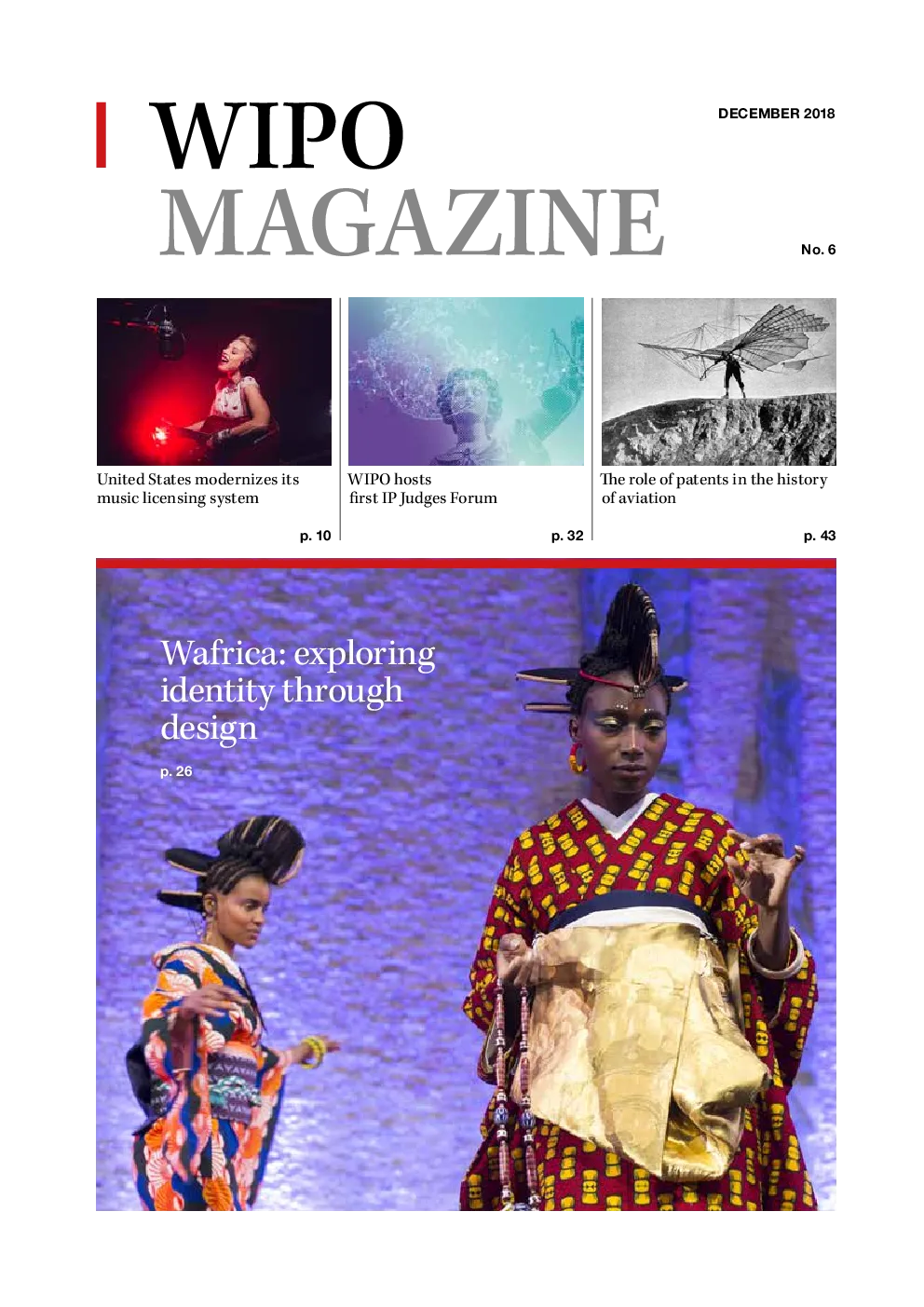
No. 6 WIPO hostsfirst IP Judges Forum United States modernizes itsmusic licensing system The role of patents in the historyof aviation p. 32 p. 10 p. 43 Wafrica: exploringidentity throughdesign p. 26 Table of Contents 2Creative industries in the platform economy10The United States modernizes its music licensing system18Innovating for the world: IP’s role in development26Wafrica: exploring identity through design32WIPO hosts first IP Judges Forum38Plain packaging of tobacco products: landmark ruling43The role of patents in the history of aviation50Gulf Cooperation Council Patent Office offersfast-track patent grant procedures Editor:Catherine Jewell © WIPO, 2018 Attribution 3.0 IGO(CC BY 3.0 IGO) The user is allowed to reproduce, distrib-ute, adapt, translate and publicly performthis publication, including for commercialpurposes, without explicit permission,provided that the content is accompa-nied by an acknowledgement that WIPOis the source and that it is clearly indi-cated if changes were made to the orig-inal content. Adaptation/translation/derivatives shouldnot carry any official emblem or logo,unless they have been approved and val-idated by WIPO. Please contact us viathe WIPO website to obtain permission. When content published by WIPO, suchas images, graphics, trademarks or logos,is attributed to a third party, the user ofsuch content is solely responsible forclearing the rights with the right holder(s). To view a copy of this license, please visithttps://creativecommons.org/licenses/by/3.0/igo Acknowledgements:2Kevin Fitzgerald,Office of the Director General, WIPO10Michele Woods, Copyright Law Division, WIPO32Nahal ZebarjadiandEun Joo Min, Division for the JudicialAdministration of Intellectual Property, WIPO38David MulsandMarcus Höpperger, Brands and Designs Sector, WIPO43Julio Raffo, Economics and Statistics Division, WIPO50Walid AbdelnasserandM’Hamed Sidi El Khir, Regional Bureaufor Arab Countries, WIPO Cover images:Left to right :wundervisuals / E+ / Getty Images;antoniokhr, liuzishan, querbeet / iStock /Getty Images Plus;maodesign / DigitalVision VectorsMain image:Violaine Martin / WIPO Creative industries inthe platform economy ByCatherine Jewell,Communications Division, WIPO The digital revolution has dramatically changed the cre-ative landscape, generating opportunities for some andchallenges for others. And in the face of falling revenues,rampant online piracy and fake news, the dominanceof tech giants like Amazon, Facebook, Google, Netflixand Spotify is the source of growing concern.SangeetChoudaryis a leading expert on the so-called platformeconomy and has written extensively on the impact ofplatforms on businesses, the economy and society.Mr. Choudary recently shared his views withWIPO Mag-azineon what the rise of the platform economy meansfor the creative sector. Platforms are the matchmakers and the taste-makersin today’s digital content market and are gaining hugemarket power, which, in the long-term, may have anegative impact on the creative sector. How do you explain the rise of the platformeconomy? The content market has been transformed by digitizationover the past 20 years. In the pre-digital era, content wasmonetized and distributed via a bundle. For example,music was bundled into an album, tied to a CD, andpushed out. In the digital world content became divorcedfrom physical media. Digitization enabled content tomove freely at near zero cost. Content could be unbun-dled and packaged in new ways. Then, as new sourcesof supply emerged with the availability of online toolsthat allowed anyone to create content cheaply, we sawan explosion in content production. Consumers foundit increasingly difficult to find the content they wanted. Why is there so much interest in platformstoday? Platforms create a lot of value by organizing the contentmarket. They are the new intermediaries. YouTube, forexample, provides the basic infrastructure for connectingcreators of video with consumers of video. “Platformsare thematchmakersand thetaste-makersin today’s digitalcontent marketand are gaininghuge marketpower.” Platforms were a natural solution to this problem. They begancurating content and helping consumers find the books, filmsand music they wanted and to decide what was worth consumingthrough their recommendation systems. In the music industry, CDs gave way to Napster and Kazaa, whichoffered a new distribution model for singles. Fast forward a fewyears and Apple began offering tools for musicians to recordmusic, creating new supply tied to the Apple iTunes store, wheremusicians could upload and sell individual tracks. Then Spotifyand Pandora emerged, assembling and curating music from dif-ferent sources and enabling users to filter their favorite songs andbenefit from their recommendation systems. Similar trends areevident across the creative sector. Because there are so many connected consumers and so manysuppliers of creative content, the companies that creat