WIPO杂志,2018年第5期(10月)
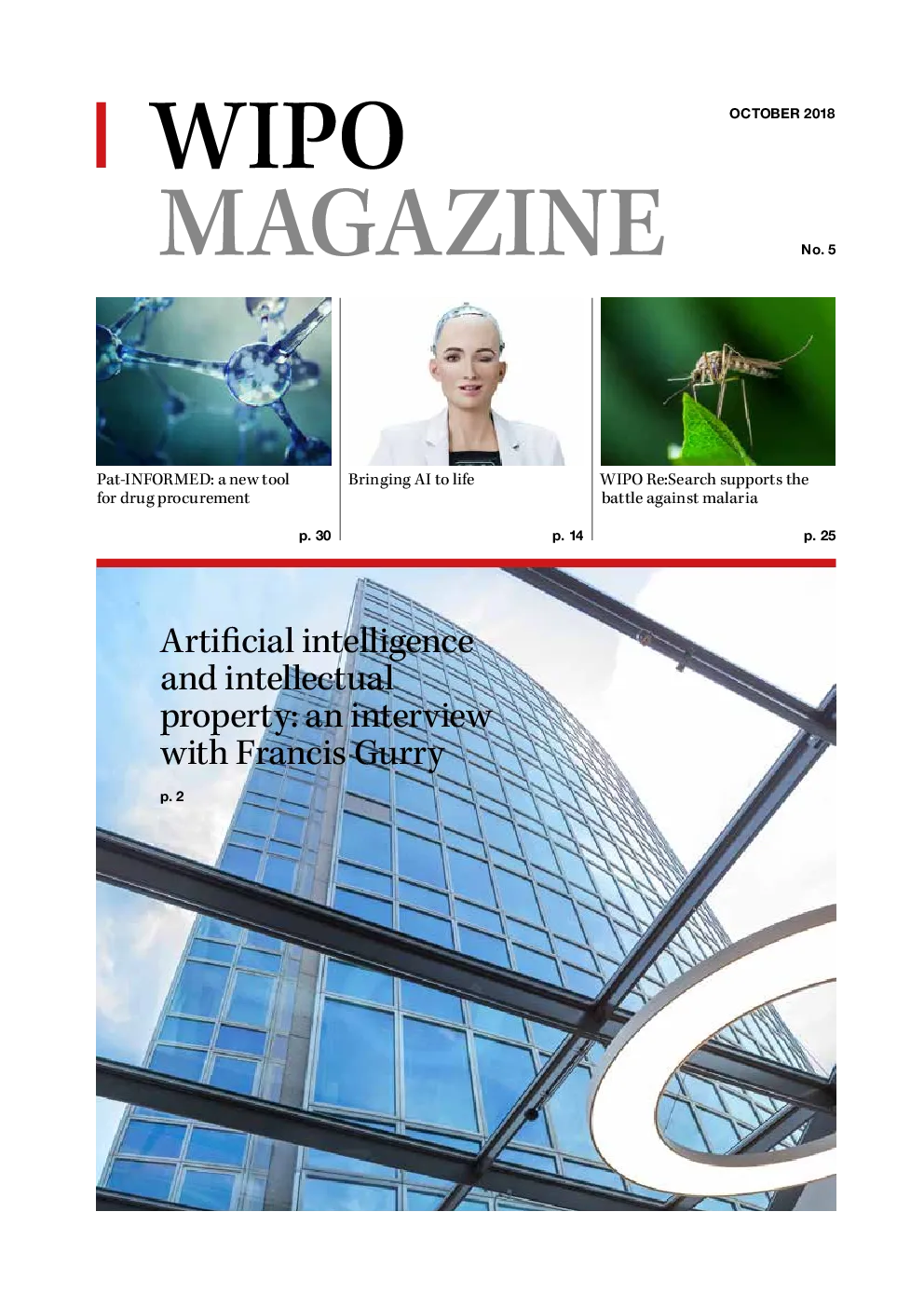
No. 5 Bringing AI to life Pat-INFORMED: a new toolfor drug procurement p. 14 p. 30 p. 25 Artificial intelligenceand intellectualproperty: an interviewwith Francis Gurry p. 2 Table of Contents 2Artificial intelligence and intellectual property:an interview with Francis Gurry8Saudi Arabia embraces AI-driven innovation14Bringing AI to life20Intellectual property and e-commerce:Alibaba’s perspective25WIPO Re:Search supports the battle against malaria30Pat-INFORMED: a new tool for drug procurement37ARIPO’s drive to strengthen Africa’s innovation ecosystem43Origin-based products in the Russian Federation Editor:Catherine JewellLayout:Ewa Przybyłowicz The user is allowed to reproduce, distrib-ute, adapt, translate and publicly performthis publication, including for commercialpurposes, without explicit permission,provided that the content is accompa-nied by an acknowledgement that WIPOis the source and that it is clearly indi-cated if changes were made to the orig-inal content. Adaptation/translation/derivatives shouldnot carry any official emblem or logo,unless they have been approved and val-idated by WIPO. Please contact us viathe WIPO website to obtain permission. When content published by WIPO, suchas images, graphics, trademarks or logos,is attributed to a third party, the user ofsuch content is solely responsible forclearing the rights with the right holder(s). Acknowledgements:2Yoshiyuki TakagiandChristophe Mazenc, Global InfrastructureSector, WIPO8Walid AbdelnasserandM’hamed Sidi El Khir, Regional Bureau forArab Countries, WIPO20Hongbing Chen, WIPO Office in China25Charles Randolph, Global Challenges Division, WIPO,Dr. Mohammad Shafiul Alam, International Centre for DiarrhoealDisease Research, Dhaka, Bangladesh30Thomas Bombelles, Non-Governmental Organizations and IndustryRelations Section, WIPO43Michal Svantner, Ilya Gribkov, Department of Transition andDeveloped Countries,Zaurbek Albegonov, WIPO Office in the RussianFederation, andAlexandra Grazioli, Lisbon Registry, WIPO To view a copy of this license, please visithttps://creativecommons.org/licenses/by/3.0/igo Cover images:Left to right:Artem_Egorov/iStock/GettyImagesPlus;Courtesy of Hanson Robotics;Konstantin Nechaev / Alamy Stock PhotoMain image:Photo: WIPO / E. Berrod Artificial intelligenceand intellectualproperty: an interviewwith Francis Gurry Ahead of the 2018 meetings of WIPO’s Assemblies, WIPO DirectorGeneral Francis Gurry shares his views on the implications ofartificial intelligence (AI) for intellectual property (IP) law and policyand its use in the administration of IP systems around the world. How would you characterize the impact of AI? AI is a new digital frontier that will have a profound impact on theworld. It will have enormous technological, economic, and socialconsequences and is going to transform the way we produce anddistribute goods and services, as well as the way we work and live. “AI is a newdigitalfrontier thatwill have aprofoundimpact onthe world.” What impact will AI-enabled technologieshave on innovation and creativity? It is too early to say, but it is clear that AI will have an impacton traditional IP concepts. Commercial AI-generated musicand AI-created inventions are not far off, and will transform theconcepts of the “composer,” “author,” and “inventor” – althoughprecisely how is not yet clear. The fundamental goals of the IP system have always been toencourage new technologies and creative works, and to createa sustainable economic basis for invention and creation. From apurely economic perspective, if we set aside other aims of the IPsystem, such as “just reward” and moral rights, there is no rea-son why we shouldn’t use IP to reward AI-generated inventionsor creations. But this still requires some thought. The answersare not yet clear. Francis Gurry,Director General, WIPO The broad use of AI technologies will also transform establishedIP concepts – patents, designs, literary and artistic works, and soon. This is already happening, but is a consequence of the digitaleconomy, not AI alone. For example, the life sciences generateenormous quantities of data that have significant value but don’tconstitute an invention in the classical sense. So we need to workout the rights and obligations that attach to them. There are strong social views on this already. The “open” move-ments for science, data, and publication, for example, favor theview that data should not have proprietary categories placed onthem. They argue that, as data is a foundation of AI, it shouldbe freely available to enable the development of AI and otherapplications. But, of equal importance in the current economic context, we haveestablished property rights for intangibles to provide incentivesfor investment in the creation of new knowledge and to ensurefair competition. These two approaches need to be reconciled. Lines willhave to be drawn between the need to keep channels ofdata open and flowing, on the one hand, and the n