世界知识产权组织杂志,2015年第5期(10月)
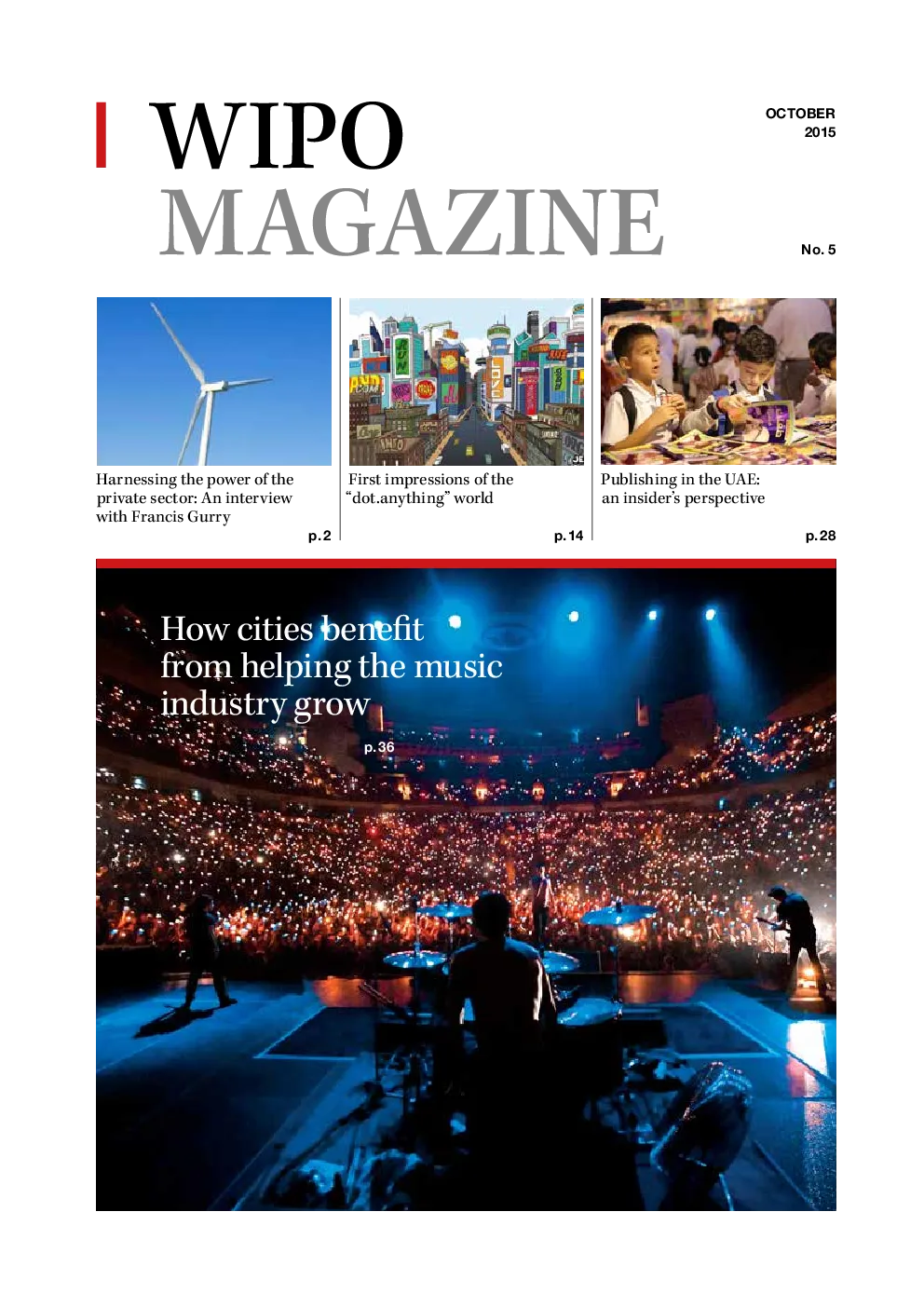
No. 5 Publishing in the UAE:an insider’s perspective Harnessing the power of theprivate sector: An interviewwith Francis Gurry First impressions of the“dot.anything” world p.2 p.14 p.28 How cities benefitfrom helping the musicindustry grow Keep connected throughthe WIPO Wire The WIPO Wire newsletter offers a quickround-up of WIPO’s news, resources,features and videos straight to your inboxevery two weeks. Available in Arabic, Chinese, English,French, Russian or Spanish Sign upatwww.wipo.int/newsletters/en/ Table of Contents Harnessing the power of the private sector:An interview with Francis Gurry Editor:Catherine Jewell Global Innovation Index 2015:Effective Innovation Policies for Development 10Micromax, Madrid, and the 1.25 millionthinternational trademark 14First impressions of the “dot.anything” world Africa’s innovators are open for business 24Mining innovation 28Publishing in the UAE: an insider’s perspective 32In the CourtsBlurred Lines: The difference between inspirationand appropriation 36How cities benefit from helping the music industry grow 40Delivering online IP services in Moldova Cover images:Left to right:iStock.com/Diyana Dimitrova;Jess3;Kalimat PublishingMain image: DustinRabin.com © World IntellectualProperty Organization Harnessing the powerof the private sector:An interview with Francis Gurry WIPO Director General Francis Gurry believes that closerengagement with the private sector, through public-private partnerships offers an opportunity for theOrganization to boost its capacity to advance agreedpublic policy goals. Mr. Gurry explains the relevanceof these partnerships to WIPO and discusses theopportunities and challenges they present. There is strong interest in public-privatepartnerships at the moment. Why is that? We have seen a general trend over the past 25 yearstowards the privatization of public functions and utilities,which means the size of the private sector has grown. Ontop of this, spare capital in the public sector has dried upas governments grapple with austerity measures followingthe global financial crisis. Today we see that spare capitalnow lies mainly in private sector hands. For example, in2012, the budget for the United Nations (UN) system as awhole amounted to USD40 billion. In the same year, privategiving in the United States alone amounted to someUSD320 billion. It is therefore desirable to find a way toharness some of that capital to fund public programs. Public-private partnerships can be very effective vehiclesfor implementing policies agreed by our member states.For example, theMarrakesh Treaty to Facilitate Accessto Published Works for Persons Who Are Blind, VisuallyImpaired of Otherwise Print Disabledseeks to addressthe famine in accessible-format books by establishingthe legal framework for such works to move more freelyaround the world. But while the Treaty creates the pos-sibility of cross border exchange of these books, it doesnot actually move them. To help make that happen – inline with the agreed policy objective of WIPO memberstates – we formed a public-private partnership, namelythe Accessible Books Consortium (ABC), which in factevolved from the WIPO Stakeholders’ Platform estab-lished by member states in 2009. How are WIPO’s public-private partnershipsmanaged? I want to underline that that public-private partnershipsare not a vehicle for establishing intellectual property (IP) laws or policies. WIPO’s normative program remains theprerogative of member states, and member states alone.It is a purely public function. visual impairment. It is getting considerable buy-in fromstakeholders. To meet its aim of increasing the number of books avail-able in accessible formats worldwide, the ABC does threethings. First, it acts as a cross-border book exchange,enabling participating libraries to download for freebooks that have already been produced in accessible for-mats by other participating libraries. Until the MarrakeshTreaty enters into force (when 20 countries ratify it) theABC is responsible for clearing rights with the relevantrights-holders to permit accessible format books to moveacross borders. Public-private partnership initiatives at WIPO are carefullymanaged in line with the Organizations principles of goodgovernance. They feature in our Program and Budgetproposals, which are reviewed and adopted by memberstates, and like any other program activity, they are subjectto rigorous oversight, audit and reporting requirements. They must also have a practical mechanism, a committeeor a board made up of stakeholder representatives, toguide the operations of the partnership. Secondly, the ABC builds up the technical skills andinstitutions that developing countries need so they canthemselves produce and distribute more books in acces-sible formats to people who need them. Can you describe examples of WIPO’s successfulinvolvement in public-private partnerships? WIPO Re:Search and the Accessible Books Consortiumare