世界知识产权组织杂志,第5/2013期(10月)
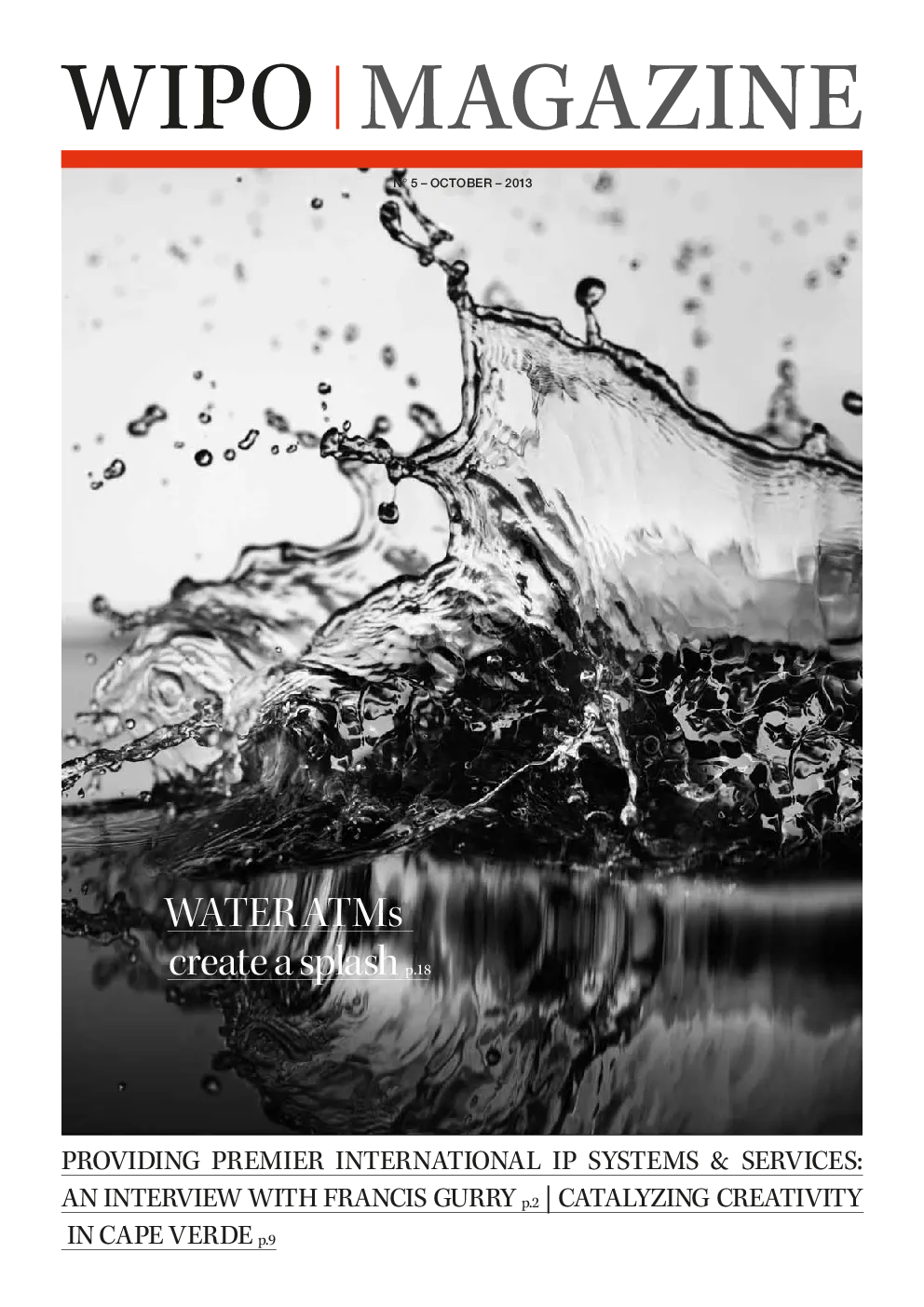
ProvidingPremier internationaliP systems & services:an interview with Francisgurryp.2|catalyzing creativityincaPeverdep.9 Contents p.2Providing premier internationalIP systems & services: An interview withFrancis Gurryp.5Promoting access to medical innovationp.9Catalyzing creativity in Cape Verdep.13Bringing broadband to Haiti:connecting communitiesp.18Water ATMs create a splashp.23Science, technology & innovation in Saudi Arabiap.27Sharing expertise to boost patent qualityp.30ICTs & innovation: The view from a top PCT filer Editor:Catherine JewellGraphic Designer:Annick Demierre Front cover:A low-cost integrated water purificationservice developed by Sarvajal, an Indiansocial enterprise, purifies and monitors thequality of local water sources in remote andunderserved communities creating localjobs and income in the process. Acknowledgements:p. 5Hans-Georg Bartels, Thomas Bombelles, Philip Stevens,Global Challenges Division, WIPOp.9&18Joseph Bradley,Department of External Relations, WIPOp. 13Ms. Anna Morawiec-Mansfield,Department of External Relations, WIPOp. 23Ms. Dalila Hamou,Regional Bureau for Arab Countries, WIPOp. 30Ms. Wang Binying,Brands and Designs Sector, WIPO ©World IntellectualProperty Organization Providing premier internationalIP systeMs& servICes: An interview with Francis Gurry As countries struggle to secure long-term economic growthand development, innovation and intellectual property (IP) havebecome priority policymaking areas. With a view to expand-ing access to IP-related knowledge in support of innovation,WIPO has developed a wide range of business solutions tosupport national IP offices in overcoming the many and variedoperational challenges they face. WIPO Director General FrancisGurry shares his views on the progress made in this importantarea of WIPO’s work. What is fuelling the need for a global IP supportsystem? Over the last 30 years, the basis for value creation has shiftedfrom tangible physical capital to intangible intellectual capital.As intellectual assets become ever more valuable, the IP rightsassociated with them become increasingly important. At thesame time, technology owners are operating in global marketsand seeking IP protection in many more countries. The result-ing surge in demand for IP rights raises a number of practicalquestions: How can IP offices cope with bigger workloads anddeliver useful and cost-effective services? What types of toolsand services are needed to improve the IP system’s overallquality and operating efficiency? How can international coop-eration be enhanced to eliminate duplication in the system? WIPO is developing and deploying various business solutionsto support national IP offices in delivering professional, high-quality and cost-effective services. While these offices operatenationally, increasingly, the businesses that use IP operateglobally. In this context, WIPO’s role is to help coordinatecooperation among national IP authorities so as to build aseamless, efficient and accessible international IP system thatsupports modern business needs. How do you see WIPO’s role in facilitating access toknowledge? One of the reasons we have a patent system is to get informa-tion about technology out into the open. The result is quiteremarkable: the patent system has produced the world’smost comprehensive and systematic record of humanity’s WIPO is contributing to solutions through more effective in-ternational cooperation. The Patent Cooperation Treaty (PCT)- the original work-sharing program in the area of patents - isan enormously successful form of international cooperation. In2012 some 194,400 international patent applications were filedunder the PCT. This year, we expect over 200,000 applications. technology. A key function of the public authority responsiblefor the IP system is to make the information the system gener-ates accessible to the public. One way in which we do this is via WIPO’s free global data-bases. Our PATENTSCOPE database makes publicly availablethe technology disclosures contained in some 32.5 million pat-ent documents. And the Global Brand Database now containsover 11 million records relating to registered trademarks, ap-pellations of origin, logos and emblems. We are also workingon a global designs database. We are also rolling-out new systems to enhance internationalcooperation, reduce duplication of work and improve the qualityand efficiency of IP operations: The WIPO Digital Access Service(DAS), for example, offers a rapid, secure, easy, and inexpen-sive means of exchanging priority and similar documents andbetween IP offices. The Centralized Access to Search andExamination (CASE) platform facilitates the sharing of confi-dential search and examination information between IP offices. WIPO also facilitates access to databases which are normallysubscription-based. ARDI (Access to Research and Develop-ment for Innovation) and ASPI (Access to Specialized PatentInformation) are especially important for dev