WIPO杂志,2017年第5期(10月)
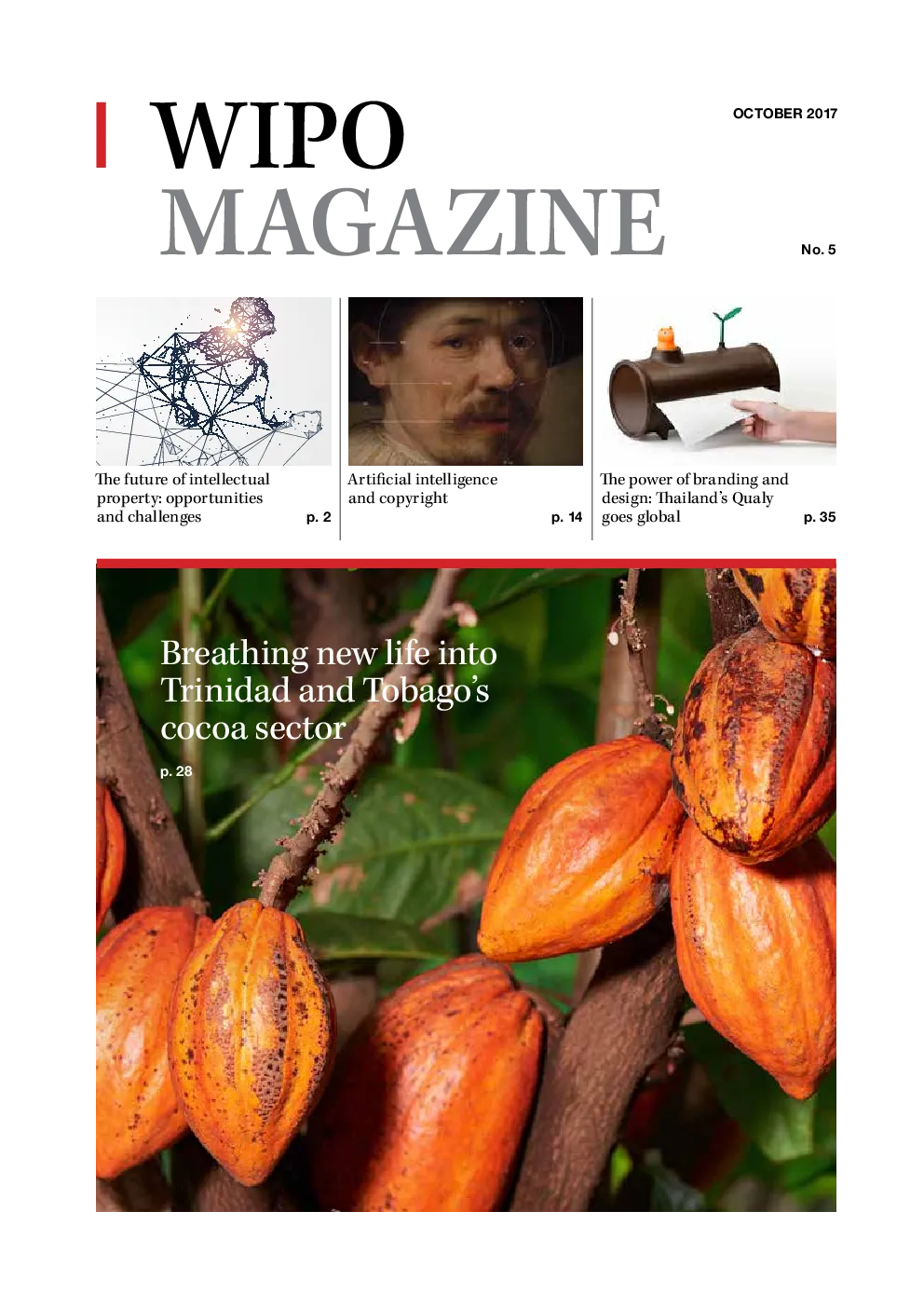
No. 5 The future of intellectualproperty: opportunitiesand challenges The power of branding anddesign: Thailand’s Qualygoes globalp. 35 Artificial intelligenceand copyright p. 2 p. 14 Breathing new life intoTrinidad and Tobago’scocoa sector p. 28 Table of Contents 2The future of intellectual property:opportunities and challenges8iROKOtv: delivering Nollywood content to the world14Artificial intelligence and copyright20Transforming Arab cinema with MAD Solutions28Breathing new life into Trinidad and Tobago’s cocoa sector35The power of branding and design:Thailand’s Qualy goes global40Georgian schoolchildren have fun with intellectual property43Keeping track of domain name jurisprudence47Hashtag trademarks: what can be protected Editor:Catherine Jewell © WIPO, 2017 Attribution 3.0 IGOlicense (CC BY 3.0 IGO) The user is allowed to reproduce, distrib-ute, adapt, translate and publicly performthis publication, including for commercialpurposes, without explicit permission,provided that the content is accompa-nied by an acknowledgement that WIPOis the source and that it is clearly indi-cated if changes were made to the orig-inal content. Adaptation/translation/derivatives shouldnot carry any official emblem or logo,unless they have been approved and val-idated by WIPO. Please contact us viatheWIPO websiteto obtain permission. When content published by WIPO, suchas images, graphics, trademarks orlogos, is attributed to a third party, theuser of such content is solely respon-sible for clearing the rights with theright holder(s). To view a copy of this license, please visithttps://creativecommons.org/licenses/by/3.0/igo Acknowledgements:14Paolo Lanteri,Copyright Law Division, WIPO28Paul RegisandBeatriz Amorim-Borher, Regional Bureau for LatinAmerica and the Caribbean, WIPO35Carsten Fink, Economics and Statistics Division,David Muls, Brandsand Designs Sector, andAndrew Michael Ong, Regional Bureau for Asiaand the Pacific, WIPO40Cécile Benbachir, Building Respect for IP Division, WIPO47David Muls, Brands and Designs Sector, WIPO Cover images:Left to right: Photo: a-image / iStock /Getty Images; www.nextrembrandt.com; Courtesy of QualyMain image:dimarik / iStock / Getty Images The future of intellectualproperty: opportunitiesand challengesThe future ofintellectual property:opportunities andchallenges WIPO Director General Francis Gurry recently met withWIPO Magazineto reflect on the future as revolutionarydevelopments in information technology (IT) and the lifesciences begin to test the premises and practices of theintellectual property (IP) system. What do you consider to be the main challengesfacing the IP system? Today we are seeing the emergence of technologies thatwill have a radical impact on the existing IP landscape.While we do not yet understand their full dimensions,we can anticipate major challenges for IP administration,policy and governance. We can also foresee significantdevelopment challenges arising from the huge differ-ences in technological capacity that exist across theworld. But with every challenge there are opportunities.The developments that are creating these challengesare not negative in themselves. We simply need to try tounderstand how they will impact the existing IP systemand its future evolution. “Today we areseeing theemergence oftechnologiesthat will have aradical impacton the existingIP landscape.” What is driving the administrative challenge? It is linked to rising global demand for IP rights. As IPbecomes ever more central to the knowledge economy,demand for IP rights continues to rise and this is likely tocontinue. In 2015, for example, 2.9 million patent appli-cations were filed along with around 6 million trademarkapplications and 870,000 design applications. These areextraordinary numbers. Managing this rising demand isa big challenge for IP offices. But as new IT solutionscome on stream, there will be new opportunities to bettermanage this demand and administrative IP processesin general. Is the existing IP system fit for purpose? The current IP system is fit for many purposes, butthere may be areas in which it needs to adapt. Artificialintelligence (AI) and the life sciences are two major areasof technological and scientific development that will raiseimportant challenges for IP, as well as for other policyareas, given their multidimensional nature. AI, for exam-ple, raises technological and economic issues rangingfrom incentives for the production of useful AI systemsto employment displacement. And inevitably ethical WIPO Director General Francis Gurry “New technologiesare beingdeveloped anddiffused globallyat unprecedentedspeed. The majorchallenge is toensure that allcountries benefitfrom the rapiddiffusion of thesetechnologies…” and governance issues will arise from the application ofIT in the life sciences, in particular. So we need to thinkcarefully about what these rapidly evolving technologieswill mean for the IP system and its administration.