WIPO杂志,2017年第2期(4月)
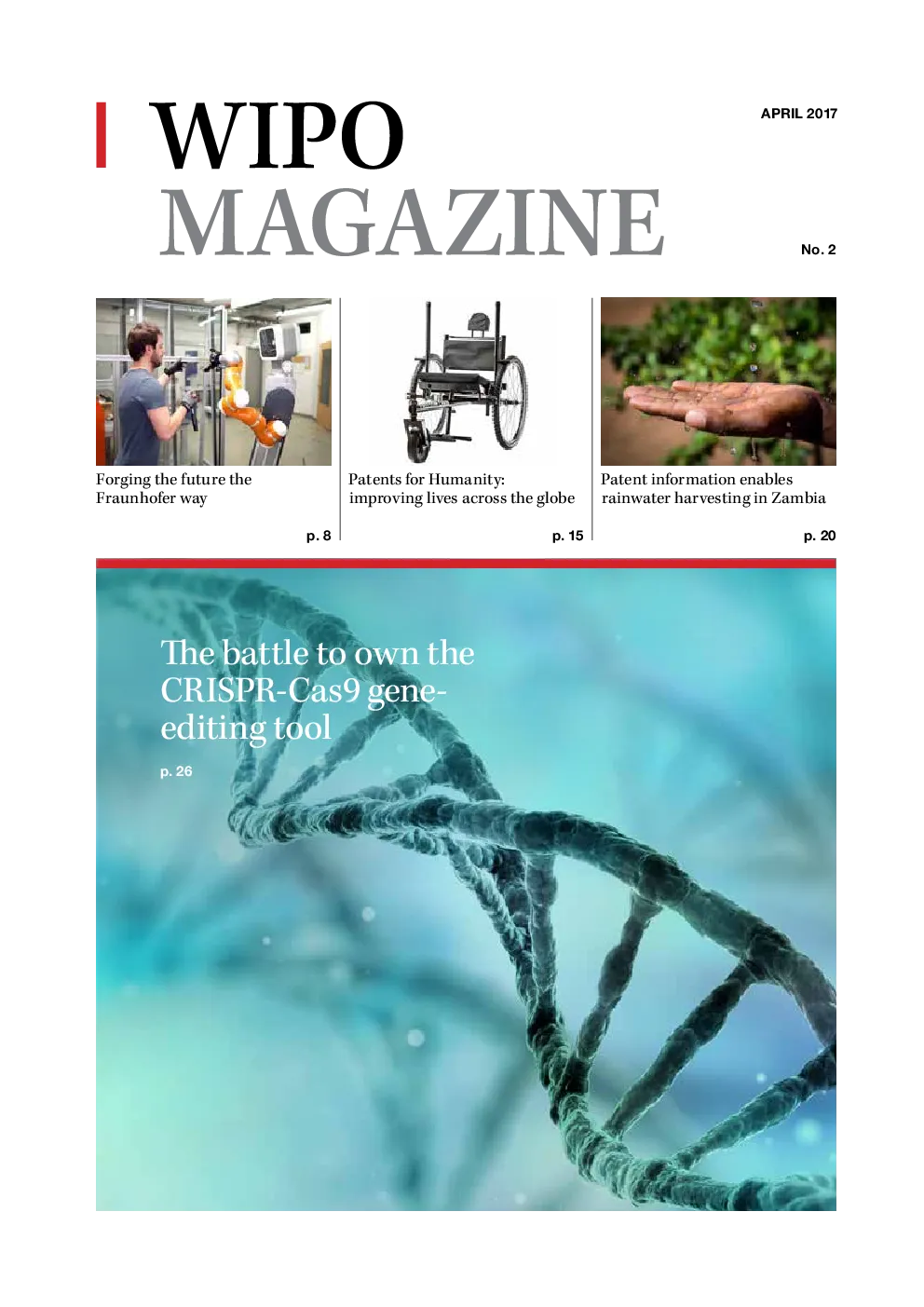
No. 2 Patents for Humanity:improving lives across the globe Forging the future theFraunhofer way Patent information enablesrainwater harvesting in Zambia p. 15 p. 8 p. 20 The battle to own theCRISPR-Cas9 gene-editing tool p. 26 World IntellectualProperty Day 2017April 26 #worldipdaywww.wipo.int/ipday Every day, ordinary people are producing extraordinary new things to changethe world for the better. Their innovations take myriad forms, from themundane to the seemingly miraculous. From new medicines and materialsto improved crop varieties and communications, innovation is making ourlives healthier, safer and more comfortable. Innovation is a human force that knows no limits. It turns problems intoprogress. It pushes the boundaries of possibility, creating unprecedentednew capabilities. This special issue of the WIPO Magazine offers a range of perspectives on theenabling role that intellectual property plays in supporting innovation in avariety of settings across the economy and in different parts of the world. For more onWorldIntellectualPropertyDay, join us on Twitter (#worldipday)and Facebook (www.facebook.com/worldipday). Table of Contents 2What lies beneath: the unsung story ofbiopharmaceutical innovation8Forging the future the Fraunhofer way15Patents for Humanity: improving lives across the globe20Patent information enables rainwater harvesting in Zambia26In the courtsThe battle to own the CRISPR-Cas9 gene-editing tool33Smart solutions to global challenges: the quest of a Turkishinventor38Catalyzing applied research in Peru45Digitizing Singapore’s chemical ecosystem: an industrialInternet of things Editor:Catherine Jewell © WIPO, 2017 Attribution 3.0 IGOlicense (CC BY 3.0 IGO) The user is allowed to reproduce, distrib-ute, adapt, translate and publicly performthis publication, including for commercialpurposes, without explicit permission,provided that the content is accompa-nied by an acknowledgement that WIPOis the source and that it is clearly indi-cated if changes were made to the orig-inal content. Adaptation/translation/derivatives shouldnot carry any official emblem or logo,unless they have been approved and val-idated by WIPO. Please contact us viatheWIPO websiteto obtain permission. When content published by WIPO, suchas images, graphics, trademarks orlogos, is attributed to a third party, theuser of such content is solely responsi-ble for clearing the rights with the rightholder(s). To view a copy of this license, please visithttps://creativecommons.org/licenses/by/3.0/igo Acknowledgements:2Marco Aleman, Patent Law Division, WIPO8Claus Matthes, PCT Legal and International Affairs Department, WIPO20Kiflé Shenkoru, Division for Least Developed Countries, WIPO26Matthew Bryan, PCT Legal and International Affairs Department, WIPO33Kaori Saito, Gender and Diversity Specialist, Human ResourcesDepartment, WIPO38Olga Spasic, SMEs and Entrepreneurship Support Division, WIPO Cover images:Left to right: Courtesy of Fraunhofer;Courtesy of GRIT;iStock.com/dave_vallerMain image:iStock.com/cosmin4000 What lies beneath:the unsung story ofbiopharmaceuticalinnovation Ingenuity is often portrayed as an archipelago of “Aha!” moments in anotherwise empty sea. Newton and the apple. Archimedes in his bath. Einsteinin a daydream that revealed his theory of general relativity. Farnsworth in acornfield whose neatly plowed rows became the basis for his invention oftelevision. The list goes on. ByCorey Salsberg, Vice President andGlobal Head of IP Affairs, Novartis Without doubt, invention and discovery are unpredictable endeavors:nonlinear and unexpected; one step forward, three steps back. Butthat does not mean that innovation is random. Quite the contrary, while“Eureka” moments surely have their place, true innovation – that which reallytouches and transforms human lives – is almost always more a product ofthe focus and persistence that comes with the pursuit of a mission than ofa chance encounter with a wandering muse. As Thomas Edison famouslyput it, “genius is one percent inspiration and 99 percent perspiration,” orthereabouts. This makes perfect sense; for it is precisely the hard work andperseverance that is done towards a mission or a goal that provides thenecessary context for those “Aha!” moments to arise, not to mention theuncelebrated before and after steps that enable the conversion of thosebold ideas into the breakthrough innovations that they eventually become. Nowhere is this more true than in the biopharmaceutical field. With an averageresearch and development (R&D) timeline of 10-15 years, biopharmaceuticalinnovation – the kind that stops a child from contracting a disease, purges avirus from deep within the body, sends a tumor into complete remission, ortransforms a death sentence into a manageable condition – neither startsnor stops with a single “Aha!” moment. It is an ongoing, complex, laboriousprocess that begins with disheartening odds (sometimes ten-thousand-to-one),