WIPO杂志,2016年第5期(10月)
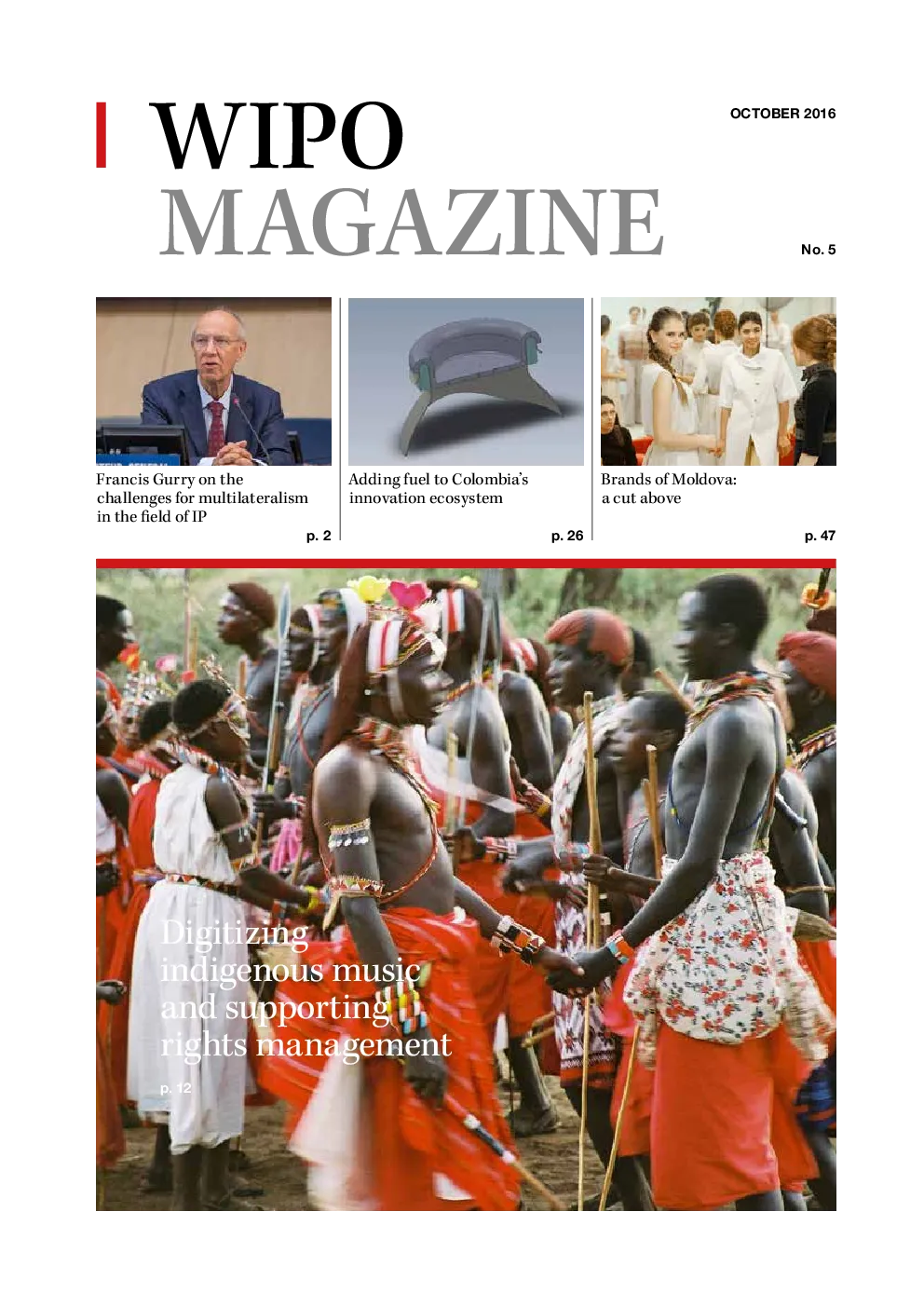
No. 5 Adding fuel to Colombia’sinnovation ecosystem Francis Gurry on thechallenges for multilateralismin the field of IPp. 2 Brands of Moldova:a cut above p. 26 p. 47 Digitizingindigenous music and supportingrights management Table of Contents 2Francis Gurry on the challenges for multilateralismin the field of IP9Exchanging books across borders - as easy as ABC12Digitizing indigenous musicand supporting rights management21Winning with global innovation:Global Innovation Index 201626Adding fuel to Colombia’s innovation ecosystem32The role of intellectual property in the battle against malaria36iQIYI on China’s booming online film market42Branding the fragrances of the Orient:an interview with Amouage47Brands of Moldova: a cut above Editor:Catherine JewellGraphic Design:Annick Demierre © WIPO, 2016 Attribution 3.0 IGOlicense (CC BY 3.0 IGO) The user is allowed to reproduce, distrib-ute, adapt, translate and publicly performthis publication, including for commercialpurposes, without explicit permission,provided that the content is accompa-nied by an acknowledgement that WIPOis the source and that it is clearly indi-cated if changes were made to the orig-inal content. Adaptation/translation/derivatives shouldnot carry any official emblem or logo,unless they have been approved and val-idated by WIPO. Please contact us viatheWIPO websiteto obtain permission. When content published by WIPO, suchas images, graphics, trademarks orlogos, is attributed to a third-party, theuser of such content is solely respon-sible for clearing the rights with theright holder(s). To view a copy of this license, please visithttps://creativecommons.org/licenses/by/3.0/igo/ Acknowledgements:2Monic a Halil-Lovblad,Accessible Books ConsortiumSecretariat, WIPO26Marco Aleman,Patent Law Division, WIPO32Anatole KrattigerandTom Bombelles,Global ChallengesDivision, WIPO36Hongbing Chen, WIPO China Office Cover images:Left to Right: WIPO; ICIPC;Courtesy of AGEPIMain image: Courtesy of the AmericanFolklife Center, Library of Congress/Guha Shankar Francis Gurry onthe challenges formultilateralism in thefield of intellectualproperty As WIPO’s 189 member states prepared to gather inGeneva for their annual meeting of Assemblies, DirectorGeneral Francis Gurry sat down withWIPO Magazineto share his views on the challenges for multilateralismin the field of intellectual property. Why is multilateralism important in the field ofintellectual property? Multilateralism is the greatest source of legitimacy andinclusiveness for making rules. Through multilateralnegotiation the international community aspires to pro-vide a system which is fair to all participating countries,including smaller states. In the field of intellectual property (IP), multilateralism isespecially important because of the mobility and globalapplication of innovation, ideas and creative works,especially in the digital age. If IP is to fulfill its mission toprovide a proper economic incentive through protectionfor creators and inventors, then similar rules will needto apply across the globe where possible. “Not everyform ofinternationalcooperationneeds to beimplementedthrougha treaty.” What are the key challenges for multilateralismin this area? The biggest challenge is the growing contrast betweenthe extremely rapid speed of technological change andof the business responses to that change, on the onehand, and the relatively slow speed of conventionalintergovernmental processes for the development ofinternational cooperation, on the other hand. Such pro-cesses are inclusive and require that all states are com-fortable with the change that occurs, which can take time.This poses a real and enduring challenge for multilater-alism in dealing with IP, which by definition is concernedwith the new – innovation and new creative works. These contrasting speeds explain in large part why overthe last 20 years we have seen more international – butnon-multilateral – cooperation at the bilateral, plurilateraland regional levels. It is easier to make rules and getagreement among a smaller number of states than it isto do so with the whole world. This shift in the interna-tional landscape is a major challenge for multilateralism. What are the implications of these challenges forIP and how is WIPO responding to them? In this new and more complex landscape, everyone inthe international community needs to think very carefully about the role of multilateralism and the value it can add. And in the areaof IP we need to carefully consider what needs to be done and what canbe achieved multilaterally. We need to evaluate what requires multilateralaction as opposed to national, bilateral or plurilateral action. We also needto ask ourselves what is the best value that a multilateral institution can add. “In the field of intellectual property(IP), multilateralism is especiallyimportant because of the mobilityand global application of innovation,ideas and creative works,” says WIPODirect