WIPO杂志,2016年第6期(12月)
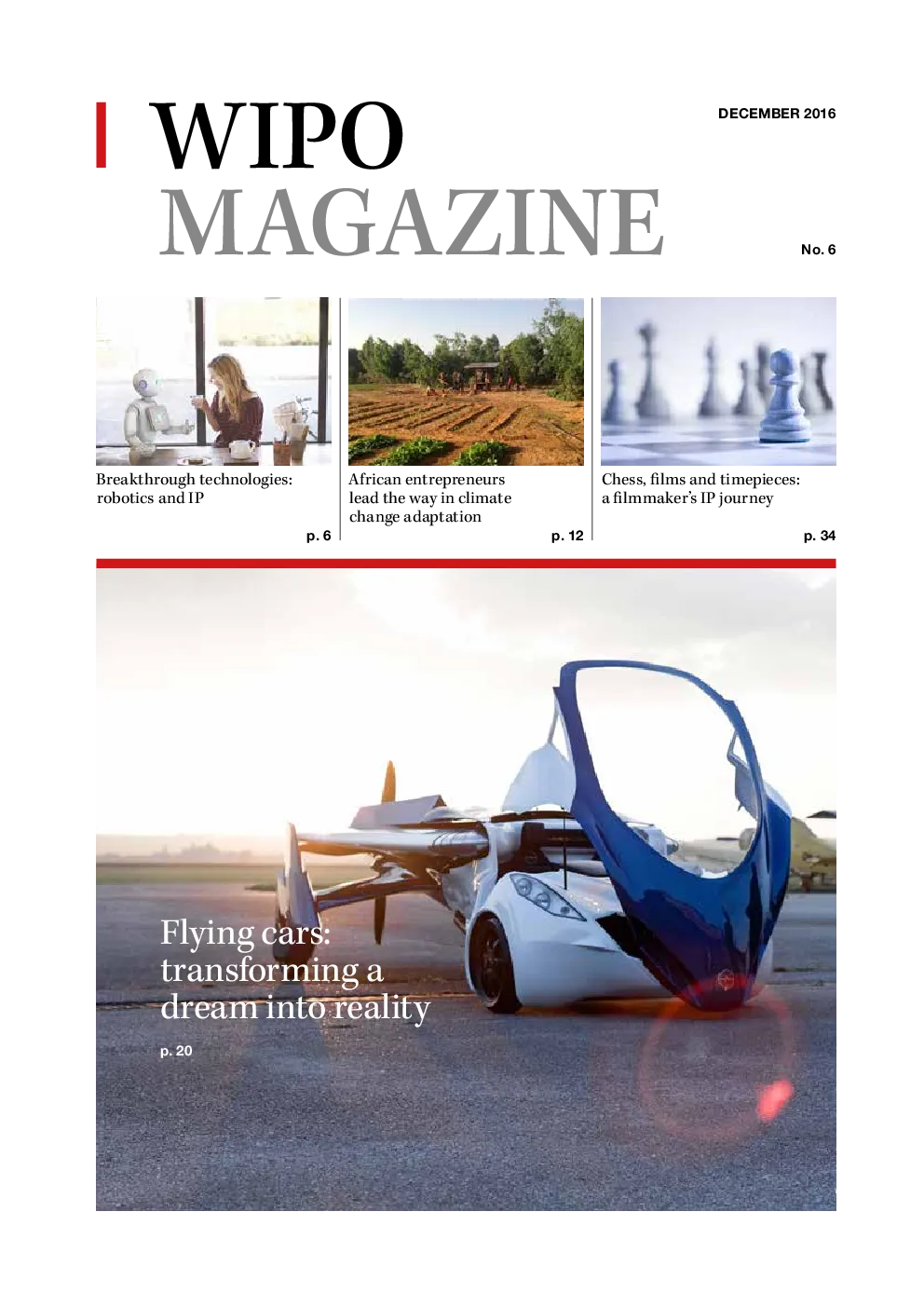
No. 6 African entrepreneurslead the way in climatechange adaptation Breakthrough technologies:robotics and IP Chess, films and timepieces:a filmmaker’s IP journey p. 6 p. 34 p. 12 Flying cars:transforming adream into reality p. 20 Table of Contents 2Helping under-resourced inventors navigatethe patent system6Breakthrough technologies: robotics and IP12African entrepreneurs lead the way in climatechange adaptation20Flying cars: transforming a dream into reality26Making sense of IP information30Meet Alex - IP Australia’s next-generation virtual assistant32In the courts: European Court of Justice: hyperlinksto unauthorized content may infringe copyright34Chess, films and timepieces: a filmmaker’s IP journey40University IP policies: perception and practice Editor:Catherine Jewell © WIPO, 2016 Attribution 3.0 IGOlicense (CC BY 3.0 IGO) The user is allowed to reproduce, distrib-ute, adapt, translate and publicly performthis publication, including for commercialpurposes, without explicit permission,provided that the content is accompa-nied by an acknowledgement that WIPOis the source and that it is clearly indi-cated if changes were made to the orig-inal content. Adaptation/translation/derivatives shouldnot carry any official emblem or logo,unless they have been approved and val-idated by WIPO. Please contact us viathe WIPO website to obtain permission. When content published by WIPO, suchas images, graphics, trademarks orlogos, is attributed to a third party, theuser of such content is solely respon-sible for clearing the rights with theright holder(s). To view a copy of this license, please visithttps://creativecommons.org/licenses/by/3.0/igo Cover images:Left to Right: Courtesy of SoftBankRobotics; Courtesy of Tech Innov;iStock.com/Trifonov_EvgeniyMain image: Courtesy of AeroMobil Helping under-resourcedinventors navigate thepatent system ByGiulia Ragonesi, Patent Law Division andEdward Harris, Communications Division, WIPO For Antonio Gonzalo Hoyos Barón, tragedy was the mother of invention. For years,the forensic scientist heard about health workers waiting at rural health clinics acrossColombia for ambulances that never arrived: the rushing vehicles hydroplaned whilecornering on rain-slicked roads before foundering and, in one instance, flipping overand killing a young female patient. Colombian inventor AntonioGonzalo Hoyos Barón (center),one of the first beneficiaries ofthe Inventor Assistance Program,with hispro bonoattorneysfrom Baker & McKenzie. Hoping to help solve this problem, Mr. Hoyos Barón began in the mid-1990s to workon a claw-like metal contraption to be mounted on vehicles traveling during SouthAmerica’s rainy season, providing lateral stability on wet and muddy roads. Workprogressed slowly. But when a prototype had the desired effect, Mr. Hoyos Barónwas thrilled. “Imagine seeing something you’ve been dreaming of for such a long timebecoming reality and with the potential to be so useful,” he says. That potential, however, remains largely untapped, because taking it to the next stepmeans obtaining the patent protection that would attract investors and help commer-cialize the product. Lacking what he calls“musculos financiarios”– financial muscle– for the costs that often include attorneys’ fees, Mr. Hoyos Barón was stuck – likemany inventors who lack financial means. SUPPORT IS IN SIGHT “We really need to encouragepro bonowork in general,but particularlypro bonoin IP,” Mr. Aleman says. “Thisis a challenge because the concept is quite new inmany jurisdictions.” Help is on the way. A new WIPO-led effort is helpingmatch Mr. Hoyos Barón and other under-resourcedinventors and small businesses in developing countrieswith intellectual property (IP) lawyers willing to work forfree to help the inventors better navigate the patent-filingprocess. For IP lawyers, actually finding under-resourced inven-tors can be difficult, since these innovators are oftenoutside the IP ecosystem and rarely seek out free legaladvice. This is where the IAP can help – by connectingthe two parties. The Inventor Assistance Program (IAP) was formallylaunched globally on October 17, 2016, following suc-cessful pilot projects in Colombia, Morocco and thePhilippines. The IAP is a WIPO initiative in cooperationwith the World Economic Forum and an array of othersponsors, including the Inter-American Association ofIntellectual Property (ASIPI), the International Federationof Inventors’ Associations (IFIA), Novartis, Qualcomm,Pfizer, the European Patent Institute (EPI) and the UnitedStates Federal Circuit Bar Association (FCBA). “Our aim is to build up a network of lawyers offering theirservices on apro bonobasis and to link them up withunder-resourced inventors. These people often live in thesame city, but have little or no opportunity to meet,” saysMr. Aleman. “These lawyers can help under-resourcedinventors navigate the patent process by providing thetechnical advice required to avoid the pitfalls that