WIPO杂志,2018年第3期(6月)
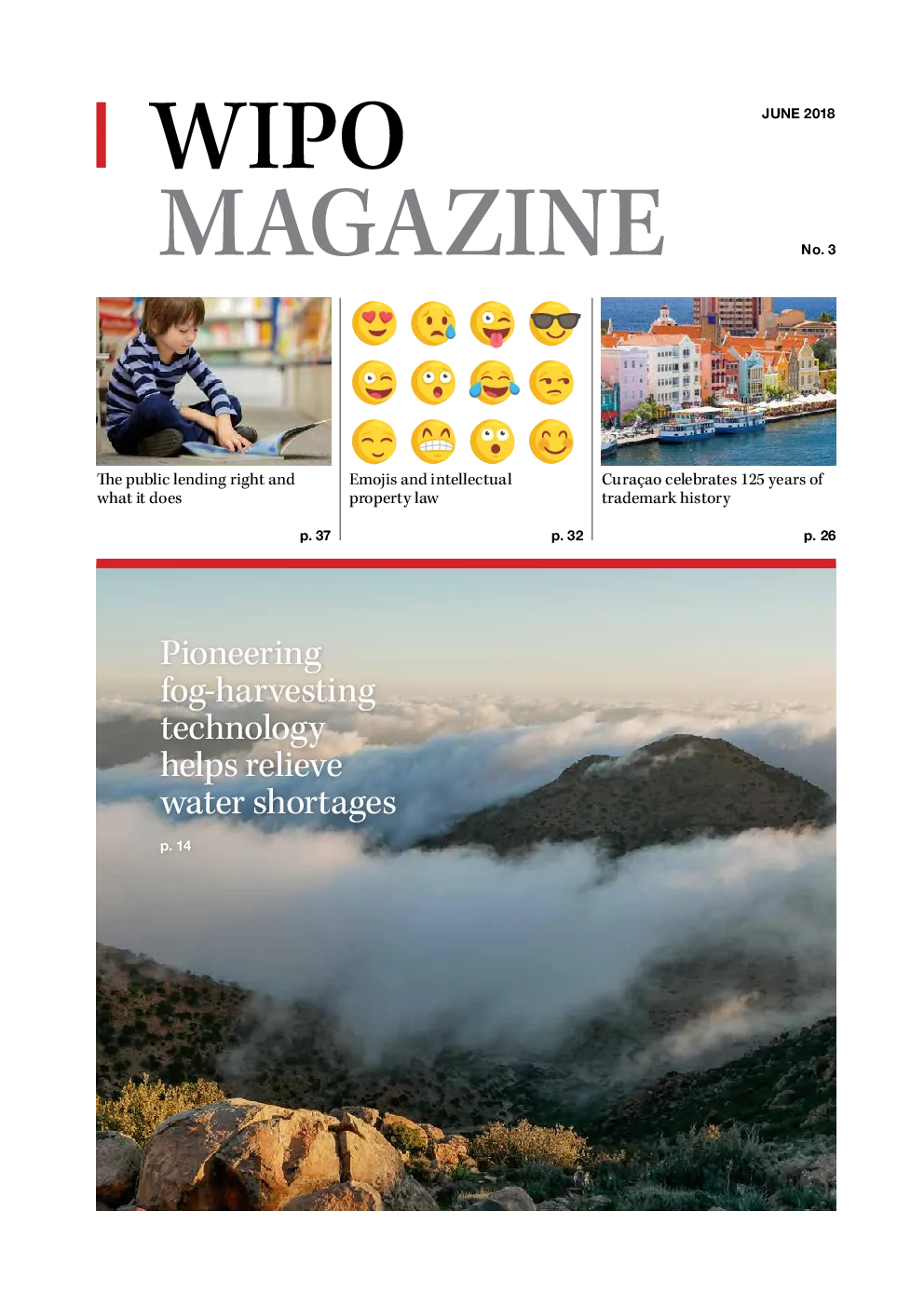
No. 3 Emojis and intellectualproperty law The public lending right andwhat it does p. 37 p. 32 p. 26 Pioneeringfog-harvestingtechnologyhelps relievewater shortages p. 14 Table of Contents 2The Patent Cooperation Treaty at 408Diagnostics for the Real World: point-of-carediagnosis made easy14Pioneering fog-harvesting technology helps relievewater shortages22IP Australia puts digital intelligence to work26Curaçao celebrates 125 years of trademark history32Emojis and intellectual property law37The public lending right and what it does Editor:Catherine JewellLayout:Ewa Przybyłowicz © WIPO, 2018 Attribution 3.0 IGOlicense (CC BY 3.0 IGO) The user is allowed to reproduce, distrib-ute, adapt, translate and publicly performthis publication, including for commercialpurposes, without explicit permission,provided that the content is accompa-nied by an acknowledgement that WIPOis the source and that it is clearly indi-cated if changes were made to the orig-inal content. Adaptation/translation/derivatives shouldnot carry any official emblem or logo,unless they have been approved and val-idated by WIPO. Please contact us viathe WIPO website to obtain permission. When content published by WIPO, suchas images, graphics, trademarks or logos,is attributed to a third party, the user ofsuch content is solely responsible forclearing the rights with the right holder(s). To view a copy of this license, please visithttps://creativecommons.org/licenses/by/3.0/igo Acknowledgements:2John Sandage, Deputy Director General andClaus Matthes, SeniorDirector, Patents and Technology Sector8Kaori Saito, Gender and Diversity Specialist, WIPO22Yoshiyuki Takagi, Assistant Director General, Global IP Infrastructure,WIPO26Sara Amini, Madrid Information and Promotion Division, WIPO32 & 37Rafael Ferraz Vazquez, Copyright Law Division, WIPO Cover images:Left to right: tatyana_tomsickova/iStock/Getty Images Plus; Pingebat/iStock/Getty Images Plus; sorincolac/iStock/Getty Images Plus;Main image:Courtesy of Aqualonis, GmbH The Patent CooperationTreaty at 40 ByMatthew Bryan, PCT Legal and User Relations Division,andCatherine Jewell, Communications Division, WIPO Today inventors around the world have access to a system, knownas the Patent Cooperation Treaty (PCT), which offers a cost-effec-tive way to seek patent protection for their high-value technologiesin multiple countries. That system, which has just celebrated its40th year of operation, has become an essential component ofthe international patent system. Today, the PCT includes 152 member countries. In the words ofWIPO Director General Francis Gurry, the PCT is “truly a globalsystem and a global treaty” that is at “the center of worldwidepatenting activity.” The world’s largest companies (see p. 4), leading universities andresearch institutions and individual inventors use the PCT as astrategic option to seek patent protection in multiple countries,since a single international patent application filed under the PCThas legal effect in all the countries bound by the Treaty. In its 40 years of operation, the PCThas moved “to the center of worldwidepatenting activity,” notes WIPODirector General Francis Gurry. ADVANTAGES OF THE PCT The PCT offers users a number of advantages. In particular, appli-cants can postpone decisions about the countries in which theywant to seek patent protection, and the significant associatedcosts, by up to 18 months longer than under the traditional patentsystem. They can also benefit from valuable feedback about thepotential patentability of their inventions; at present, 22 patentoffices that serve as International Searching Authorities partnerwith WIPO to provide users with such feedback. This additionaltime and feedback creates opportunities for applicants to continuethe technical development of their invention, test the market forit and, if necessary, find business partners and secure financing. The PCT also offers national and regional patent offices a numberof advantages, in particular, by providing them with the samevalue-added information on the potential patentability of an inven-tion as provided to applicants, and by freeing those offices fromhaving to evaluate the formal aspects of the application. In thisway, the PCT process facilitates decision-making and can increaseconfidence in the quality of the patents if ultimately granted. About the PatentCooperation Treaty (PCT) The Patent Cooperation Treaty (PCT)offers users of the patent system a cost-effective means of protecting their inven-tions internationally. The PCT facilitates the process of seekingpotential patent protection in multiplecountries and postpones some of themajor costs of such internationalization.The granting of patent rights, however,remains under the control of the nationalor regional patent offices concerned. WHAT USERS ARE SAYING ABOUT THE PCT “WIPO’s Patent Cooperation Treaty is a cornerstone of our IP busi-ness,” notes Alexander Kurz, Executive Vice President