世界知识产权组织杂志,2015年第4期(8月)
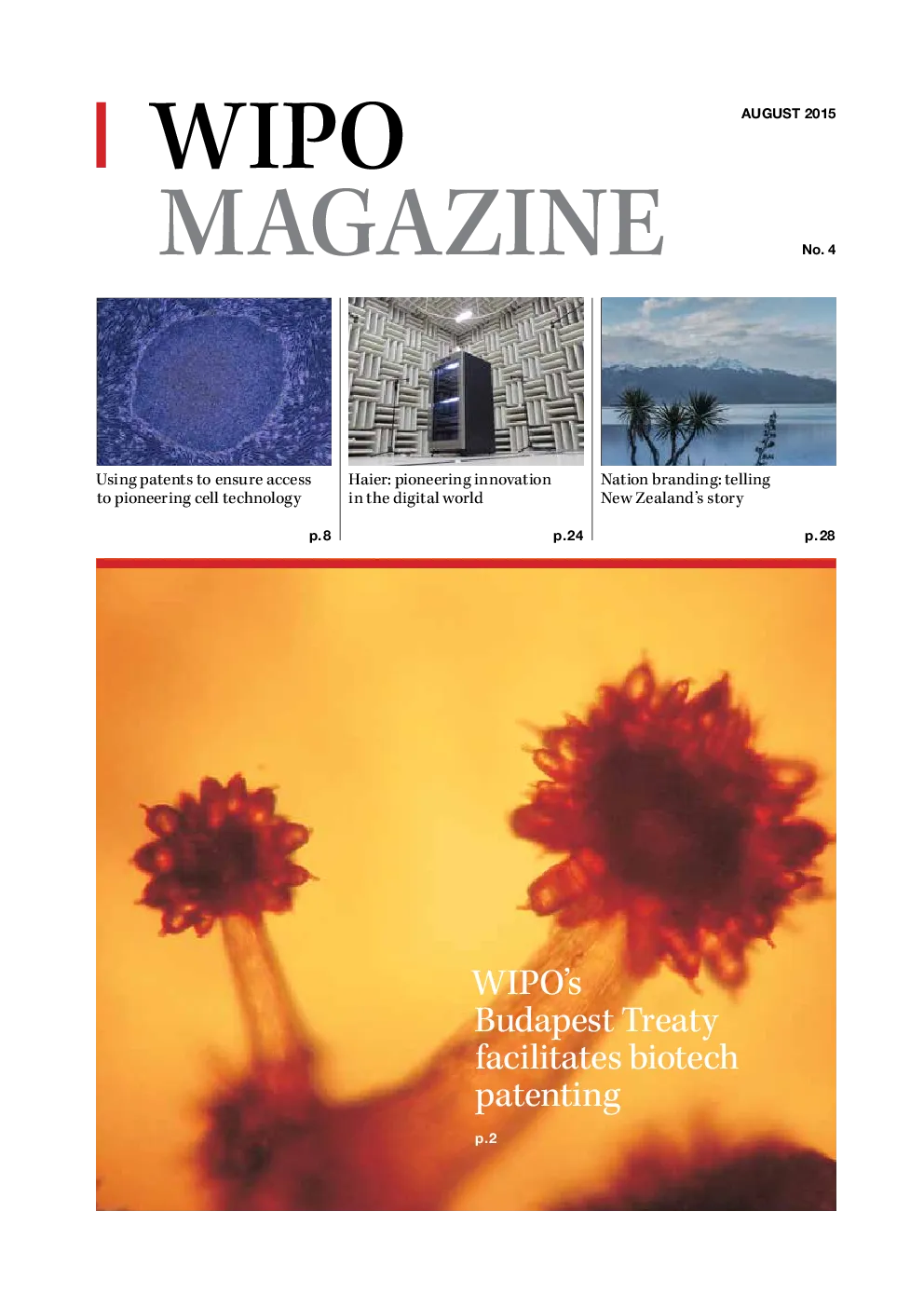
No. 4 Haier: pioneering innovationin the digital world Nation branding: tellingNew Zealand’s story Using patents to ensure accessto pioneering cell technology p.24 p.8 p.28 WIPO’sBudapest Treatyfacilitates biotechpatenting p.2 Table of Contents WIPO’s Budapest Treaty facilitates biotech patentingUsing patents to ensure access to pioneering cell technologyWho benefits from IP rights in agricultural innovation?The puzzle that is patent qualityTanzanian entrepreneur develops innovative water filterHaier: pioneering innovation in the digital worldNation branding: telling New Zealand’s storyGenerating value from the public domain Editor:Catherine Jewell Cover images:Right to left: Leibnitz Institut –Deutsche Sammlung vonMikrooganismen und ZellkulturenGmbH, (DSMZ);Haier;Rob Suistedmain image: DSMZ Acknowledgements:2Marco Aleman and Ewald Glantschnig, Patent Law Division, WIPO8Yoshiyuki Tagaki, Global Infrastructure Sector and Masaki Okamoto,WIPO Japan Office12Anatole Krattiger, Global Challenges Division, WIPO16Marco Aleman, Patent Law Division, WIPO24Binying Wang, Brands and Designs Sector, WIPO,Mr. Guoliang Lu, WIPO China Office30Martha Parra de Friedli, Law and Legislative Advice Division, WIPO34Intan Hamdan-Livramento, Economics and Statistics Division, WIPO © World IntellectualProperty Organization WIPO’sBudapest Treatyfacilitates biotechpatenting ByCatherine Jewell,Communications Division, WIPO Humans have been using microorganisms for mil-lennia.Tiny, single-cell living organisms like yeast andbacteria are essential to produce food products like wine,beer and cheese. Only in the 20thcentury, however, didthe industrial application of these microscopic power-houses take off. Greater understanding of biologicalprocesses, thanks in large part to Watson and Crick’swork on DNA, paved the way for the development ofrevolutionary techniques such as genetic engineering,enabling scientists to manipulate microorganisms inspectacular new ways, to enormous social benefit. HOW BIOTECH PATENTING IS DIFFERENT For many technologies, a written description is enoughto enable a specialist working in the relevant field toreproduce an invention for which patent protection issought. When it comes to microorganisms, however, thiswill not generally suffice. Take, for example, an organismisolated in soil that has been “improved” by mutation andfurther selection. It would be practically impossible todescribe the strain and its selection in a way that wouldguarantee that another skilled microbiologist wouldobtain the same strain. In such instances, the micro-organism itself is considered a key part of the disclosure(seehttp://tinyurl.com/p2az6vl). For this reason, manycountries require that when patenting microorganisms,written disclosure is complemented by deposit of thebiological material in question with a specialized culturecollection. In the medical field, microorganisms are used to producea host of life-saving therapies – antibiotics, vaccines,insulin – and diagnostic tools; in agriculture, they areused in developing high-yielding, resistant crop varieties.They are also used in environmental waste managementsystems and many industrial applications, includingthe production of green fuels like ethanol. These tinyorganisms have huge potential to improve the quality ofour lives and the environment in which we live, and toreduce our carbon footprint. However, depositing multiple samples with each patentapplication is impractical. IP offices are ill-equippedto store and preserve biological materials and such arequirement would be hugely time-consuming and costly. For many, biotechnology holds the key to overcomingsome of the daunting challenges facing humanity in the21stcentury. AN INTERNATIONAL MECHANISM THATFACILITATES BIOTECH PATENTING Recognizing the peculiar challenges of patentingmicroorganisms, and the need for a streamlined and cost-effective international procedure, in the late 1970spolicymakers adopted the WIPO-administered BudapestTreaty on the International Recognition of the Deposit ofMicroorganisms for the Purposes of Patent Procedure. Developing these groundbreaking applications takes amassive investment of time, energy and resources. It isa high-risk research undertaking, and successful innova-tions can be imitated at little cost. As such, researchersand the biotech companies that employ them rely heavilyon the intellectual property system, especially patents,to protect their know-how and maximize the chances ofgetting a return on their investment. A key advantage of the Budapest Treaty is that for thepurposes of patenting procedures, it eliminates theneed to deposit multiple samples of the same biologicalmaterial with biological resource centers in differentcountries. As such, it offers applicants an efficient,streamlined and cost-effective means of meeting thedisclosure requirements associated with patentingmicroorganisms and other biological material. CRITERIA FOR PATENT PROTECTION Applic