世界知识产权组织杂志,2013年第4期(8月)
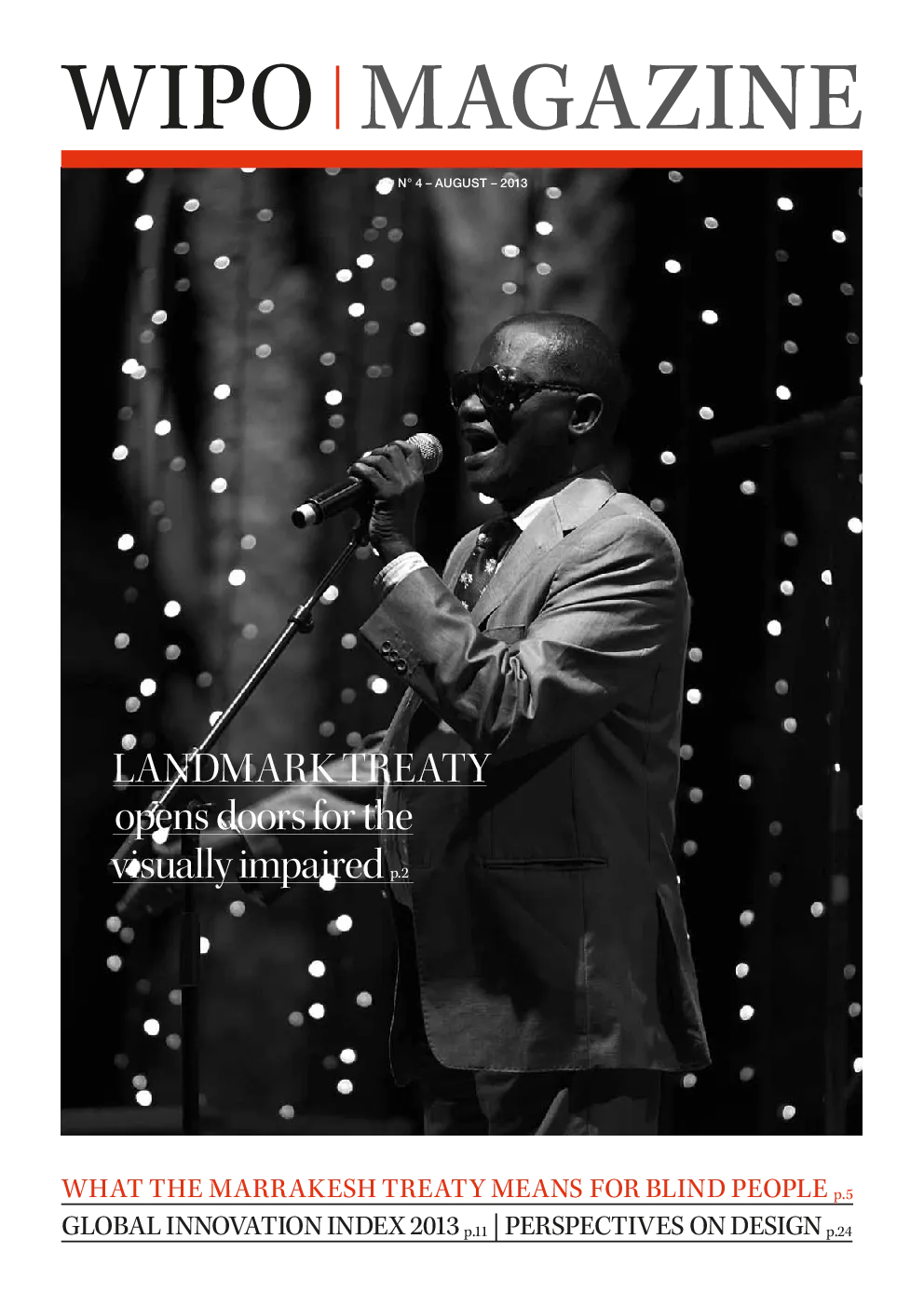
What the Marrakesh treatyMeans for blind peoplep.5Globalinnovationindex 2013p.11|perspectives on desiGnp.24 Contents p.2Landmark treaty opens doorsfor the visually impairedp.5What the Marrakesh treaty means for blind peoplep.7Beyond Marrakeshp.11Global Innovation Index 2013p.14Mining innovation: the Filipino wayp.17IP and philanthropy:the Gates Foundation’s approachp.21In the courts: What Myriad means for biotechp.24Perspectives on designp.30Polish design: a metamorphosis Editor:Catherine JewellGraphic Designer:Annick Demierre Front cover:In June 2013 the international copyrightcommunity concluded a landmark agree-ment that will open up a whole new worldof literature, entertainment and learning forblind, visually impaired and print disabledpeople around the world. ©World IntellectualProperty Organization Landmark treatyopens doors for thevisually impairedByCatherine Jewell,Communications Division, WIPO In a move widely heralded as a triumph for multilateralism, WIPO’s member statesrecently concluded a landmark agreement that will boost access to literature, enter-tainment and learning for blind, visually impaired and print disabled people aroundthe world. After five years of intense negotiations, on June 27, 2013, WIPO’s 186 member statesadopted the Marrakesh Treaty to Facilitate Access to Published Works for PersonsWho Are Blind, Visually Impaired or Otherwise Print Disabled at a Diplomatic Confer-ence hosted by the Kingdom of Morocco. Why was this historic treaty needed andhow will it help improve access to published works by blind, visually impaired andprint disabled people around the world? InternAtIonAlCopyrIght:ABAlAnCIngACt Since the first international copyright treaty, the Berne Convention on the Protec-tion of Literary and Artistic Works, was concluded in 1886, international copyrightlaw has recognized the need to balance the rights of authors of creative works andspecial provisions (known as “limitations and exceptions”) that are in the public inter-est. The Berne Convention and subsequent copyright treaties include these specialprovisions that allow for some uses of copyrighted material without authorizationfrom the rightholder. The definition of the “special cases” to which these provisionsapply is left to national governments, the only caveat being that the reproductionof the works produced under them “does not conflict with a normal exploitation ofthe work and does not unreasonably prejudice the legitimate interests of the author.” In practice the copyright limitations and exceptions contained in national laws varywidely. A study undertaken by WIPO in 2006 indicated that just 57 countries hadspecial provisions for visually impaired persons in their copyright laws. Becausecopyright law is territorial, where such special provisions exist in national law theydo not cover the import or export of works converted into accessible formats (suchas Braille, large print and digitized audio versions of works), even between countrieswith similar rules. Organizations seeking to produce works in accessible formatshave to negotiate with rightholders to exchange special formats across borders orpay to produce their own materials. according to the Worldblind Union(WbU), of the millions of books publishedeach year around the world less than5 percent are available in formatsaccessible to visually impaired persons. This complex situation explains why, according to the World Blind Union (WBU), of themillions of books published each year around the world less than 5 percent are avail-able in formats accessible to visually impaired persons. It explains why, for example,the Libraries of the National Organization of Spanish Blind People (ONCE) which hasmore than 100,000 titles and its counterpart in Argentina with over 50,000 workscannot share their titles with Latin America’s other 19 Spanish-speaking countries. The Marrakeshtreaty adopted by Wipomember states in June 2013 seeks toalleviate the book famine which excludesmillions of visually impaired people fromthe bulk of the world’s published works. “What hashappened herein Marrakeshrepresents hopefor the blindcommunityand theinternationalcommunity.We are giving ahuman face toglobalization.” Recognizing the need to address this problem, in 2004, WIPO’smember states began exploring whether copyright limitationsand exceptions in general should be harmonized internation-ally. The adoption of the United Nations Convention on theRights of Persons with Disabilities added impetus to thesediscussions with respect to visually impaired persons and ledto calls for a formal treaty to address the situation in respectof the global community of visually impaired persons. Thesediscussions culminated, in June 2013, in the adoption of thelandmark Marrakesh Treaty. negotiators for their ability to reach consensus in creating a“simple, workable and effective” framework that respects theinternational architecture of the copyright system. “The treatyhas achieved a very f