中东冲突升级,全球外部形势报告#9-2026年6月11日
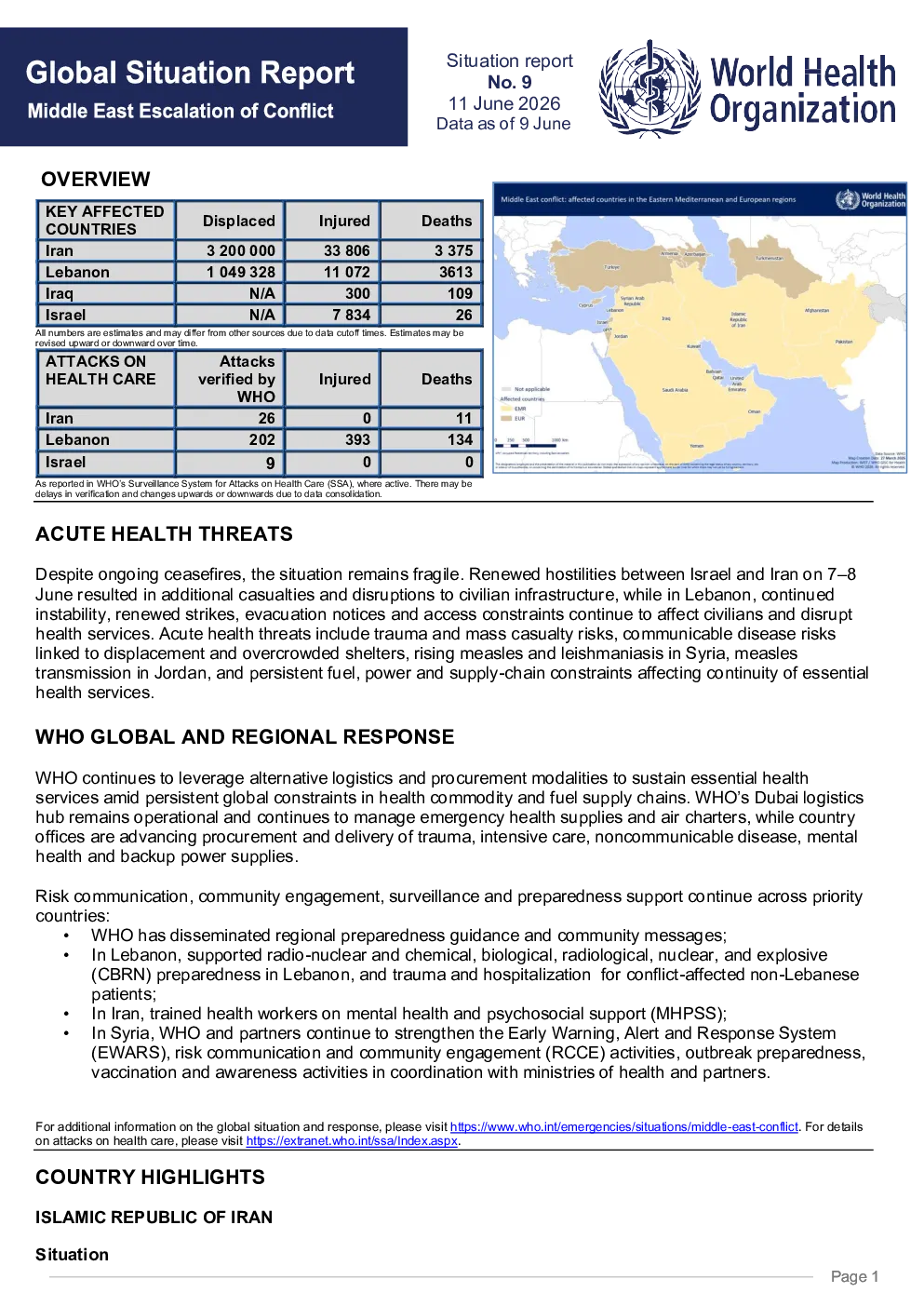
ACUTEHEALTHTHREATS Despite ongoing ceasefires, the situation remains fragile. Renewed hostilities between Israel and Iran on 7–8June resulted in additional casualties and disruptions to civilian infrastructure, while in Lebanon, continuedinstability, renewed strikes, evacuation notices and access constraints continue to affect civilians and disrupthealth services.Acute health threats include trauma and masscasualty risks, communicable disease risks WHOGLOBAL AND REGIONALRESPONSE WHO continues to leverage alternative logistics and procurement modalities to sustain essential healthservices amid persistent global constraints in health commodity and fuel supply chains. WHO’s Dubai logisticshub remains operational and continues to manage emergency health supplies and air charters, while country Risk communication, community engagement, surveillance and preparedness support continue across prioritycountries: •WHO has disseminated regional preparedness guidance and community messages;•In Lebanon,supportedradio-nuclear andchemical, biological,radiological,nuclear, and explosive(CBRN)preparedness in Lebanon, andtraumaand hospitalization for conflict-affected non-Lebanesepatients;•In Iran,trainedhealthworkersonmentalhealth andpsychosocialsupport (MHPSS);•In Syria, WHO and partners continue to strengthen the Early Warning, Alert and Response System ISLAMIC REPUBLIC OFIRAN Situation According to national authorities, 15 injuries were reportedduring the latest escalationon8June, of whom 14had been discharged from hospital.Flight operations have returned to normal following temporary suspensionsaffectingseveral airports, while internet access has largely been restored although connectivity remains limitedin some areas. Potential environmental health implications from attacks in southern Iran remain under WHO response Implementation of WHO support to the Ministry of Health continues, including procurement of generators anduninterruptible power supply systems for health facilities, with delivery expected within two weeks, and NCDsupplies expected by late June. WHO is also strengthening mental health and psychosocial services (MHPSS),with 250 health workers trained across 29 provinces, 87 peer-support sessions reaching approximately 4,700 LEBANON Situation Despite the ongoing ceasefire in Lebanon, the security situation remains highly volatile, with multiple recentattacks and evacuation notices reportedparticularlyaffecting the south of thecountry.Since 2 March, 3526deaths and 10733 injuries have been reportedby the ministry ofhealth, including more than 1023 deaths and Attacks on health care continue to affect service delivery. WHO has recorded202attacks on health care since2 March, including 32 attacks during the last three weeks alone.On 2 June 2026,Jabal AmelHospitalinTyresustained critical damage, including to the emergency and intensive care departments, but remained Approximately 135,000 internally displaced people remain in collective shelters, with shelter capacity criticallystretched in several governorates.A rapid health assessment conducted across 86 communities and 72 healthfacilities found a widening gap between increasing health needs and declining health system capacity. Accessto health care remains constrained by insecurity, affordability barriers, medicine shortages and reducedavailability of specialized services, while health facilities continue to face workforce shortages, infrastructure Flexible and rapid funding is urgently required to sustain emergency health operations and uninterruptedlifesaving services. Enhanced access is critical to restore outreach services, expand shelter and community-based surveillance, improve early detectionand response to communicable disease threats, and replenish WHO response To date, WHO has distributed 120 trauma backpacks to ambulance and emergency medical service teams, aswell as 20 trauma and emergency surgery kits and 15 ICU ventilators to priority hospitals. WHO continues to support trauma-related hospitalization costs for non-Lebanese patients affected by theconflict, with 122 patients supported to date, complementing government efforts to ensure coverage for allaffected populations. WHO also continues to cover treatment costs for individuals with severe mental healthneeds, remaining the only organization providing support for such cases. The Inter-Agency Flash Appeal for Lebanon has been extended for an additional three months and seeksadditional US$331 million to address urgent humanitarian needs, including US$74.3 million for health targeting1 million people. For additional information on the situation and responsein the EasternMediterraneanregion, please visithttps://www.emro.who.int/emergencies/middle- Funding updates WHO’s US$30.3 million emergency appeal to support health operations across five Middle Eastern countriesremains critically underfunded, with only13% (US$4.1 million)received so far.