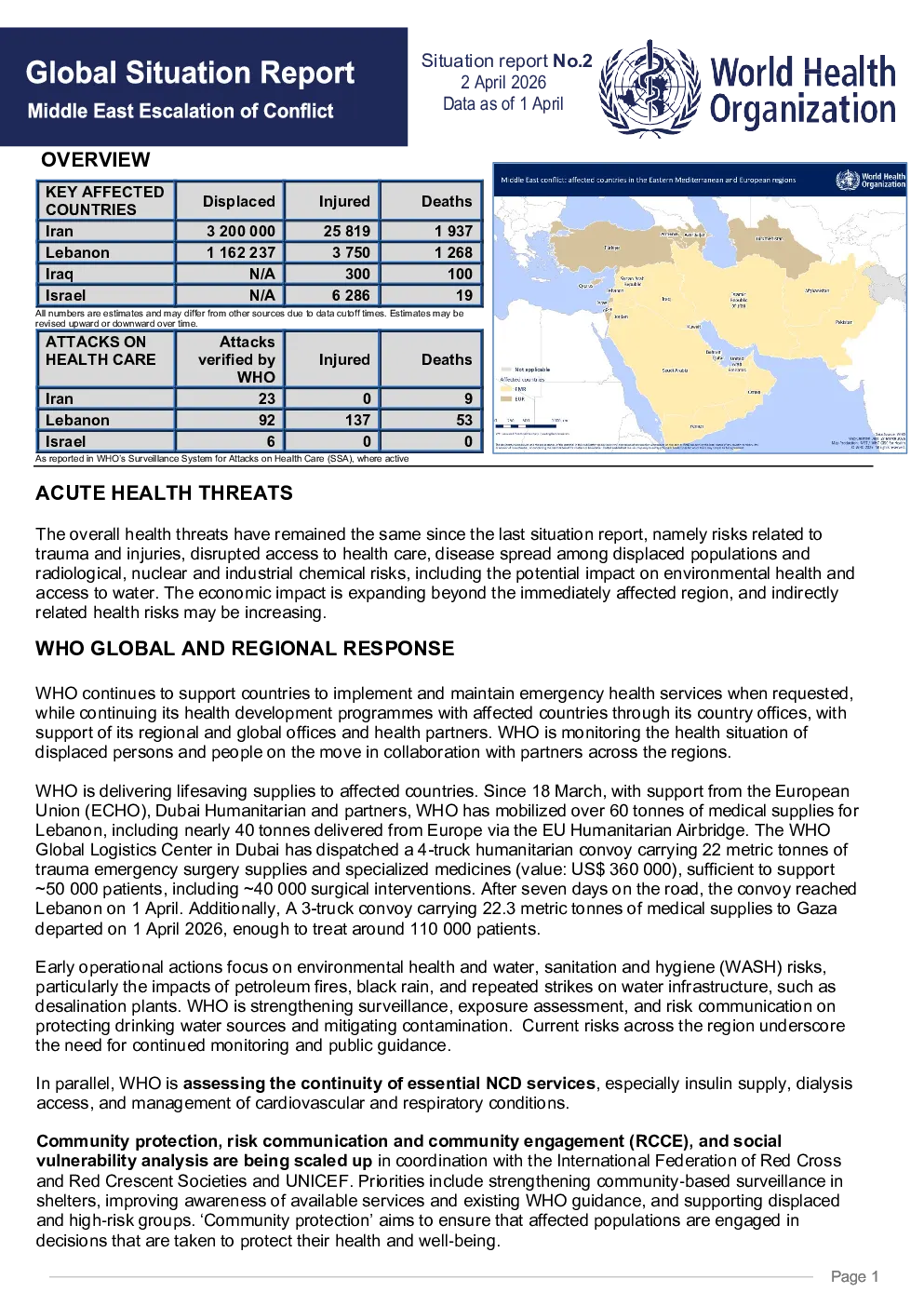
OVERVIEW ACUTE HEALTH THREATS The overall health threats have remained the same since the last situation report, namely risks related totrauma and injuries, disrupted access to health care, disease spread among displaced populations andradiological, nuclear and industrial chemical risks, including the potential impact on environmental health andaccess to water. The economic impact is expanding beyond the immediately affected region, and indirectlyrelated health risks may be increasing. WHO GLOBAL AND REGIONAL RESPONSE WHO continues to support countries to implement and maintain emergency health services when requested,while continuing its health development programmes with affected countries through its country offices, withsupport of its regional and global offices and health partners. WHO is monitoring the health situation ofdisplaced persons and people on the move in collaboration with partners across the regions. WHO is delivering lifesaving supplies to affected countries. Since 18 March, with support from the EuropeanUnion (ECHO), Dubai Humanitarian and partners, WHO has mobilized over 60 tonnes of medical supplies forLebanon, including nearly 40 tonnes delivered from Europe via the EU Humanitarian Airbridge. The WHOGlobal Logistics Center in Dubai has dispatched a 4-truck humanitarian convoy carrying 22 metric tonnes oftrauma emergency surgery supplies and specialized medicines (value: US$ 360 000), sufficient to support~50 000 patients, including ~40 000 surgical interventions. After seven days on the road, the convoy reachedLebanon on 1 April. Additionally, A 3-truck convoy carrying 22.3 metric tonnes of medical supplies to Gazadeparted on 1 April 2026, enough to treat around 110 000 patients. Early operational actions focus on environmental health and water, sanitation and hygiene (WASH) risks,particularly the impacts of petroleum fires, black rain, and repeated strikes on water infrastructure, such asdesalination plants. WHO is strengthening surveillance, exposure assessment, and risk communication onprotecting drinking water sources and mitigating contamination. Current risks across the region underscorethe need for continued monitoring and public guidance. In parallel, WHO isassessing the continuity of essential NCD services, especially insulin supply, dialysisaccess, and management of cardiovascular and respiratory conditions. Community protection, risk communication and community engagement (RCCE), and socialvulnerability analysis are being scaled upin coordination with the International Federation of Red Crossand Red Crescent Societies and UNICEF. Priorities include strengthening community‑based surveillance inshelters, improving awareness of available services and existing WHO guidance, and supporting displacedand high‑risk groups. ‘Community protection’ aims to ensure that affected populations are engaged indecisions that are taken to protect their health and well‑being. WHO is reviewing clinical care needs and management of patients exposed to chemicals, building andexpanding on evidence that was developed and published by WHO in 2015 to guide clinicians and other front-line health workers. WHO provides global-level support to risk communications that are tailored to specificenvironmental or disease risks. Finally,WHO is in close contact with the International Atomic Energy Agency (IAEA)following multiplestrikes on nuclear‑related facilities. IAEA has reported no release of radiation to the environment. WHO iscoordinating with IAEA and contributing to risk assessments as part of broader preparedness planning. COUNTRY HIGHLIGHTS ISLAMIC REPUBLIC OF IRAN SituationHealth services are reportedly continuing to operate at scale, with high service utilization and pressure on emergency and hospital care, while damage to health facilities highlight risks to service continuity and systemresilience. Mapping of functional dialysis centres is ongoing. The WHO country office suffered minor damage on the nights of 29 and 30 March due to explosions in thevicinity. No staff were injured and all are reported safe. WHO responseWHO continues to support the Ministry of Health in procurement of priority vaccine and noncommunicable disease management supplies, as well as in bolstering mental health and psychosocial support. Following discussions with national authorities, WHO is working with the UN Office for the Coordination ofHumanitarian Affairs (OCHA) and other humanitarian partners to prepare a package of humanitarianinterventions for consideration. LEBANON SituationLebanon’s health system continues to manage a high volume of trauma cases. Children and women remain significantly affected, placing further pressure on overstretched emergency, surgical, ICU, and pediatricservices. The government is refining needs, reorganizing secondary healthcare services, and advancingdisability-inclusive and mental health and psychosocial support programming to enhance the overall response.Mapping of fu