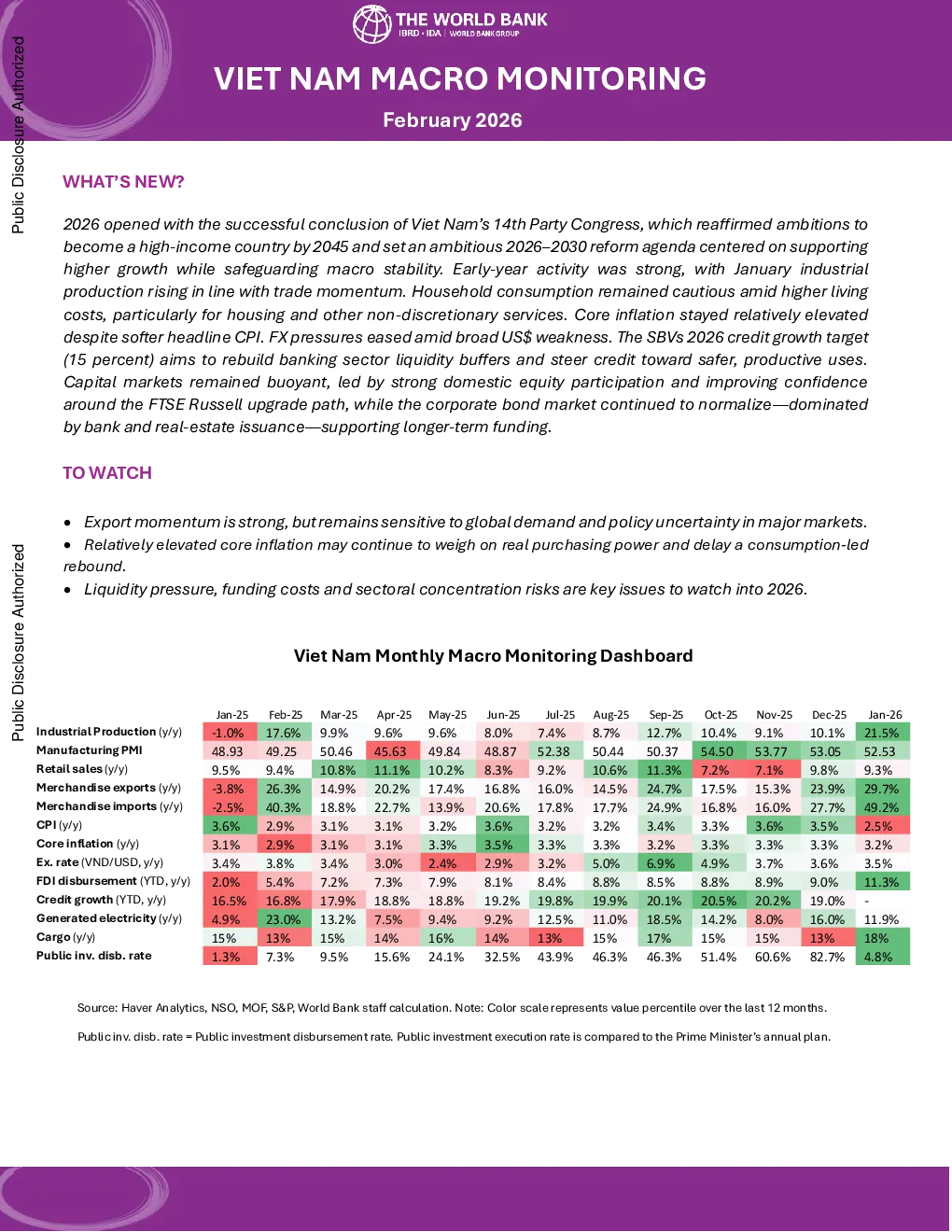
February 2026 WHAT’SNEW? 2026 opened with the successful conclusion of Viet Nam’s 14th Party Congress, which reaffirmedambitions tobecome ahigh-incomecountry by 2045 andsetan ambitious 2026–2030reformagendacenteredonsupportinghighergrowth while safeguarding macro stability. Early-year activity was strong, with Januaryindustrialproductionrisingin line withtrade momentum.Household consumption remained cautiousamidhigher livingcosts,particularlyforhousing and other non-discretionary services. Core inflation stayed relatively elevatedPublic Disclosure Authorized TO WATCHPublic Disclosure Authorized •Export momentum is strong, but remains sensitive to global demandand policy uncertainty in major markets.•Relatively elevatedcore inflationmay continue to weigh onreal purchasing powerand delay a consumption-ledrebound. Viet NamMonthlyMacro Monitoring Dashboard VIET NAM MACRO MONITORING February2026 2026 opened with the successful conclusion of Viet Nam’s 14th Party Congresswhichreaffirms VietNam’s 2045 ambitionto become a high-incomeeconomy and sets a more demanding 2026–2030 agendacentered on a new growth model driven by science and technology, innovation, and national digitaltransformation, alongside greener growth and stronger human capital. It targets average GDP growth of at least10% a year in 2026–2030, while emphasizing macro stability. The Resolution highlights three strategic Industrial activitystarted 2026strong(+21.5 percent y/y)supported by robust trade momentumwitha sharpacceleration in exports (up 29.7percentfrom January 2025)(Figure 1). Imports jumpedby more(49.2percenty/y), pointing to strong demand for intermediate inputs feeding export-oriented production.Forward-lookingindicators-the S&P Global Manufacturing PMI stood at52.5 in January 2026,well above the 50 threshold— However,growth remains led by exports and investment,and has yet to broaden to householdconsumption.Domestic retail salesgrowthin January 2026remainedsteady(Figure 3)as real income gainswere partly offset by higher living costs—especially housing-related expenses and somenon-discretionaryservicesincluding education and healthcare.Despitesome easing of headlineCPI in Januaryhelped by lower Exchange rate pressures eased in early 2026(Figure 5)as broad-based USD weakness reduced a keyconstraint on monetary policy, giving the SBV more room to keep interest rates lowandeaseliquiditywithoutheightening depreciation risks.A persistent funding gap, likely driven by capital allocation toward real estate,gold, equity market, and U.S. dollar assets, has exerted upward pressure on overnight interbank rates sincelate 2025, peaking at around 17 percent in early February 2026(Figure 6). The SBV’s open market operationsand VND/USD swap interventions have temporarily eased liquidity conditions, bringing interbank rates down. Viet Nam’s capital markets strengthened in 2025,with the rallyextending into2026.Equity marketsoutperformed regional peers, driven by surging domestic retail participation despite continued foreign netoutflows.Market sentiment has been supported by FTSE Rusell’s reclassification of Viet Nam from Frontier toSecondary Emerging Market (EM) statusinOctober2025. The EM index inclusion is scheduled to take place inSeptember 2026, subject to an interim review in March 2026, andis expected to attract US$3-5 billion in VIET NAM MACRO MONITORING February2026 VIET NAM MACRO MONITORING February2026 Sources and notes: All data are from Haver and sourced from theNationalStatistics Office (NSO) of VietNam, except: Governmentbudget revenues and expenditures (Ministry of Finance); PMI and producer price inflation (survey by Nikkei and IHSMarkit); Purchasing Managers' Index is derived from a survey of 400 manufacturing companies and is based on fiveindividual indexes on new orders, output, employment, suppliers’ delivery times (and stock of items purchased). It isseasonally adjusted. A reading above 50 indicates an expansion of the manufacturing sector compared to the VIET NAM MACRO MONITORING February 2026