您的浏览器禁用了JavaScript(一种计算机语言,用以实现您与网页的交互),请解除该禁用,或者联系我们。 [世界银行]:越南宏观监测 2026年1月 - 发现报告

越南宏观监测 2026年1月

2026-01-26 世界银行 记忆待续
报告封面

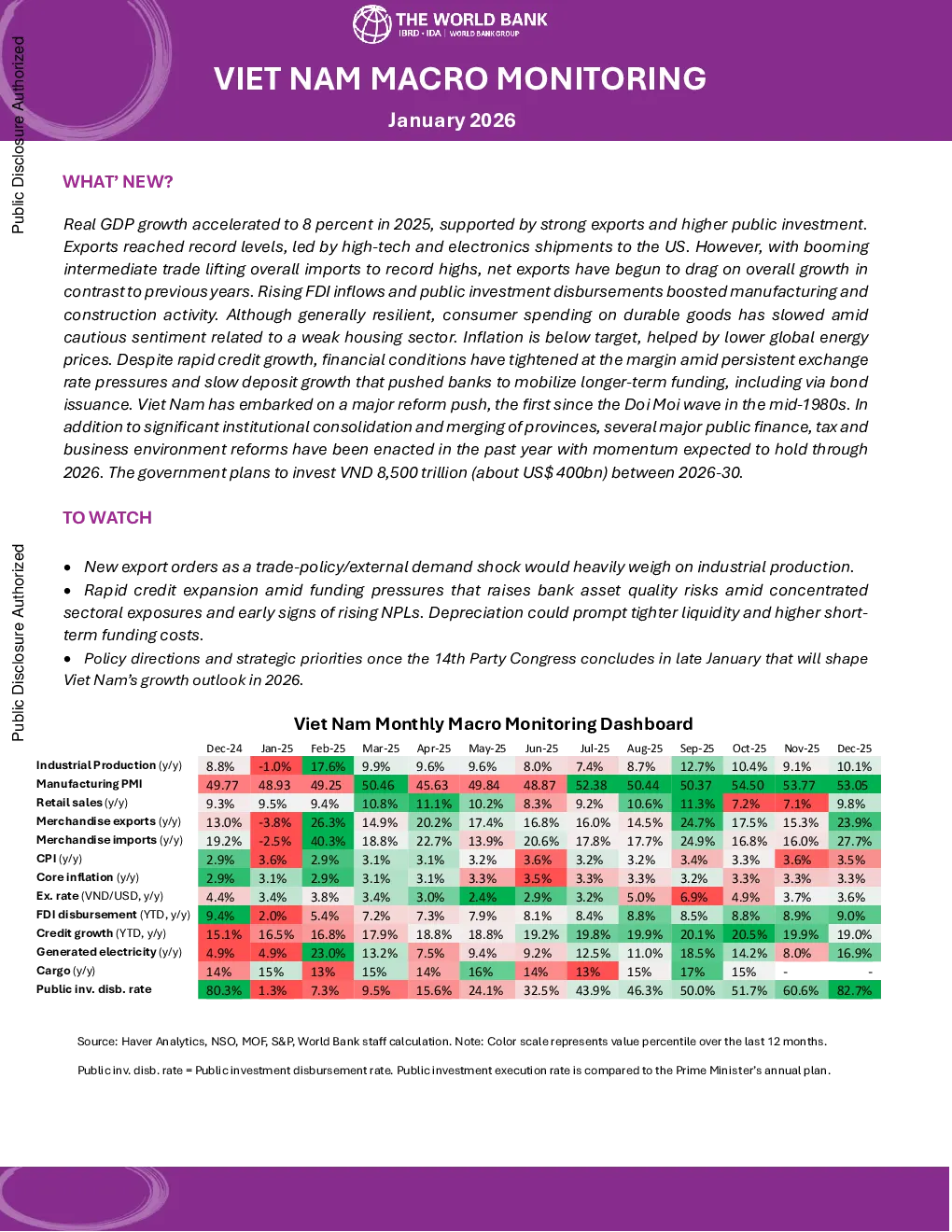
January 2026 WHAT’ NEW? Real GDP growth accelerated to 8 percent in 2025, supported by strong exports andhigher public investment.Exportsreached record levels, led by high-techand electronicsshipments to theUS.However,withboomingintermediatetrade liftingoverallimportsto record highs,net exports havebegun to drag on overall growthincontrast to previous years.RisingFDIinflowsand publicinvestmentdisbursements boostedmanufacturingandconstructionactivity.Although generally resilient, consumer spendingondurable goodshasslowedamidcautious sentimentrelated to a weak housingsector. Inflationisbelow target,helped bylowerglobal energyprices.Despite rapid credit growth, financial conditionshavetightened at the marginamid persistentexchangerate pressuresand slowdeposit growththatpushed banks to mobilize longer-term funding, including via bondissuance.VietNam has embarked on amajor reform push, the first since the Doi Moi wave inthe mid-1980s. Inaddition to significantinstitutionalconsolidation and merging of provinces, several majorpublic finance, tax andbusiness environmentreforms have been enacted in the past yearwithmomentum expected toholdthrough2026.The governmentplans to investVND8,500trillion (aboutUS$400bn) between 2026-30.Public Disclosure AuthorizedPublic Disclosure Authorized TO WATCH •New export ordersas a trade-policy/external demandshock wouldheavilyweigh on industrial production.•Rapid credit expansion amid funding pressuresthatraisesbank assetquality risksamid concentratedsectoral exposuresandearly signs of rising NPLs.Depreciation could prompt tighter liquidity and higher short-term funding costs.•Policy directions and strategic prioritiesoncethe 14th Party Congress concludes in late Januarythat willshapeViet Nam’s growth outlook in 2026. VIET NAM MACRO MONITORING January2026 Real GDP growth accelerated to 8 percent in 2025,upfrom7.1percentin2024(Figure 1), driven by bothrobustexports andhigher public investment.Exports rose by16.7 percentin 2025(vs14.5 percent in 2024),ledby high-techand electronicsshipments to theUSthatreached US$153 billion(28.1 percent higherthan 2024).Imports also increased markedly(19.4 percent), reflectinggrowingintermediatetrade(Figure 2).As a result,net exportsare an increasingdrag ongrowth, compared to2022–23(whentheycontributed 2 percentagepoints,Figure 1).In tandem,FDI disbursements reached US$27.6 billionin 2025, up 9 percenty/y (Figure 6),amid rising inflows from China and reconfiguration of regional value chains.Strongerexports, resilient FDI inflows, andhigherpublic investment boosted industrial activityand sentimentin 2025,liftingoutputby 9.2 percent (Figure 3)andkeepingmanufacturing PMIindiceswell abovethe 50 thresholdin the second half of the year(Figure 4).Arecovery inreal estate activity and faster publicinvestment(Figure 5)boosteddemandand activity in theconstructructionsector.Whileservices andessentials(food and clothing)spendingremained resilient,durablegoods purchaseshave slowedamidcautious sentiment.Tourism arrivals exceed pre-pandemic levels (21.2 million in 2025, +20.4 percentfrom2024)helping to support servicesector activity(Figure 7).Inflationremainedlow despite rapid credit growth and rising public and FDI investment; however exchange rate pressures persisted.Headline inflation averaged3.3 percent in 2025,below the4-4.5 percenttarget ratehelped bylowerglobal energyprices(Figure8).However, at 3.3 percent core inflation(excludingvolatile food, fuels, and administered prices) remainedrelativelyelevatedcompared topre-COVID levels,drivenby higherhousing costs.DespiterecentUSFederal Reservepolicyrate cuts,theDong weakenedby 3.6percent through2025as tradesurplusesnarrowedlimitingscope forrate cuts by the central bank. As a resultthe marketexchangeratehasremainednear the top of thecentral bank’s±5 percent band(Figure 9).The SBVhastightenedliquiditythrough OMO,reflected in risingovernight interbank rates inDecember 2025 (Figure 10)and adding strain to banks’ short-term funding conditions.Higher credit growth targets during 2025supported activity but also increased financial-sector risks. With thecentral bank raisingcredit targets for commercial banks to 19 percent from 16 percent at the start of2025, total credit reached~145percent of GDPin 2025,up19 percentfromthe previous year(Figure11),amongthe highest in theASEAN region.Maintaining prudent lending standards and close monitoring of creditquality remain essential to safeguard financial stability.With deposits growingmore slowlyand liquiditytightening,commercial banksissuedUS$16billion in bonds,an increase of+ 31percent(Figure 12)andabout70 percent of total corporate bond issuancein 2025,to secure medium-and long-term funding.2025 marked a transformative yearwithmajor institutional,legal and regulatoryreforms inititated.Abold administrativereform–mergingministries(from 18 to 14) and provinces (from 63 to 34)andeliminating districtlevel–aims toimprove administrative efficiency and speed up decision-makin