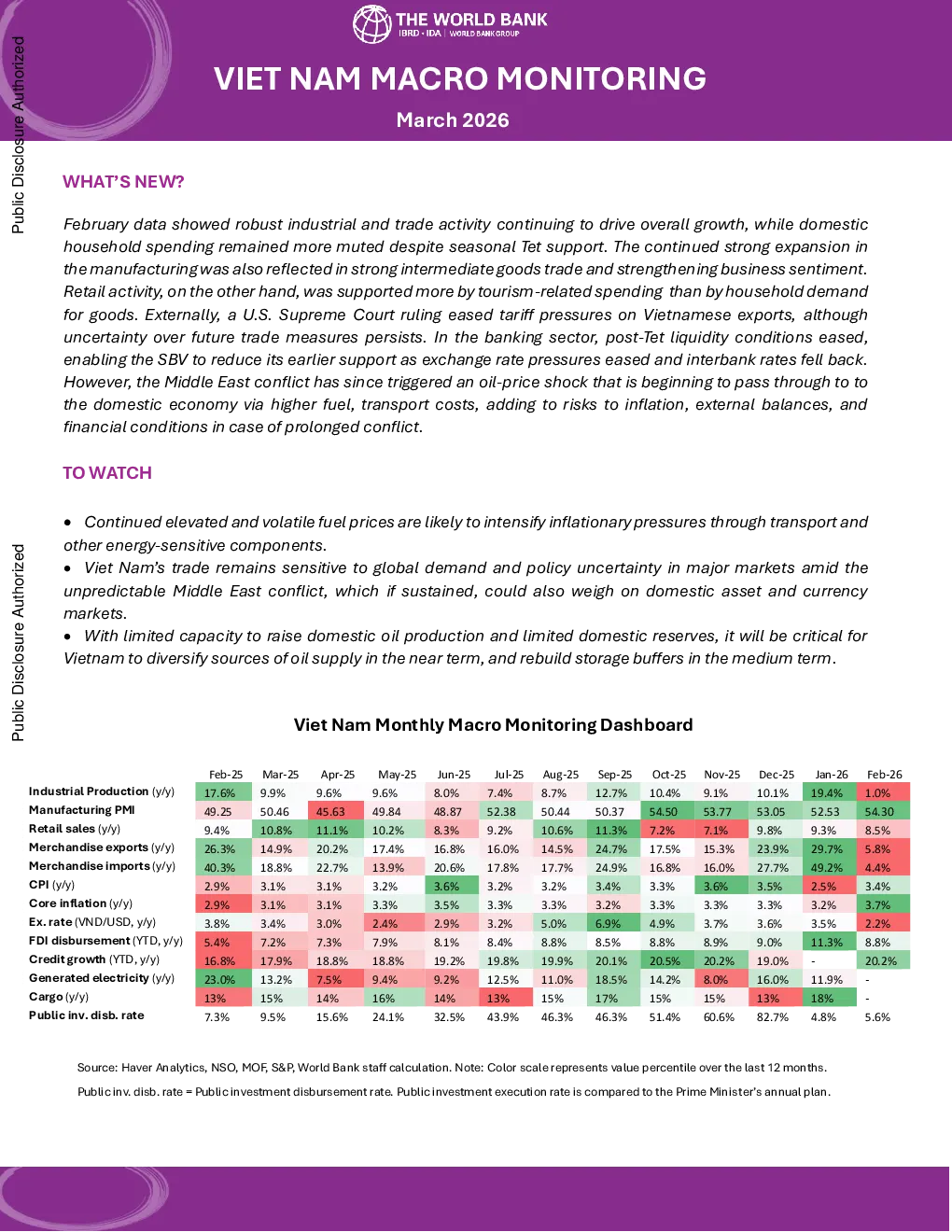
March2026 WHAT’SNEW? February datashowed robust industrial and trade activitycontinuing to drive overall growth, whiledomestichousehold spending remained more muteddespite seasonal Tet support.The continued strong expansion inthe manufacturingwas alsoreflected instrongintermediate goods tradeandstrengtheningbusiness sentiment.Retail activity, on the other hand, wassupported more by tourism-related spendingthan by household demandfor goods. Externally, a U.S. Supreme Court ruling eased tariff pressures on Vietnamese exports,althoughPublic Disclosure Authorized TO WATCHPublic Disclosure Authorized •Continued elevated and volatile fuel prices are likely to intensify inflationary pressuresthrough transport and •Viet Nam’s traderemains sensitive to global demandand policy uncertainty in major marketsamid theunpredictable Middle East conflict, which if sustained, could also weigh on domestic asset and currency •With limited capacity to raise domestic oil production and limited domestic reserves, it will be critical forVietnam todiversify sources of oil supply in the near term, and rebuild storage buffers in the medium term. Viet NamMonthlyMacro Monitoring Dashboard VIET NAM MACRO MONITORING March2026 February data present a mixed picture of Viet Nam’s economy, with production driving growth while domesticconsumptionremainedsubdued.Industrial productionrose by10.4 percentyear-on-year,in the first two monthsof 2026,1up from 7.5 percent in the same period of 2025. Manufacturing was themaindriver,led byconsumergoods, vehicles, and traditional exports (textiles, woodproducts), with theexpansionalso signaled in trade and PMIdata.While exportsrose18.1 percent in 2M-2026, imports surged by 25.9 percentamid growinginput demand(around 90 percent of imports were production materials).Business sentiment rose toPMI rising from 52.5 in February also saw a major U.S. trade policy development, with the Supreme Court striking down sweepingemergency tariffs easing tariff pressures on Viet Nam’s exports.Tariffs on Vietnamese goods fell by 2.8percentage points to 18.78 percent after the shift from IEEPA to Section 122 rates, delivering an estimated US$3.8billion in relief (0.74 percent of GDP). Viet Nam still holds a tariff advantage over China, Indonesia, and Cambodia,althoughit now faces higher tariffs than India. While the overall impact is positive, uncertainty remains over the July2026 expiry of Section 122,the possible reimposition of tariffs, stricter transshipment enforcement, and weaker Post-Tet liquidity conditions normalized, easing exchange rate pressures and enabling the SBV to shift frompre-holiday support to post-holiday liquidity withdrawal.After a brief spike, the USD/VND stabilized as systemliquidity improved(Figure 3), while the overnight interbank rate fell from 16.4 percent earlier in the month to2.8percent by February 26th, suggesting that the earlier stress was largely seasonal(Figure 4). Reflecting this The activation of the fuel stabilization fund has limited full pass-throughto domestic pricesfrom theMiddleEast conflictand higher oil prices.Brent crudesurgedaround 45 percent in two weeks (from~$72/bbl on 27February to$104/bbl as of 15March)and remainshighly volatile(Figure5).Thegovernment has partially shieldeddomestic prices by activating fuel stabilization fundsandsuspending import fuel taxes.With the price stabilizationfunddisbursing4,000 VND/liter for gasoline and 5,000 VND/liter for diesel, domestic fuel prices have stabilizedandare now4-14 percent highercompared to the pre-shock period for gasoline type, and17 percent higher for diesel(Figure 6).Every $10/bbl sustained price increase is estimated to add approximately 0.4ppts to headline inflation2.CPI is expected to increase in March led by higher transport fuel prices and second-round effects on electricity and Viet Namremainsvulnerable to prolonged supply disruptions in the Strait of Hormuz.Rising freight andinsurance costsare increasinglogistics expenses, weakeningcompetitiveness, andwill weigh oninvestment.Atthe same time, risk repricing can tighten financial conditions through wider spreads, capital outflows, and currencydepreciation.High trade-dependence (180 percent of GDP) increases sensitivity to external demand shocks VIET NAM MACRO MONITORING March2026 VIET NAM MACRO MONITORING March2026 Sources and notes: All data are from Haver and sourced from theNationalStatistics Office (NSO) of VietNam, except: Governmentbudget revenues and expenditures (Ministry of Finance); PMI and producer price inflation (survey by Nikkei and IHSMarkit); Purchasing Managers' Index is derived from a survey of 400 manufacturing companies and is based on fiveindividual indexes on new orders, output, employment, suppliers’ delivery times (and stock of items purchased). It isseasonally adjusted. A reading above 50 indicates an expansion of the manufacturing sector compared to the VIET NAM MACRO MONITORING March2026