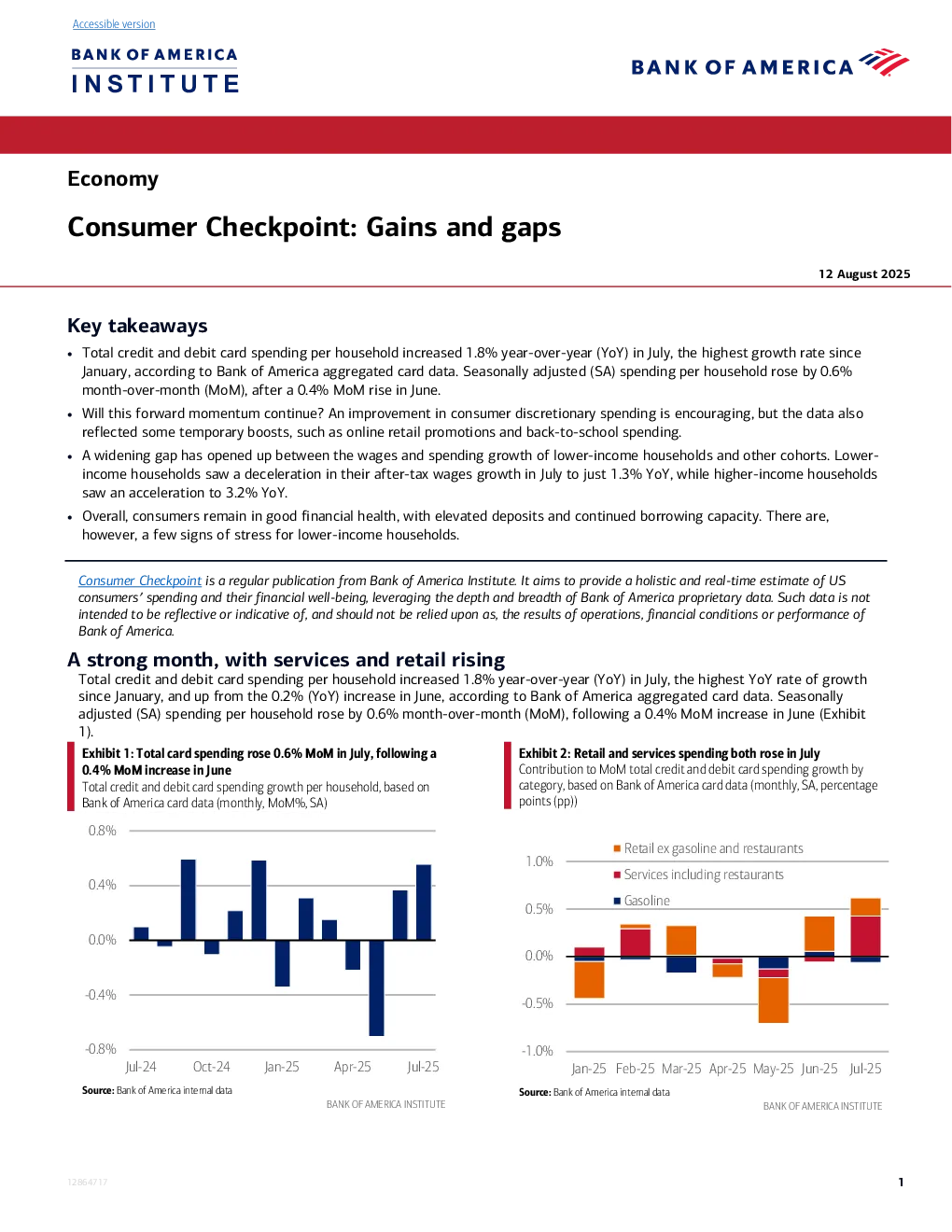
Consumer Checkpoint: Gains and gaps 12 August 2025 Key takeaways •Total credit and debit card spending per household increased 1.8% year-over-year (YoY) in July, the highest growth rate sinceJanuary, according to Bank of America aggregated card data. Seasonally adjusted (SA) spending per household rose by 0.6%month-over-month (MoM), after a 0.4% MoM rise in June. Will this forward momentum continue? An improvement in consumer discretionary spending is encouraging, but the data alsoreflected some temporary boosts, such as online retail promotions and back-to-school spending. •A widening gap has opened up between the wages and spending growth of lower-income households and other cohorts. Lower-income households saw a deceleration in their after-tax wages growth in July to just 1.3% YoY, while higher-income householdssaw an acceleration to 3.2% YoY. •Overall, consumers remain in good financial health, with elevated deposits and continued borrowing capacity. There are,however, a few signs of stress for lower-income households. Consumer Checkpointis a regular publication from Bank of America Institute. It aims to provide a holistic and real-time estimate of USconsumers’spending and their financial well-being, leveraging the depth and breadth of Bank of America proprietary data. Such data is notintended to be reflective or indicative of, and should not be relied upon as, the results of operations, financial conditions or performance ofBank of America. A strong month, with services and retail risingTotal credit and debit card spending per household increased 1.8% year-over-year (YoY) in July, the highest YoY rate of growth since January, and up from the 0.2% (YoY) increase in June, according to Bank of America aggregated card data. Seasonallyadjusted (SA) spending per household rose by 0.6% month-over-month (MoM), following a 0.4% MoM increase in June (Exhibit1). Exhibit1: Total card spending rose0.6% MoM in July, following a0.4% MoM increase in JuneTotal credit and debit card spending growth per household, based on Exhibit2: Retailand servicesspendingbothrose in JulyContribution to MoM total credit and debit card spending growth by category, based on Bank of America card data (monthly, SA, percentagepoints (pp)) Bank of America card data (monthly, MoM%, SA) Looking at the data in more detail, the rise in MoM total card spending in July was fairly broad based, with both retail andservices contributing (Exhibit 2), and services spending reversing after three months of declines. The 0.9% MoM servicesincrease was the largest since April 2024. Does this rise in spending mean that the weakening we saw in April and May is largely behind us? Perhaps, but there are reasonsto be cautious on that view. First, retail spending in July appears to have been boosted by online promotions by numerous retailers, such as‘Prime Day,’which lasted longer than in 2024 (Exhibit 3). This resulted in stronger online retail spending this year compared to the year prior(see our recent publication,Add to cart: Online shopping surges).Back-to-school (BTS) spending also appears to have picked upin July, following a slow start in June (Exhibit 4).In our view, strength in spending in both of these areas does not necessarilysay much about the underlying momentum of the consumer going forward, asthis spendingis, by nature, temporary and “eventdriven,”andcould reverse in subsequent months. Exhibit3:Total online retail spending aroundthePrime Dayperiodwas stronger than last year through all of JulyTotal online retail credit and debit card spending per household (Index, 7-day moving average of spending levels, 7-day moving average as of 16July 2024 = 100 and 8 July 2025 = 100) Another reason for caution: the spending gains may reflect some impact from tariffs. For one, it is possible some of the increasein spending was due to retailers passing through current or prospective tariff increases onto customers. When we look at thenumber of card transactions per household in July, we see a smaller rise than in dollar terms (Exhibit 5). Additionally, the August1stdeadline for countries to reach trade deals with the US may have also encouraged some consumers to“buy ahead”to avoidfuture price rises. Exhibit6:Airline and lodging spendingboth rose in July, whilerestaurant spending remained steadyCredit and debit card spending per household on select categories Exhibit5:Retail (excludinggas and restaurants) transactions rose0.3% MoM in July, less than the 0.4% rise in retail spendingRetail (excluding gas and restaurants) credit and debit card transactions (monthly, SA, July 2024=100) per household (monthly, SA, index January 2025=100) Still, one good sign in the July data is that the slowdown in consumer discretionary travel services eased, with airline and lodgingspending rising in July (Exhibit 6) compared to June, and restaurant and bar spending holding steady. If this rebound continues, itwould be good news for underlying momentum. A