您的浏览器禁用了JavaScript(一种计算机语言,用以实现您与网页的交互),请解除该禁用,或者联系我们。 [美国银行]:消费者检查点:2月份反弹 - 发现报告

消费者检查点:2月份反弹

商贸零售 2026-03-01 美国银行 @·*&&
报告封面

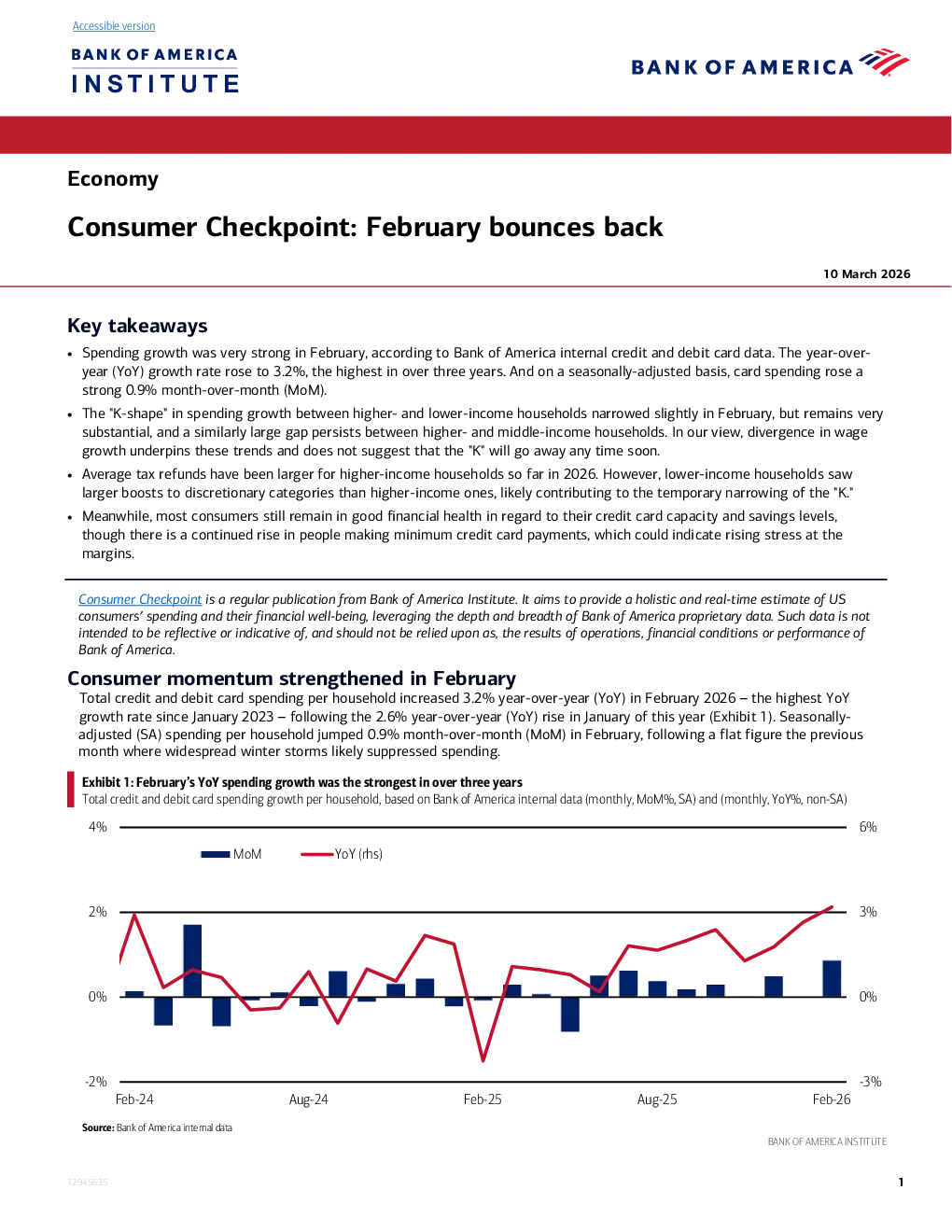
Consumer Checkpoint: February bounces back 10 March 2026 Key takeaways •Spending growth was very strong in February, according to Bank of America internal credit and debit card data. The year-over-year (YoY) growth rate rose to 3.2%, the highest in over three years. And on a seasonally-adjusted basis, card spending rose astrong 0.9% month-over-month (MoM). •The "K-shape" in spending growth between higher- and lower-income households narrowed slightly in February, but remains verysubstantial, and a similarly large gap persists between higher- and middle-income households. In our view, divergence in wagegrowth underpins these trends and does not suggest that the "K" will go away any time soon. •Average tax refunds have been larger for higher-income households so far in 2026. However, lower-income households sawlarger boosts to discretionary categories than higher-income ones, likely contributing to the temporary narrowing of the "K." •Meanwhile, most consumers still remain in good financial health in regard to their credit card capacity and savings levels,though there is a continued rise in people making minimum credit card payments, which could indicate rising stress at themargins. Consumer Checkpointis a regular publication from Bank of America Institute. It aims to provide a holistic and real-time estimate of USconsumers’spending and their financial well-being, leveraging the depth and breadth of Bank of America proprietary data. Such data is notintended to be reflective or indicative of, and should not be relied upon as, the results of operations, financial conditions or performance ofBank of America. Consumer momentum strengthened in FebruaryTotal credit and debit card spending per household increased 3.2% year-over-year (YoY) in February 2026–the highest YoY growth rate since January 2023–following the 2.6% year-over-year (YoY) rise in January of this year (Exhibit 1). Seasonally-adjusted (SA) spending per household jumped 0.9% month-over-month (MoM) in February, following a flat figure the previousmonth where widespread winter storms likely suppressed spending. Exhibit1:February’sYoYspending growthwasthe strongest inoverthreeyearsTotal credit and debit card spending growth per household, based on Bank of America internal data (monthly, MoM%, SA) and (monthly, YoY%, non-SA) Spending held up well in the Northeast despite winter storms in late FebruaryOverall February card-spending growth was solid across most of the US and likely benefited from a rebound in spending after January’s winter weather, which affected the South and eastern seaboard. Portions of the South saw more modest growth, likelyas some of the previous month’s winter storm impacts appear to have spilled over into early February (Exhibit 2). However,spending was decent for most of the month in the Northeast, despite blizzards suppressing growth in New York, New Jersey,Connecticut, Massachusetts and Rhode Island toward the end of February, according to Bank of America card data (Exhibit 3). Exhibit3:…despite notable YoY declines in late February due towinter stormsSpending growth by state (7-day moving average to February 28, YoY%, Exhibit2:Spending growth in the Northeast was solid YoY…Spending growth by state (28-day moving average to February 28, YoY%, (dark blue: >4%, light blue: 4% to 2%, orange: -2% to 2%, red: <-2%)) (dark blue: >4%, light blue: 4% to 2%, orange: -2% to 2%, red: <-2%)) Services still in the driver’s seat of card spending growthWhat are people spending on? Recent momentum looks fairly balanced between services and retail spending. Services spending reflects positive contributions from highly discretionary categories like lodging, airlines and food services, and a broader rangeof other services (Exhibit 4), though retail spending (excluding gasoline and food services) also shows positive growth. Gasoline spending has made little contribution to spending in recent months, up or down. But recent rises in the internationalprice of oil and the knock-on effect on gasoline prices may put some upward pressure on household spending in this category indue course, potentially chipping away at some discretionary spending. That said, it is too early to be sure–it will ultimatelydepend on the extent and duration of higher prices at the pump. Exhibit4:Services spendingisstillthe mainstay of overall spending momentumContribution to overall three-month on three-month credit and debit card spending growth by category (percentage points) The spending “K” narrows (temporarily?)The good news is that all income cohorts saw a rise in their three-month average YoY spending growth rates in February. In fact, the “K-shape” (or divergence) in spending growth between higher- and lower-income households narrowed slightly in February.Lower-income households spending growth was 1.1% YoY, 1.8 percentage points lower than higher-income households, at 2.9%.That is the lowest differential in growth between the cohorts in six month