消费者检查点:年轻消费者的早期皱纹
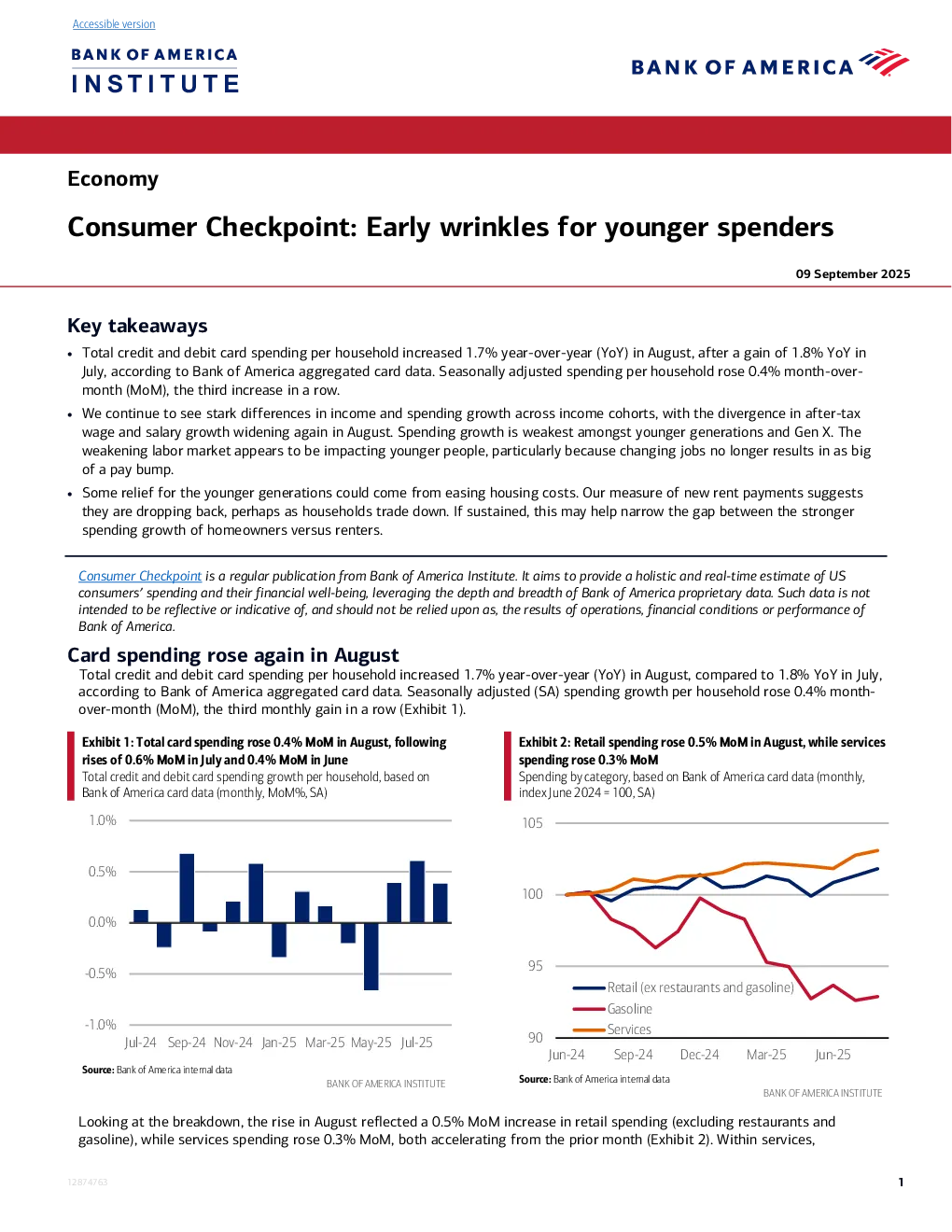
Consumer Checkpoint: Early wrinkles for younger spenders 09 September 2025 Key takeaways •Total credit and debit card spending per household increased 1.7% year-over-year (YoY) in August, after a gain of 1.8% YoY inJuly, according to Bank of America aggregated card data. Seasonally adjusted spending per household rose 0.4% month-over-month (MoM), the third increase in a row. •We continue to see stark differences in income and spending growth across income cohorts, with the divergence in after-taxwage and salary growth widening again in August. Spending growth is weakest amongst younger generations and Gen X. Theweakening labor market appears to be impacting younger people, particularly because changing jobs no longer results in as bigof a pay bump. •Some relief for the younger generations could come from easing housing costs. Our measure of new rent payments suggeststhey are dropping back, perhaps as households trade down. If sustained, this may help narrow the gap between the strongerspending growth of homeowners versus renters. Consumer Checkpointis a regular publication from Bank of America Institute. It aims to provide a holistic and real-time estimate of USconsumers’spending and their financial well-being, leveraging the depth and breadth of Bank of America proprietary data. Such data is notintended to be reflective or indicative of, and should not be relied upon as, the results of operations, financial conditions or performance ofBank of America. Card spending rose again in AugustTotal credit and debit card spending per household increased 1.7% year-over-year (YoY) in August, compared to 1.8% YoY in July, according to Bank of America aggregated card data. Seasonally adjusted (SA) spending growth per household rose 0.4% month-over-month (MoM), the third monthly gain in a row (Exhibit 1). Exhibit2: Retail spending rose0.5% MoMinAugust,whileservicesspending rose 0.3% MoMSpending by category, based on Bank of America card data (monthly, Exhibit1: Total card spending rose 0.4% MoM inAugust,followingrises of 0.6% MoM in July and 0.4% MoM in JuneTotal credit and debit card spending growth per household, based on index June 2024 = 100, SA) Bank of America card data (monthly, MoM%, SA) Looking at the breakdown, the rise in August reflected a 0.5% MoM increase in retail spending (excluding restaurants andgasoline), while services spending rose 0.3% MoM, both accelerating from the prior month (Exhibit 2). Within services, households increased their spending at restaurants and bars as well as airlines. Households also shelled out more in retailcategories including electronics, furniture, clothing, and general merchandise. Meanwhile, grocery spending was flat on themonth. By income category, we continue to see considerably weaker spending among lower-income households (Exhibit 3). In August,YoY spending growth for this cohort rose just 0.3%. By contrast, the gain was 2.2% YoY for higher-income households. Thesedivergences are also reflected in Bank of America deposit data on after-tax wage and salary growth. In August, after-tax wageand salary growth slipped to 0.9% YoY for lower-income households, the smallest gain since the start of the series in 2016, butrose to 3.6% YoY for higher-income households, the most since November 2021 (Exhibit 4). Exhibit3:Lower-income households'spending growth was 0.3%YoY in August, compared to 2.2% YoY for higher-incomehouseholds Exhibit4:In August higher-income wage growth rose to 3.6% YoY,while it moderated to 0.9% YoY for lower-income householdsAfter-tax wage and salary growth by household income terciles, based on Bank of America aggregated consumer deposit data (3-month movingaverage, YoY%, SA) Total credit and debit card spending per household, according to Bank ofAmerica card data, by household income terciles (3-month movingaverage, YoY%, SA) Younger shoppers are slowing their spendingGenerationally, spending growth continues to look relatively weak among younger consumers, though there are signs they are beginning to open their purse strings (Exhibit 5). In fact, Bank of America credit and debit card spending data shows thatspending among Gen Z and Millennial households rose 0.5% YoY in August, compared to 2.4% YoY for Baby Boomers andTraditionalists. But Gen X’s spending growth per household was also weak, gaining 0.1% YoY, significantly below that of BabyBoomers and Traditionalists, and even a little softer than younger generations. Exhibit5:Gen X spending growth has fallen below that of youngergenerations throughout 2025Total credit and debit card spending per household, based on Bank of Exhibit6: Gen X was thehighest spendinggeneration in 2023,reflecting its higher before-tax incomeHousehold shares by generation in numbers of households, total income before tax and total consumer spending (2023, % share) America data, by generation (three-month moving average, % YoY) It’s important to note why Gen X matters when it comes to consumer spending