消费者检查点:快乐但有节制
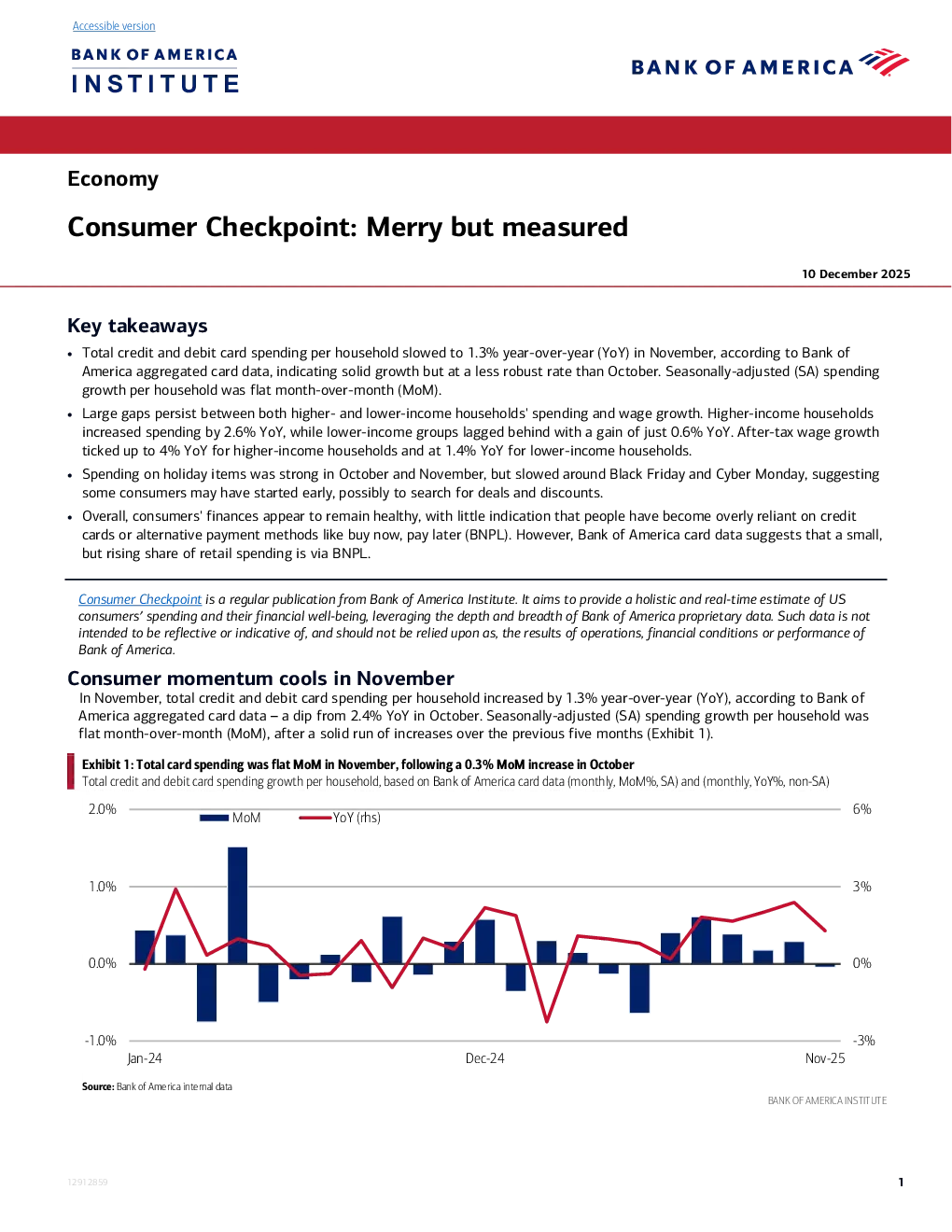
Consumer Checkpoint: Merry but measured 10 December 2025 Key takeaways •Total credit and debit card spending per household slowed to 1.3% year-over-year (YoY) in November, according to Bank ofAmerica aggregated card data, indicating solid growth but at a less robust rate than October. Seasonally-adjusted (SA) spendinggrowth per household was flat month-over-month (MoM). •Large gaps persist between both higher- and lower-income households' spending and wage growth. Higher-income householdsincreased spending by 2.6% YoY, while lower-income groups lagged behind with a gain of just 0.6% YoY. After-tax wage growthticked up to 4% YoY for higher-income households and at 1.4% YoY for lower-income households. •Spending on holiday items was strong in October and November, but slowed around Black Friday and Cyber Monday, suggestingsome consumers may have started early, possibly to search for deals and discounts. •Overall, consumers' finances appear to remain healthy, with little indication that people have become overly reliant on creditcards or alternative payment methods like buy now, pay later (BNPL). However, Bank of America card data suggests that a small,but rising share of retail spending is via BNPL. Consumer Checkpointis a regular publication from Bank of America Institute. It aims to provide a holistic and real-time estimate of USconsumers’spending and their financial well-being, leveraging the depth and breadth of Bank of America proprietary data. Such data is notintended to be reflective or indicative of, and should not be relied upon as, the results of operations, financial conditions or performance ofBank of America. Consumer momentum cools in NovemberIn November, total credit and debit card spending per household increased by 1.3% year-over-year (YoY), according to Bank of America aggregated card data–a dip from 2.4% YoY in October. Seasonally-adjusted (SA) spending growth per household wasflat month-over-month (MoM), after a solid run of increases over the previous five months (Exhibit 1). Total credit and debit card spending growth per household, based on Bank of America card data (monthly, MoM%, SA) and (monthly, YoY%, non-SA) Overall services spending dropped in November, but the past quarter has been solid otherwiseLooking across categories, retail spending (excluding gasoline and restaurants) was flat MoM, while services spending (including restaurants) declined (Exhibit 2). Within services, travel spending, including airlines and lodging, also saw declines, potentially inpart reflecting an impact from the government shutdown. However, despite the recent decreases,“discretionary”outlays such astravel and entertainment have still shown solid growth over the past quarter (Exhibit 3). Exhibit3:Travel, tourism and leisure are showing robustmomentumContribution to three-month on three-month services growth by Exhibit2:In November, services drove MoMtotalcard spendinggrowthContribution to MoM total credit and debit card spending growth by discretionary services category (quarterly, pp) category, based on Bank of America card data (monthly, SA, percentagepoints (monthly, pp)) Spending trends by income continue to show a K-shaped pattern: in November, lower-income households saw just 0.6% YoYgrowth in their three-month average total card spending, compared to a 2.6% increase for higher-income households (Exhibit 4).While spending gains softened across all income cohorts in November, middle-income households moderated the most, withspending growth up 1.4% YoY compared to the 1.7% YoY increase in October. Labor market trends likely remained a key driver, even as wage growth has stabilized a bit. After-tax wage and salary growthamong lower-income households continued to lag behind higher-income households (Exhibit 5). However, the deceleration inlower-income wage growth seen in the spring and summer appears to have leveled off. Exhibit5:InNovember, higher-income household wage growthticked up slightly to 4% YoY, while for lower-income households itincreased to 1.4% Exhibit4:Lower-incomehouseholds' spending growth was 0.6%YoY in November, compared to 2.6% YoY for higher-income peersTotal credit and debit card spending per household, according to Bank of America card data, by household income terciles (3-month movingaverage, YoY%, SA) After-tax wage and salary growth by household income terciles, based onBank of America aggregated consumer deposit data (3-month movingaverage, YoY%, SA) Holiday spending: Festive start, but chilled around Thanksgiving?Holiday spending–a key focus this time of year–appears relatively encouraging so far. Bank of America card data shows YoY spending growth for“holiday items”(defined below) rose 4.9% so far during the holiday period from the beginning of October tothe day after Cyber Monday (Exhibit 6). However, spending in the last seven days of this period was softer, at just 2.7% YoY. The relative weakness over the key Thanksgiving period may be, in our v