消费者检查点:抵御风暴
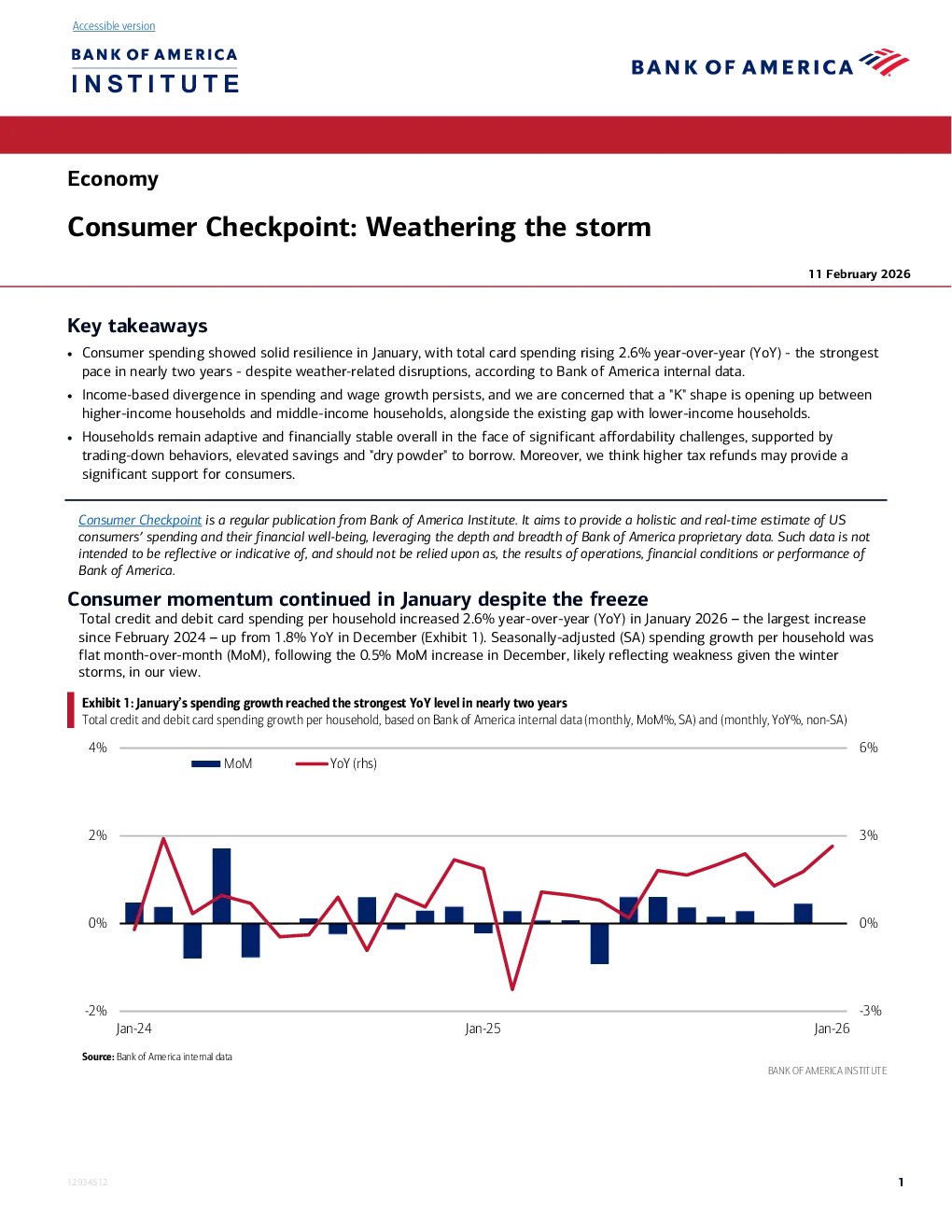
Consumer Checkpoint: Weathering the storm 11 February 2026 Key takeaways •Consumer spending showed solid resilience in January, with total card spending rising 2.6% year-over-year (YoY) - the strongestpace in nearly two years - despite weather‑related disruptions, according to Bank of America internal data. •Income‑based divergence in spending and wage growth persists, and we are concerned that a "K" shape is opening up betweenhigher-income households and middle-income households, alongside the existing gap with lower-income households.•Households remain adaptive and financially stable overall in the face of significant affordability challenges, supported bytrading‑down behaviors, elevated savings and "dry powder" to borrow. Moreover, we think higher tax refunds may provide asignificant support for consumers. Consumer Checkpointis a regular publication from Bank of America Institute. It aims to provide a holistic and real-time estimate of USconsumers’spending and their financial well-being, leveraging the depth and breadth of Bank of America proprietary data. Such data is notintended to be reflective or indicative of, and should not be relied upon as, the results of operations, financial conditions or performance ofBank of America. Consumer momentum continued in January despite the freezeTotal credit and debit card spending per household increased 2.6% year-over-year (YoY) in January 2026–the largest increase since February 2024–up from 1.8% YoY in December (Exhibit 1). Seasonally-adjusted (SA) spending growth per household wasflat month-over-month (MoM), following the 0.5% MoM increase in December, likely reflecting weakness given the winterstorms, in our view. Total credit and debit card spending growth per household, based on Bank of America internal data (monthly, MoM%, SA) and (monthly, YoY%, non-SA) Winter weather caused notable declines in spending along the East Coast and South toward the end of JanuaryLooking across the US, overall January card spending growth was strongest in regions untouched by bad weather, but more modest in major portions of the South and certain portions of the Midwest and Northeast (Exhibit 2). Yet, while spending wassolid throughout the month, winter storms toward the end of January led to significant declines in spending in affected regions,according to Bank of America internal data (Exhibit 3). Exhibit2:Southern states saw noticeably more modest YoYspending growth throughout January…Spending growth by state (28-day moving average to January 31st, YoY%, Exhibit3:…with notable YoY declinesacross major portions of theSouth and Northeast in the last week of JanuarySpending growth by state (7-day moving average to January 31st, YoY%, (blue: >2%, orange: -2% to 2%, red: <-2%)) (blue: >2%, orange: -2% to 2%, red: <-2%)) Is the “K” factor emerging for middle-income families as well?In our view, a“K-shape”(or divergence) in spending growth may be beginning to emerge between higher-income households and middle-income households, as opposed to just with lower-income households. In fact, in January, the gap in spending growthbetween higher-income households and all others was at its largest since mid-2022, according to Bank of America internal data.Lower- and middle-income households’spending growth ticked down to 0.3% and 1.0% YoY, respectively, while higher-incomehouseholds’spending was more stable at 2.5% YoY (Exhibit 4). A similar pattern is emerging in after-tax wage growth, with the gap between higher- and middle-income households at itslargest in nearly five years, according to Bank of America internal data (Exhibit 5). While higher-income households’wage growthwas 3.7% YoY in January, a solid improvement from the 3.3% YoY in December, middle-income families’wage growth saw only amarginal improvement, increasing to just under 1.6% YoY in January from over 1.5% in December. However, one positive is that the difference in wage growth between higher- and lower-income families does not appear to havewidened further from the peak last fall; lower-income households saw an average wage increase of 0.9% YoY in January. Exhibit5: InJanuary, higher-income households’wage growthwas3.7% YoY, while growth for lower- and middle-income householdswas approximately 0.9% and 1.6% YoY, respectivelyAfter-tax wage and salary growth by household income terciles, based on Exhibit4:Lower-income households' spending growth was 0.3%YoY in January, compared to 2.5% for higher-income householdsTotal credit and debit card spending per household, according to Bank of America card data, by household income terciles (3-month movingaverage, YoY%, SA) Bank of America aggregated consumer deposit data (3-month movingaverage, YoY%, SA) Consumers have adapted to the squeeze on affordability so farHouseholds have faced significant affordability challenges recently (read more inRegional Roundup: Mapping out affordability). For example, food at home and gasoline prices, as measured by the Bure