消费者检查点:夏季温度检查
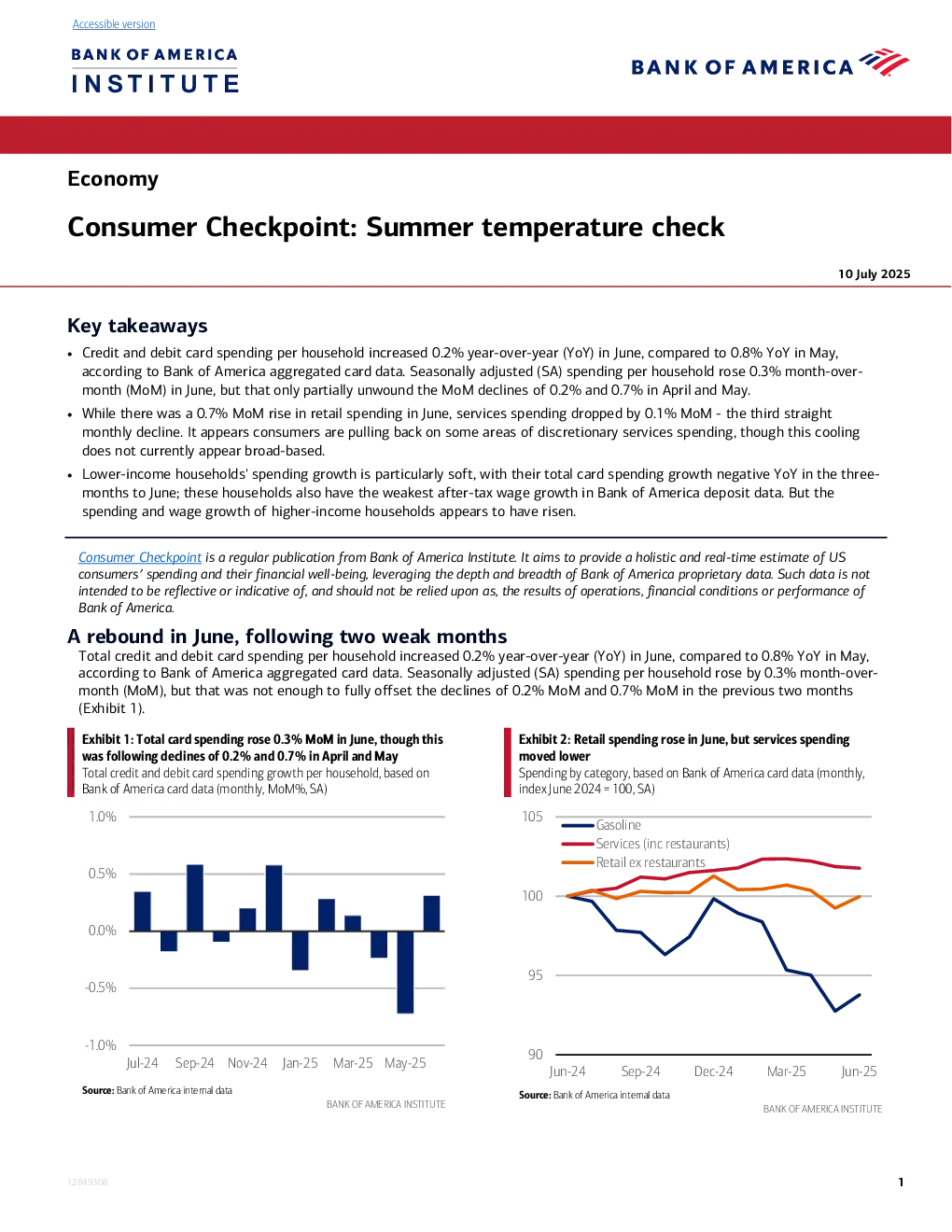
Consumer Checkpoint: Summer temperature check 10July2025 Key takeaways •Credit and debit card spending per household increased 0.2% year-over-year (YoY) in June, compared to 0.8% YoY in May,according to Bank of America aggregated card data. Seasonally adjusted (SA) spending per household rose 0.3% month-over-month (MoM) in June, but that only partially unwound the MoM declines of 0.2% and 0.7% in April and May. •While there was a 0.7% MoM rise in retail spending in June, services spending dropped by 0.1% MoM - the third straightmonthly decline. It appears consumers are pulling back on some areas of discretionary services spending, though this coolingdoes not currently appear broad-based. •Lower-income households' spending growth is particularly soft, with their total card spending growth negative YoY in the three-months to June; these households also have the weakest after-tax wage growth in Bank of America deposit data. But thespending and wage growth of higher-income households appears to have risen. Consumer Checkpointis a regular publication from Bank of America Institute. It aims to provide a holistic and real-time estimate of USconsumers’spending and their financial well-being, leveraging the depth and breadth of Bank of America proprietary data. Such data is notintended to be reflective or indicative of, and should not be relied upon as, the results of operations, financial conditions or performance ofBank of America. A rebound in June, following two weak monthsTotal credit and debit card spending per household increased 0.2% year-over-year (YoY) in June, compared to 0.8% YoY in May, according to Bank of America aggregated card data. Seasonally adjusted (SA) spending per household rose by 0.3% month-over-month (MoM), but that was not enough to fully offset the declines of 0.2% MoM and 0.7% MoM in the previous two months(Exhibit 1). Exhibit2: Retail spending rose in June, but services spendingmoved lowerSpending by category, based on Bank of America card data (monthly, Exhibit1: Total card spending rose 0.3% MoM in June, though thiswas following declines of 0.2% and 0.7% in April and MayTotal credit and debit card spending growth per household, based on Bank of America card data (monthly, MoM%, SA) index June 2024 = 100, SA) Looking at the detail, the rise in MoM total card spending was, somewhat unusually, due to a rise in retail spending (Exhibit 2).This rise was fairly broad-based: gasoline, grocery, clothing and general merchandise spending all rose (Exhibit 3). However,across most categories the rise in June was not enough to offset April and May declines. Meanwhile, electronics and furniturespending remained soft, likely in part reflecting the lingering impact coming from the unwinding of“buying ahead”of tariffs, asdiscussed in theJune Consumer Checkpoint. Spending byselect retail category, based on Bank of America card data (monthly, MoM%, SA) While the rise in retail spending is encouraging, in our view, it’s concerning that consumers appear to be spending lessenthusiastically on services, the mainstay of spending growth over the past few years. Services spending has now declined threemonths in a row on a seasonally adjusted basis–the first time it has fallen for three straight months in our data since 2008. Discretionary services growth has softenedWhen we dig into services spending, we find evidence of a continuing pull back in“nice to have”discretionary services spending momentum. Exhibit 4andExhibit 5show the contribution to YoY services growth from various sub-components. As we first highlighted inourApril Consumer Checkpoint, there are signs that the momentum in some areas of discretionary services spending, particularlytravel and tourism, has cooled off, while spending on“necessity”services categories remains more robust. One large outlay isproperty insurance (see:Insurance: Climbing coverage costs cut into consumer budgets), with utility bills also seeing anincreasing contribution (see also ourFebruary publication on utilities). Exhibit5:Insurance, rent and utilities have consistently drivennondiscretionary services spending growth over the past twoyearsContribution to YoY services growth by nondiscretionary services Exhibit4: Discretionary services spending,particularly in travel,appears to be contributing negatively to services growthContribution to YoY services growth by discretionary services category (3-month moving average, percentage points) category (3-month moving average, percentage points) What form of “easing back”?If some households are recalibrating their discretionary spending decisions, both in services and potentially discretionary goods, they could do so in several ways. For example, they could decide to reduce the amount they spend per shopping trip, make fewershopping trips each month, or even forgo some spending categories entirely. Looking across Bank of America card data at categories where spending tends to be a more discretionary decisi