您的浏览器禁用了JavaScript(一种计算机语言,用以实现您与网页的交互),请解除该禁用,或者联系我们。 [美国银行]:消费者检查点:两个钱包的故事 - 发现报告

消费者检查点:两个钱包的故事

商贸零售 2025-10-01 美国银行 话唠
报告封面

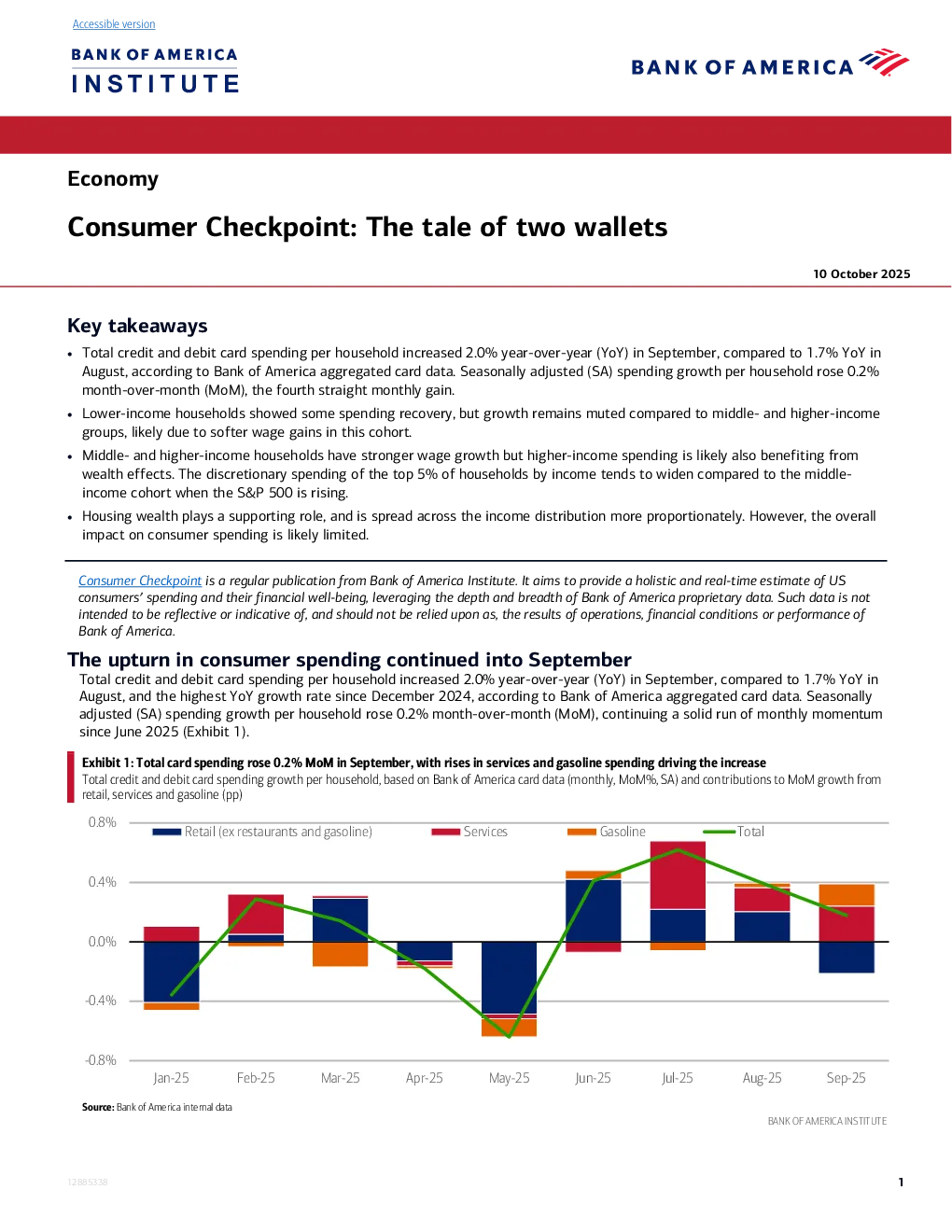
Consumer Checkpoint: The tale of two wallets 10 October 2025 Key takeaways •Total credit and debit card spending per household increased 2.0% year-over-year (YoY) in September, compared to 1.7% YoY inAugust, according to Bank of America aggregated card data. Seasonally adjusted (SA) spending growth per household rose 0.2%month-over-month (MoM), the fourth straight monthly gain. Lower-income households showed some spending recovery, but growth remains muted compared to middle- and higher-incomegroups, likely due to softer wage gains in this cohort. •Middle- and higher-income households have stronger wage growth but higher-income spending is likely also benefiting fromwealth effects. The discretionary spending of the top 5% of households by income tends to widen compared to the middle-income cohort when the S&P 500 is rising. •Housing wealth plays a supporting role, and is spread across the income distribution more proportionately. However, the overallimpact on consumer spending is likely limited. Consumer Checkpointis a regular publication from Bank of America Institute. It aims to provide a holistic and real-time estimate of USconsumers’spending and their financial well-being, leveraging the depth and breadth of Bank of America proprietary data. Such data is notintended to be reflective or indicative of, and should not be relied upon as, the results of operations, financial conditions or performance ofBank of America. The upturn in consumer spending continued into SeptemberTotal credit and debit card spending per household increased 2.0% year-over-year (YoY) in September, compared to 1.7% YoY in August, and the highest YoY growth rate since December 2024, according to Bank of America aggregated card data. Seasonallyadjusted (SA) spending growth per household rose 0.2% month-over-month (MoM), continuing a solid run of monthly momentumsince June 2025 (Exhibit 1). Exhibit1: Total card spending rose0.2% MoM in September, withrises in services and gasolinespendingdriving the increaseTotal credit and debit card spending growth per household, based on Bank of America card data (monthly, MoM%, SA) and contributions to MoM growth fromretail, services and gasoline (pp) In September, services and gasoline spending rose and contributed to the overall monthly gain. Within services, there was asmall decline in restaurant spending (down 0.1% MoM) and a larger drop in airline spending (down 1.0% MoM), with a rise inlodging (up 0.2% MoM). Overall, there has been a steady rebound in YoY discretionary services spending growth after a wobblein the spring (Exhibit 2). Exhibit3:There is some modest sign of upward price pressures intariff sensitive categoriesCard transactions per household (HH) and spending per household in Exhibit2:The rebound in discretionary services spending remainsintact Discretionary and non-discretionary services growth (3-month movingaverage, % YoY) select retail categories (% change July-September compared April-June) Retail reversal Retail spending (ex-gasoline and restaurants), on the other hand, declined 0.5% MoM in September. This might seem surprisinggiven some areas of goods spending are more exposed to price rises from tariffs–potentially pushing up the amount spent onthem even if the volume of goods didn’t change. Exhibit 3 shows that over the July-September period, the change in the numberof transactions in some categories of spending on certain tariff-exposed goods such as furniture was weaker than the change inthe amount spent on them, suggesting some upward price pressures beneath the surface. Still, this remains fairly modest so far. One reason for this modest impact is likely that retailers have not passed the full impact of tariffs through onto consumers.Another could be that consumers are being more selective in their purchases when they see price rises or more selective in howthey choose to spend their money. For example, when we look at spending on“durables”(e.g., electronics, autos, furniture, andbuilding materials) we find that over the last year, consumers across generations actually tended to favor premium goods ratherthan value ones (Exhibit 4). So, they may have some scope to throttle back on these premium purchases and thereby offset sometariff impacts. Divergences continue across income distribution Lower-income weakness The story of a wide divergence in spending growth between lower-income households and other cohorts remains, though thegap did not widen further. In September, the YoY spending growth of the lowest-income households was 0.6%, while that ofmiddle- and higher-income households was 1.6% and 2.6%, respectively (Exhibit 5). Looking at lower-income households in more detail, we find that all generations, aside from Gen Z, have seen a softening in theirspending growth over 2025 (Exhibit 6), however the rate of growth is weakest for Millennial and Gen X households. Exhibit6: Among lower-income households, all generations, asidefrom Gen Z, have see