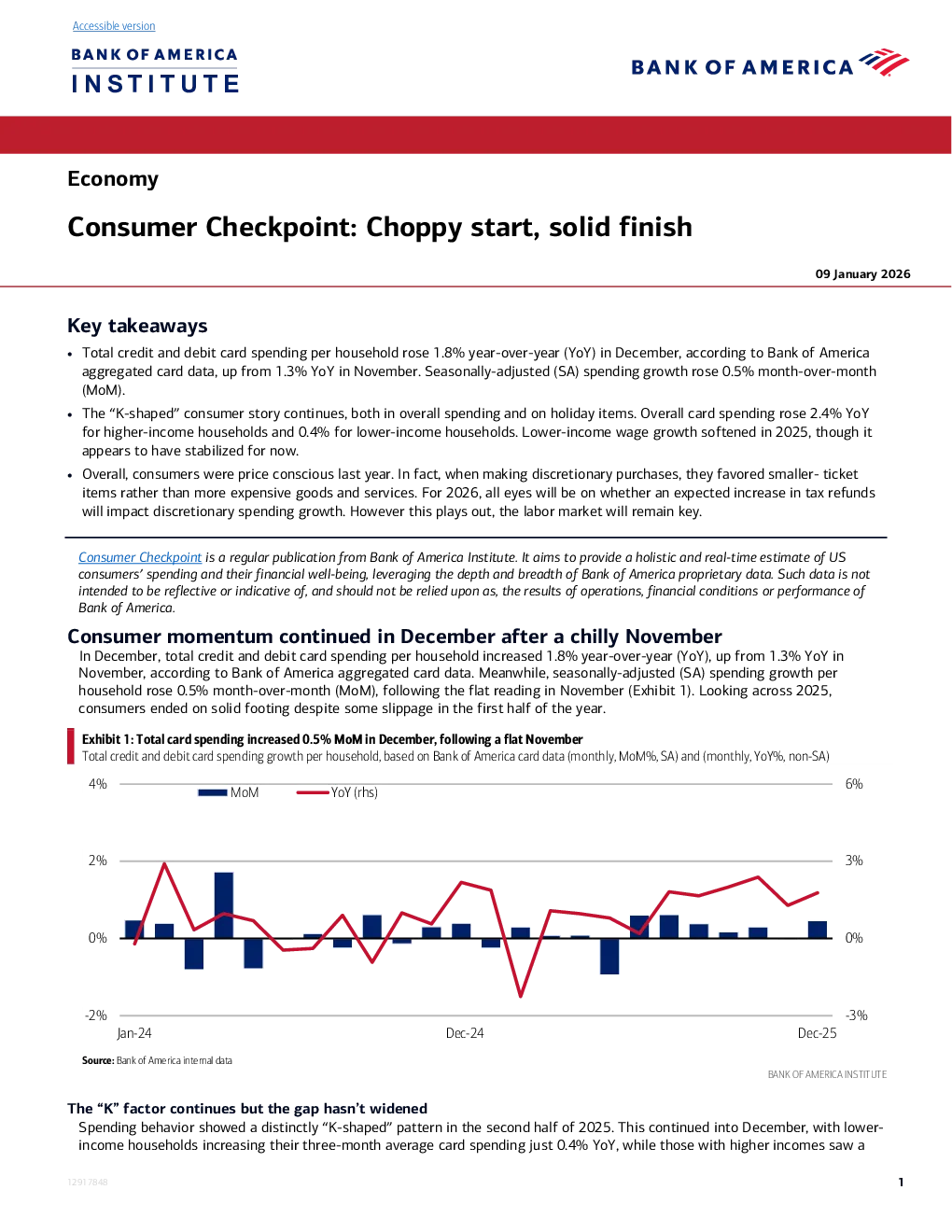
Consumer Checkpoint: Choppy start, solid finish 09 January 2026 Key takeaways •Total credit and debit card spending per household rose 1.8% year-over-year (YoY) in December, according to Bank of Americaaggregated card data, up from 1.3% YoY in November. Seasonally-adjusted (SA) spending growth rose 0.5% month-over-month(MoM). •The“K-shaped”consumer story continues, both in overall spending and on holiday items. Overall card spending rose 2.4% YoYfor higher-income households and 0.4% for lower-income households. Lower-income wage growth softened in 2025, though itappears to have stabilized for now. •Overall, consumers were price conscious last year. In fact, when making discretionary purchases, they favored smaller- ticketitems rather than more expensive goods and services. For 2026, all eyes will be on whether an expected increase in tax refundswill impact discretionary spending growth. However this plays out, the labor market will remain key. Consumer Checkpointis a regular publication from Bank of America Institute. It aims to provide a holistic and real-time estimate of USconsumers’spending and their financial well-being, leveraging the depth and breadth of Bank of America proprietary data. Such data is notintended to be reflective or indicative of, and should not be relied upon as, the results of operations, financial conditions or performance ofBank of America. Consumer momentum continued in December after a chilly NovemberIn December, total credit and debit card spending per household increased 1.8% year-over-year (YoY), up from 1.3% YoY in November, according to Bank of America aggregated card data. Meanwhile, seasonally-adjusted (SA) spending growth perhousehold rose 0.5% month-over-month (MoM), following the flat reading in November (Exhibit 1). Looking across 2025,consumers ended on solid footing despite some slippage in the first half of the year. Total credit and debit card spending growth per household, based on Bank of America card data (monthly, MoM%, SA) and (monthly, YoY%, non-SA) The “K” factor continues but the gap hasn’t widenedSpending behavior showed a distinctly“K-shaped”pattern in the second half of 2025. This continued into December, with lower- income households increasing their three-month average card spending just 0.4% YoY, while those with higher incomes saw a 2.4% gain (Exhibit 2). While the gap remains around 2 percentage points (pp), it has been relatively stable over the past sixmonths (read more in theDecember employment report). Weaker wage growth for lower- and middle-income households explains part of the disparity. However, it appears the differencein wage growth is not widening further (Exhibit 3). In particular, lower-income wage growth was 1.1% YoY in December, a slightdip from 1.4% YoY in November. But middle-income households’after-tax wage growth dropped back by more–to 1.5% YoYfrom 2.3% YoY in November–while higher-income households’wage growth dropped to 3.0% YoY from 3.7% YoY in November.Some of this softening may prove temporary, but bears watching as it could impact spending if it persists. Exhibit3:InDecember, higher-and middle-income household wagegrowth slowed to 3% YoY and 1.5%, respectively, while for lower-income households it ticked down to 1.1% YoYAfter-tax wage and salary growth by household income terciles, based on Exhibit2:Lower-income households’spending growth was 0.4%YoY in December, compared to 2.4% for higher-income peersTotal credit and debit card spending per household, according to Bank of America card data, by household income terciles (3-month movingaverage, YoY%, SA) Bank of America aggregated consumer deposit data (3-month movingaverage, YoY%, SA) More than O-K – A bright holiday seasonAs for the overall holiday season, spending growth was strong. Although, it seemed to lose a little momentum around Thanksgiving and early December, suggesting that consumers shopped early. Even so, during the holiday period–from thebeginning of October to January 2–Bank of America card data shows spending on holiday items (defined below) increased 4.7%YoY (Exhibit 4). Exhibit5:Holiday spending growth was strong in October andNovember, but cooled slightly in December across all incomecohorts Exhibit4:Holiday spending was strong early on, but slowed in lateNovember and early December before strengthening againCard spending per household for holiday items, based on Bank of America card data (7-day moving average, index July 2023 average = 100) Card spending per household for holiday items, based on Bank of Americacard data, by household income tercile (monthly, YoY%) While the“K-shape”also persisted in holiday shopping, the gap was considerably smaller than the divergence in total cardspending, according to Bank of America card data (Exhibit 5). With cost-of-living issues still looming, in our view, it’s likely thatconsumers were able to stretch their dollars and shop smart by looking for deals. Lower-income households, in particul