AI智能总结
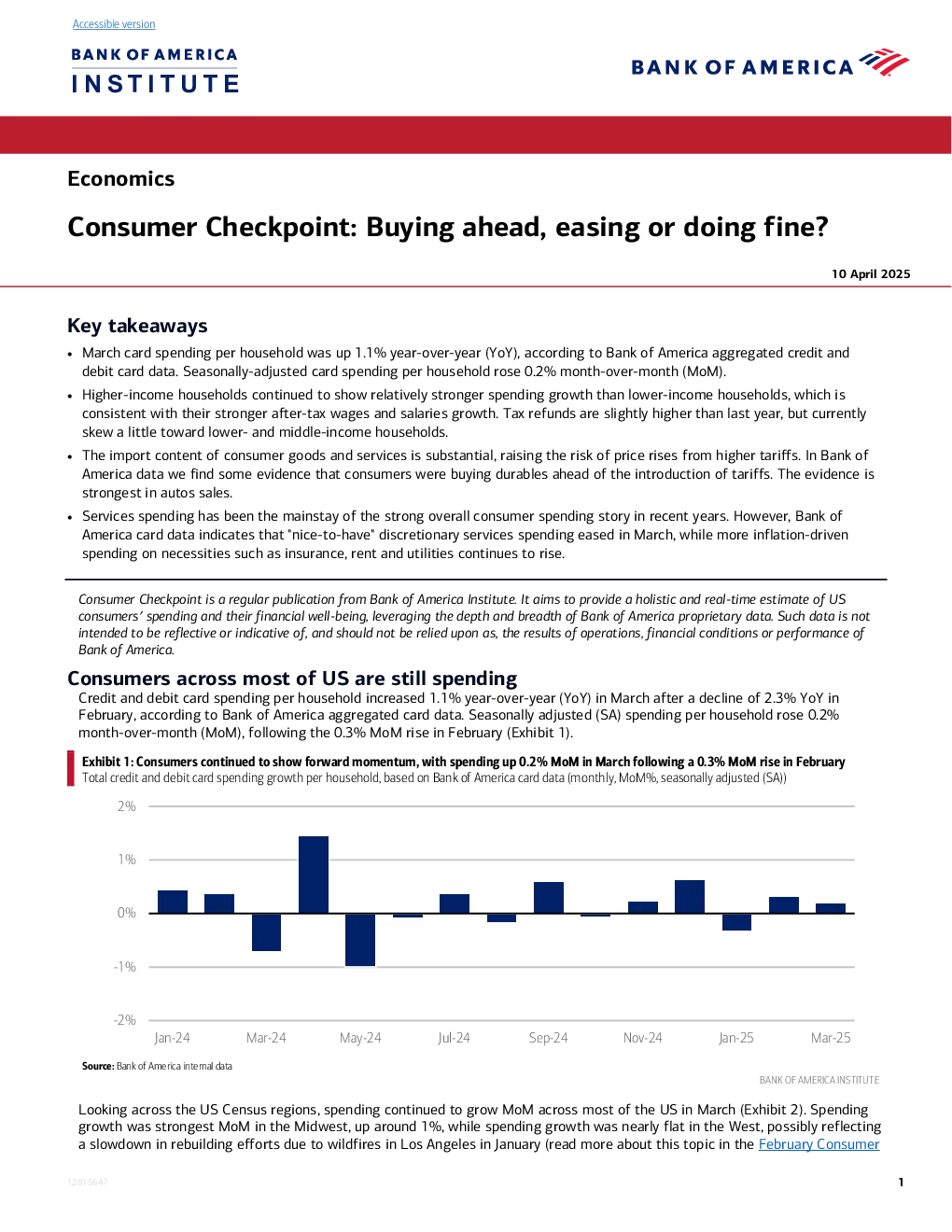
Consumer Checkpoint: Buying ahead, easing or doing fine? 10 April 2025 Key takeaways •March card spending per household was up 1.1% year-over-year (YoY), according to Bank of America aggregated credit anddebit card data. Seasonally-adjusted card spending per household rose 0.2% month-over-month (MoM). •Higher-income households continued to show relatively stronger spending growth than lower-income households, which isconsistent with their stronger after-tax wages and salaries growth. Tax refunds are slightly higher than last year, but currentlyskew a little toward lower- and middle-income households. •The import content of consumer goods and services is substantial, raising the risk of price rises from higher tariffs. In Bank ofAmerica data we find some evidence that consumers were buying durables ahead of the introduction of tariffs. The evidence isstrongest in autos sales. •Services spending has been the mainstay of the strong overall consumer spending story in recent years. However, Bank ofAmerica card data indicates that "nice-to-have" discretionary services spending eased in March, while more inflation-drivenspending on necessities such as insurance, rent and utilities continues to rise. Consumer Checkpoint is a regular publication from Bank of America Institute. It aims to provide a holistic and real-time estimate of USconsumers’spending and their financial well-being, leveraging the depth and breadth of Bank of America proprietary data. Such data is notintended to be reflective or indicative of, and should not be relied upon as, the results of operations, financial conditions or performance ofBank of America. Consumers across most of US are still spendingCredit and debit card spending per household increased 1.1% year-over-year (YoY) in March after a decline of 2.3% YoY in February, according to Bank of America aggregated card data. Seasonally adjusted (SA) spending per household rose 0.2%month-over-month (MoM), following the 0.3% MoM rise in February (Exhibit 1). Looking across the US Census regions, spending continued to grow MoM across most of the US in March (Exhibit 2). Spendinggrowth was strongest MoM in the Midwest, up around 1%, while spending growth was nearly flat in the West, possibly reflectinga slowdown in rebuilding efforts due to wildfires in Los Angeles in January (read more about this topic in theFebruary Consumer Checkpoint). In DC, spending growth rebounded MoM in March, but the level of spending in the Washington, DC-Arlington-Alexandria metropolitan statistical area (MSA) was still lower than other cities relative to six months prior (Exhibit 3). Exhibit2: Spending continued to grow MoM across most of the US,but flattened in the West in March Exhibit3:Spending in the Washington,DC MSA bounced back inMarch, though remains lower than other cities relative to October2024 Total credit and debit card spending per household by census region(March 2025, SA, MoM% and YoY%) Aggregated credit and debit card spending growth per household forWashington DC and select eastern MSAs (monthly, SA, index, October2024=100) The muted spending growth in DC came as the number of households receiving unemployment income in Bank of Americadeposit accounts in this city increased by 135% in March compared to the 2024 average (Exhibit 4). But it’s important to notethat the 2024 levels of households receiving unemployment payments started from a very low point and a strong recent jobsreport suggests the overall US labor market remains in good shape. So, while attempts to reduce the size of the federal workforce may be contributing to some slowing of consumer spending inWashington, DC, the rise in unemployment in March was flat MoM for the overall United States. We would continue tocharacterize the US consumer as having some underlying forward momentum as of March. Lower-income households showing slowing wage growthLooking at spending by income, we see a consistent trend: higher-income households show no clear sign yet of easing their spending. The top third of households by income (which accounts for over half of overall US consumer spending according to Bureau of Economic Analysis data) have largely had higher card spending growth than middle- or lower-income peers for morethan a year (Exhibit 5). In our view, that’s likely because those at the top of the income scale have seen stronger relative after-tax wage and salarygrowth. In fact, their growth accelerated over 2024 and into 2025 after a period of weakness in 2023. However, the pace ofgrowth for higher-income households broke a four-month acceleration streak in March 2025, with after-tax wage and salarygrowth for this cohort up 2.6% YoY in March versus 3.6% in February. And, notably, after-tax wage growth for lower-incomehouseholds was just 1.4% YoY, the lowest rate of wage growth since April 2017, according to Bank of America deposit data(Exhibit 6). Exhibit6: Wage growth for higher-income householdseased backto 2.6% YoY in Marc