世界知识产权组织杂志,第2/2012期(4月)
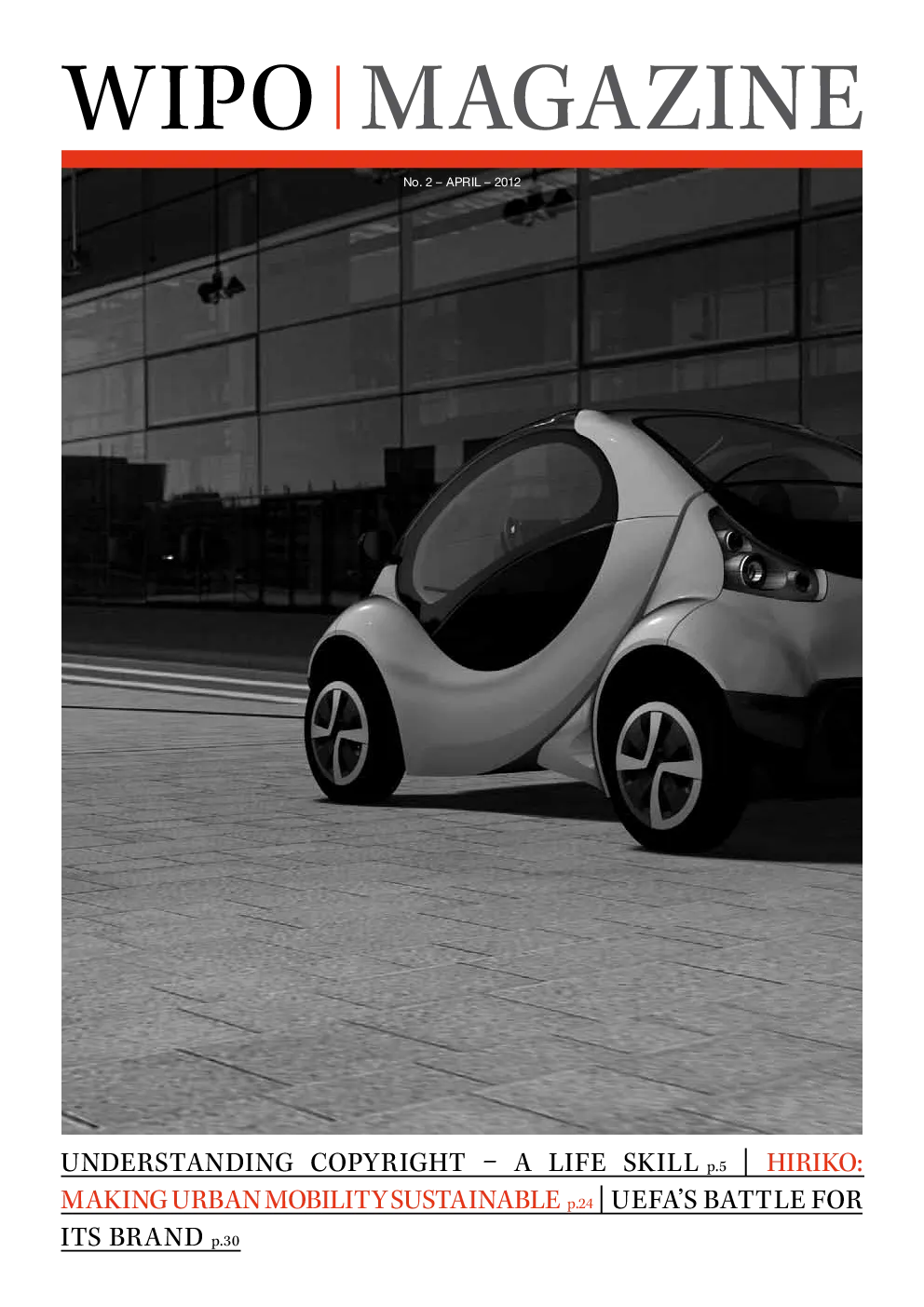
World Intellectual Property Day – April 26MessagefromDirectorGeneralFrancis Gurry World Intellectual Property Day is an opportunity tocelebrate the contribution that intellectual propertymakes to innovation and cultural creation – andthe immense good that these two social phenomenabring to the world. was awarded two Nobel prizes in two separatedisciplines – in physics and in chemistry – the onlyperson ever to have achieved this. In the arts, innovation revolves around new waysof seeing things. A visionary artist or a composeror a writer is able to show us a different way, a newway of looking at the world. Bob Dylan, for example:he captured what was in the air and transformedseveral genres of music, essentially bending thegenres of folk and rock music. Or consider architects– like Zaha Hadid or Norman Foster – who aretransforming urban landscapes, and beautifying ourexistence in new ways, while at the same time takinginto account the need to preserve the environment. It is an opportunity to create greater understandingabout the role of intellectual property as a balancingmechanism between the competing interests whichsurround innovation and cultural creation: theinterests of the individual creator and those ofsociety; the interests of the producer and those of theconsumer; the interest in encouraging innovationand creation, and the interest in sharing the benefitsthat derive from them. We are dependent upon innovation to move forward.Without innovation we would remain in the samecondition as a human species that we are in now.Yet inventions or innovations – in the health fieldfor example – are of relatively little value to societyunless they can be used and shared. This is thegreat policy dilemma. On the one hand, the cost ofinnovation in modern medicine is enormous. On theother hand, the need for compassion, and the needfor sharing useful innovations, is also enormous. This year the theme of World IP Day isvisionaryinnovators– people whose innovations transformour lives. Their impact is enormous. They can, attimes, change the way society operates. Take the Chinese innovator, Cai Lun. He laid thefoundations for the manufacturing of paper – atechnology that transformed everything, becauseit enabled the recording of knowledge. Then therewas the invention of moveable type. This wastaken up in Europe by Johannes Gutenberg withhis invention of the printing press, which in turnenabled the dissemination and democratization ofknowledge. In our own lifetimes we have witnessedthe migration of content to digital format, and thegreat distributional power for creative works thathas been brought about by the Internet and thedevelopment of the World Wide Web – for whom wehave to thank, among others, Tim Berners Lee. I believe we should look upon intellectual propertyas an empowering mechanism to address thesechallenges. But we have to get the balances right, and that iswhy it is so important to talk about intellectualproperty. On this World Intellectual Property DayI would encourage young people in particular tojoin in the discussion, because intellectual propertyis, by definition, about change, about the new. It isabout achieving the transformations that we wantto achieve in society. Behind many extraordinary innovations there areextraordinary human stories. At a time when therewere few female scientists, Marie Curie Sklodowskahad to struggle to establish herself as a scientist inher own right as opposed to the wife of a scientist.She also struggled as an immigrant working inanother community. Her desire to understandled to the fundamental discoveries for which she Contents p–2Publishers: the Midwives of Literaturep–5Understanding Copyright – A Life Skillp–9Uncorking Georgia’s Winemaking Potentialp–14Panama: Three Marks for Developmentp–20The Evolution of Technology Markets: SeparatingFact from Fictionp–24Hiriko: Making Urban Mobility Sustainablep–29Chile Reforms R&D Lawp–30UEFA’s Battle for its Brandp–35In the News Editor:Catherine JewellGraphic Designer:Annick DemierreCover image:Hiriko (Afypaida) Acknowledgements:p–5:Carlos Castrop–9:Matthijs Geuzep–14:Francesca Toso,Nathalie Montillotp–30:Marcus Höpperger ©World IntellectualProperty Organization Publishers–the Midwives of Literature What does the digital revolution mean to the publishing industry? RichardCharkin, Executive Director of Bloomsbury Publishing, the home of HarryPotter books and countless other bestsellers, believes it is the greatest op-portunity for a generation to transform the business. Mr. Charkin recentlysat down with WIPO Magazine and shared his views about the opportunitiesand challenges confronting the industry today. What is the role of a publisher? We try to spot talented writers and help them make their books better. We encouragewriting and then we tell the world about it. We collect money on the author’s behalfand try to make a profit on the way. Part of our role is to put readers in touch with authors and vice versa but it