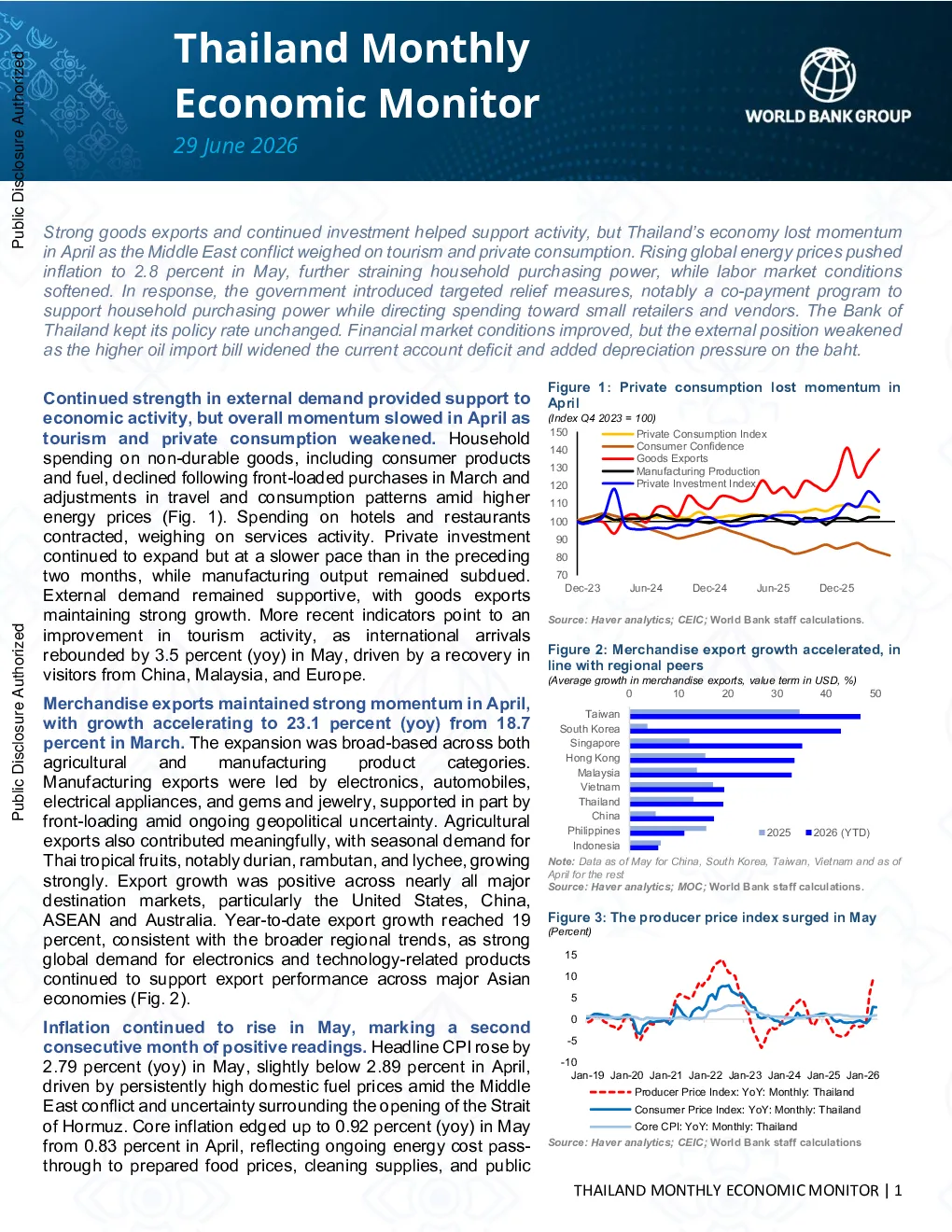
Monitor29 June 2026 Strong goods exports and continuedinvestmenthelped support activity,butThailand’s economy lost momentumin April asthe Middle East conflict weighedontourism and private consumption.Rising global energy prices pushedinflation to2.8 percentin May,further straininghousehold purchasing power, while labor market conditionssoftened. In response, the government introduced targeted relief measures, notablyaco-payment programtosupport household purchasing power while directing spending toward small retailers and vendors. The Bank ofThailand kept its policy rate unchanged. Financial marketconditionsimproved, but the external position weakenedasthe higher oil import billwidened the current account deficit and addeddepreciationpressure on the baht.Public Disclosure Authorized Continued strength in external demand provided support toeconomic activity, but overall momentum slowed in April astourismand private consumption weakened.Householdspending on non-durable goods, including consumer productsand fuel, declined following front-loaded purchases in March andadjustments in travel and consumption patterns amid higherenergy prices(Fig.1).Spending on hotels and restaurantscontracted, weighing on services activity. Private investmentcontinued to expand but at a slower pace than in the precedingtwomonths, while manufacturing output remained subdued.External demand remained supportive,with goods exportsmaintaining strong growth.More recent indicators point to animprovementin tourism activity,as international arrivalsrebounded by 3.5 percent (yoy) in May, driven by a recovery invisitors from China,Malaysia, and Europe.Public Disclosure Authorized Merchandise exports maintained strong momentum in April,with growth accelerating to 23.1 percent (yoy) from 18.7percent in March.The expansion was broad-based across bothagriculturalandmanufacturingproductcategories.Manufacturing exports were led by electronics, automobiles,electrical appliances, and gems and jewelry, supported in part byfront-loading amid ongoing geopolitical uncertainty. Agriculturalexports also contributed meaningfully, with seasonal demand forThai tropical fruits, notably durian, rambutan, and lychee, growingstrongly.Export growth was positive across nearly all majordestinationmarkets,particularly the United States,China,ASEAN and Australia.Year-to-dateexport growthreached19percent, consistent with the broader regional trends, as strongglobal demand for electronics and technology-related productscontinued to support export performance across major Asianeconomies(Fig. 2).Public Disclosure Authorized Inflationcontinued to rise in May,marking a secondconsecutive month of positive readings.Headline CPI roseby2.79 percent(yoy)in May,slightly below2.89 percentin April,driven bypersistently highdomestic fuel pricesamidthe MiddleEast conflict and uncertainty surrounding theopeningof the Straitof Hormuz. Core inflation edged up to 0.92 percent (yoy) in Mayfrom 0.83 percent in April, reflecting ongoing energy cost pass-through to prepared food prices, cleaning supplies, and publicPublic Disclosure Authorized transport fares (Fig 4). The five-month average headline CPI(January–May 2026) stood at 0.82 percent (yoy).Electricity priceinflationremainednegativeas regulated tariffs, adjusted onlyevery four months, were kept unchanged from January to April.Upstream price pressures have also intensified, with the producerprice indexrising by8.5 percent(yoy), pointing to continued costpressures ahead(Fig. 3). Figure 4:Inflation increased intransportsectors, foodand consumer products(percent, year-on-year) BOT signaled that it would maintain the policy rate at 1.0percent,viewing the recent increase in inflation astemporary. Inflation is expected to begin easing in Q2 2027 tothe 1–3 percent target range. BOT projects 2026 GDP growth at2.3percent, up from a prior estimate of 1.5 percent, reflecting theexpectedimpact of the fiscal stimulus package,strongermomentum in the technology and AI cycle lifting merchandiseexportsand private investment,and an improving outlooksurrounding the Middle East conflict.Growth is expected tomoderate to 1.8percent in 2027 as the stimulus-related baseeffectfades. Labormarketconditionssoftenedamidweakeninghousehold incomes.Theunemployment rate edged up to 0.94percent in Q1,equivalent to about390,000 persons, up from 0.89percentduring the same period last year (Fig. 5). Long-termunemployment,defined asthose out of work for more than oneyear, increased sharply by 27 percentto87,000 persons. At thesame time, real incomesweakenedwithaverage monthly wagesdecliningby 0.6 percent to THB 16,145, while earnings amongthe self-employed fell by 2.5 percent.Togetherwith elevatedliving costs, these trends are eroding household purchasingpower. Thecombinedpressures fromhigherenergy-related costsand technology-driven structural changes in the labor marketposea growing risk to household income growth andconsumption resilience. The "Thai Helps Thai