您的浏览器禁用了JavaScript(一种计算机语言,用以实现您与网页的交互),请解除该禁用,或者联系我们。 [世界银行]:泰国月度经济监测,2026年3月 - 发现报告

泰国月度经济监测,2026年3月

文化传媒 2026-04-03 世界银行 💤 👏
报告封面

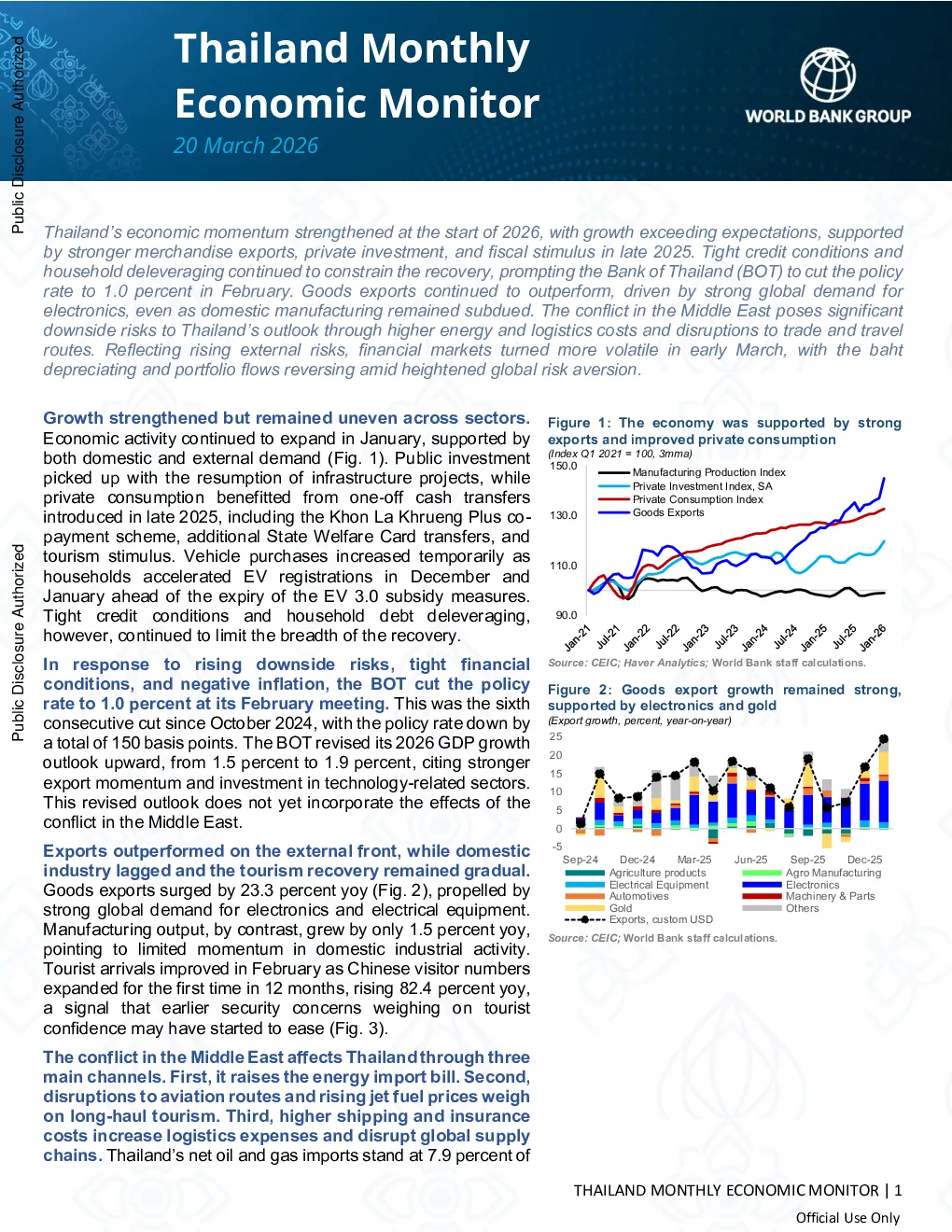
Monitor20 March 2026 Thailand’s economic momentumstrengthened atthestartof 2026, with growthexceedingexpectations,supportedby stronger merchandise exports, private investment, and fiscal stimulusin late 2025.Tight credit conditions andhousehold deleveraging continued to constrain the recovery,promptingthe Bank of Thailand(BOT)tocut the policyrate to 1.0 percent in February.Goodsexportscontinued tooutperform,drivenbystrong global demand forelectronics,even asdomestic manufacturing remained subdued.The conflict in the Middle EastposessignificantPublic Disclosure Authorized Growth strengthened but remained uneven across sectors. Economic activity continued to expand in January, supported byboth domestic and external demand(Fig.1).Public investmentpicked upwiththe resumption of infrastructure projects, whileprivateconsumption benefitted from one‑off cash transfersintroduced in late 2025, includingtheKhon La Khrueng Plus co-payment scheme, additional State Welfare Card transfers, andPublic Disclosure Authorized Inresponse to rising downside risks,tight financialconditions,andnegativeinflation,theBOTcut the policyrateto1.0 percent at its February meeting.Thiswas the sixthconsecutivecut since October 2024, with the policy rate down bya total of 150 basis points.The BOTrevised its 2026GDP growthPublic Disclosure Authorized Exports outperformedon the external front,while domestic industry laggedandthetourism recovery remained gradual.Goodsexportssurgedby23.3 percent yoy(Fig.2), propelled bystrong global demand for electronics andelectrical equipment.Manufacturing output, by contrast,grew byonly 1.5 percent yoy, The conflict in the Middle East affects Thailand through threemainchannels. First, it raises the energyimportbill. Second,disruptions to aviation routes and rising jet fuel prices weighon long-haul tourism. Third,higher shipping and insurance GDP, the highest in ASEAN.To cushion the domestic impact ofhigherglobal oil prices,the government has implementedtemporarypricestabilization measures. Authorities capped theretail diesel price at 29.98 baht per liter forat least15 days,at anestimated cost of roughly 700 million baht per day,while alsoholdingcooking gas prices steady,financed through theState OilFund.As a result, the Fundturned intodeficit in thesecondweekofMarch,reaching THB 15 billion(Fig.4).Authoritiessubsequentlyraised the diesel price cap to 33.0 baht per literfrom March 18,allowing prices to adjust gradually upward. EvolvingUStrade policy developments present bothupsideand downsideriskstoThailand’s export outlook.FollowingtheU.S. Supreme Courtruling, Thailand’s effective tariffrate inthe U.S. market declined to 17.3percent,fromthe previous 19.4percent,providing modest short-term relief for exporters.However, this arrangement will apply for only 150 days, leavinguncertainty over the future tariff regime. In parallel, the U.S. TradeRepresentative has launched a Section 301 investigation intoThailandto assess potential unfair trade practices, with hearings Thai financial markets turned more volatile in early Marchamid rising global riskaversion.The Thai baht depreciated inearly March, reversingpart ofits appreciation since November2025,as the Middle East conflict triggered global risk-offsentiment and strengthened the U.S. dollar(Fig.5). Reflectingheightenedglobal uncertainty,net portfolio flows from both Source:Haver analytics;World Bank staff calculations. Rising public spending has widened the fiscal deficit andpushed public debt closer to the statutory ceiling.Thecentralgovernment deficit widenedin the first four months of FY2026,asbothcurrent and capital spending accelerated.Public debtincreasedto 66.0 percent of GDP in January,around 20percentage points above pre-pandemic levels,reinforcingtheimportance of aligning near‑term support measures with the