您的浏览器禁用了JavaScript(一种计算机语言,用以实现您与网页的交互),请解除该禁用,或者联系我们。 [世界银行]:泰国月度经济监测,2025年11月 - 发现报告

泰国月度经济监测,2025年11月

信息技术 2025-11-25 世界银行 徐红金
报告封面

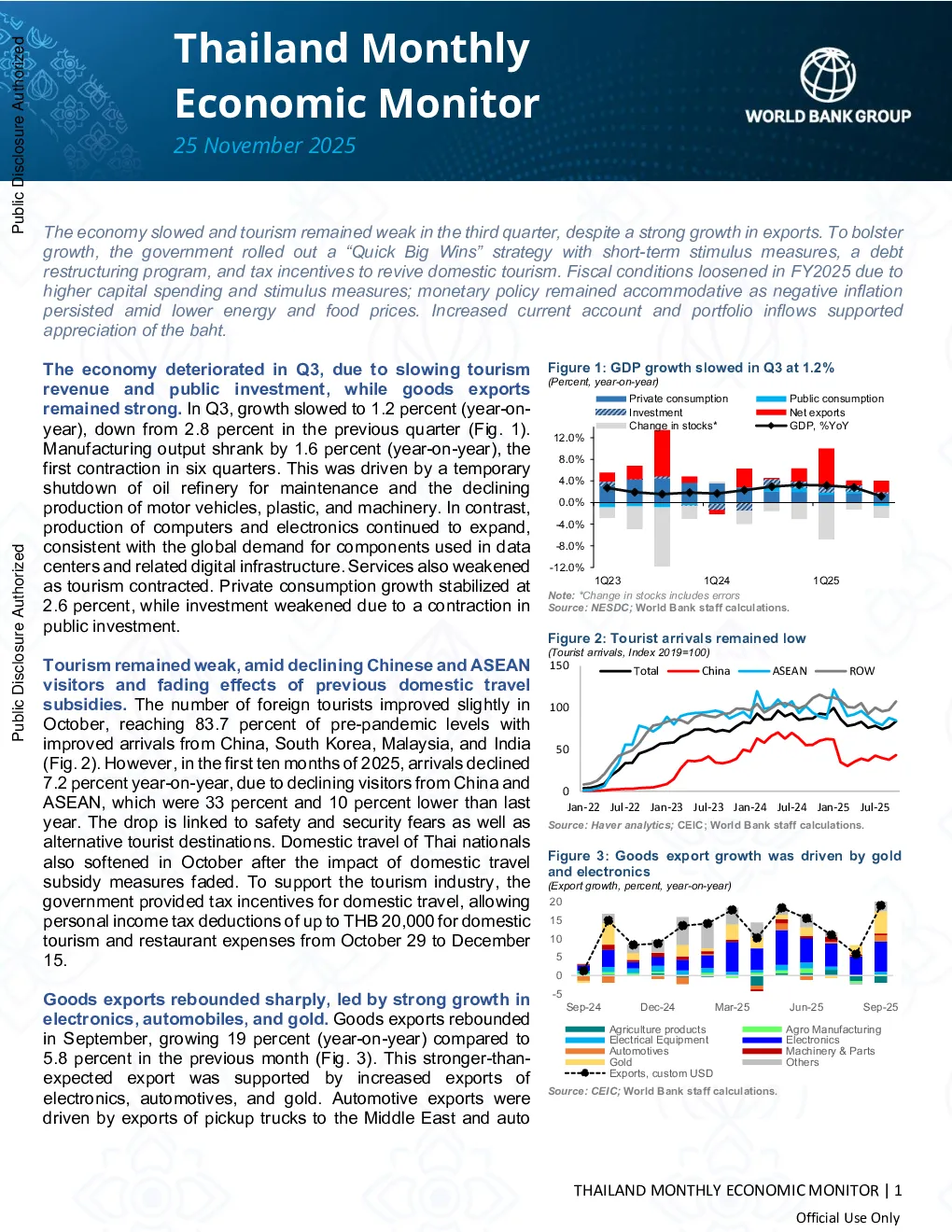
Monitor25 November 2025 The economyslowedand tourism remained weakin the third quarter,despiteastrong growth inexports. To bolstergrowth,the government rolled out a“Quick Big Wins” strategy with short-term stimulus measures,a debtrestructuring program,and tax incentivesto revivedomestictourism. Fiscal conditions loosenedin FY2025due tohigher capital spending andstimulusmeasures;monetary policy remained accommodative asnegative inflationpersistedamid lower energy and food prices.Increased current account and portfolio inflows supportedappreciation of the baht.Public Disclosure Authorized The economy deteriorated in Q3, due toslowingtourismrevenueand public investment,while goods exportsremained strong.InQ3,growthslowed to1.2 percent (year-on-year), down from 2.8 percent in the previous quarter(Fig. 1).Manufacturingoutputshrankby1.6percent (year-on-year),thefirst contraction in six quarters. This wasdriven byatemporaryshutdownof oil refinery for maintenance and the decliningproduction of motor vehicles,plastic,and machinery. In contrast,production ofcomputersandelectronics continuedto expand,consistent with the global demand for components used in datacenters and related digital infrastructure.Servicesalso weakenedastourism contracted.Private consumption growth stabilized at2.6 percent, whileinvestment weakened due toacontraction inpublic investment.Public Disclosure Authorized Tourism remained weak,amid declining Chinese and ASEANvisitorsand fading effects of previous domestic travelsubsidies.The number of foreigntouristsimprovedslightlyinOctober,reaching 83.7 percent of pre-pandemic levels withimproved arrivals fromChina,South Korea,Malaysia,and India(Fig. 2).However,inthe firsttenmonths of 2025, arrivals declined7.2percent year-on-year,due to declining visitors fromChinaandASEAN,which were33percentand 10 percentlower than lastyear.The drop is linked tosafety and securityfearsas well asalternative touristdestinations.Domestic travel of Thai nationalsalso softened in October after the impact of domestic travelsubsidymeasuresfaded.To support the tourism industry, thegovernment providedtaxincentivesfor domestic travel,allowingpersonal income tax deductions of up to THB 20,000 for domestictourism and restaurant expensesfrom October29to December15.Public Disclosure Authorized Goods exports rebounded sharply, led by strong growth inelectronics, automobiles, and gold.Goods exportsreboundedinSeptember,growing19percent(year-on-year) compared to5.8percentin the previousmonth(Fig.3). Thisstronger-than-expectedexport was supported by increased exports ofelectronics,automotives,and gold.Automotive exports weredriven by exports of pickup trucks to the Middle East and autoPublic Disclosure Authorized partsto ASEAN,Japan,and the US.Electronics exportscontinued togrowasthey are exempt fromthe US’reciprocaltariffsand global demand continued to rise.Gold exportsincreased due to profit-taking by traders following a 90+percentsurge in prices over the past two years.Falling exportsof durianand ricecontributed to contraction in agriculturaloutput. The central government's fiscal deficit widenedin FY2025,promptingeffortstosustainmedium-term fiscal discipline.In FY 2025, the central government's fiscal deficit (GFS basis)widened to2.9percent of GDP, up from 2.4percent a year earlierandabovepre-pandemic levels (Fig.4).The increased deficitwas supported mainly by higher capital expenditure, as budgetexecution normalizedfollowinglast year’s delay. On the revenueside, the tax revenue increased due to slightly higher VAT andpersonal income tax collection, as well as higher excise revenuefrom the removal ofa fuel tax cut.In FY 2025, public debtincreasedto64.8percent of GDP, from63.2percent last fiscalyear.To sustain fiscal discipline and confidence in fiscalmanagement, the government set a target to reduce the fiscaldeficit to below 3 percent of GDP by 2029 and keep public debtunder 70 percent of GDPas part of the revisedMedium-TermFiscal Framework (MTFF). Tostimulate domestic demand and provide near-termhouseholdsupport,Thailand has introduced short-termmeasures financed through the existing approved budget.Key policies include the Khon La Kruengplus(“Half-half”) co-payment scheme, providing around THB 60 billion in subsidiesfor purchases by over 30 million people to stimulate retail andrestaurant spending.Thesubsidycan beusedfrom October29toDecember31.Complementing these demand-side measures,the government maintained energy subsidies to ease the cost ofliving, including electricity price caps atTHB4.18 per unit anddieseland gasolinepricesreductions through the Oil Fund. In addition, the government rolled outadebt restructuringprogram aimed at easing household debt and restoringcredit access by transferring small borrowers’ NPLs to assetmanagementcompanies.The program targets small-scaledebtors(total NPLs belowTHB 100,000 as of September 30)andaims to help borrowers with repayment potential clear their baddebt records from the N