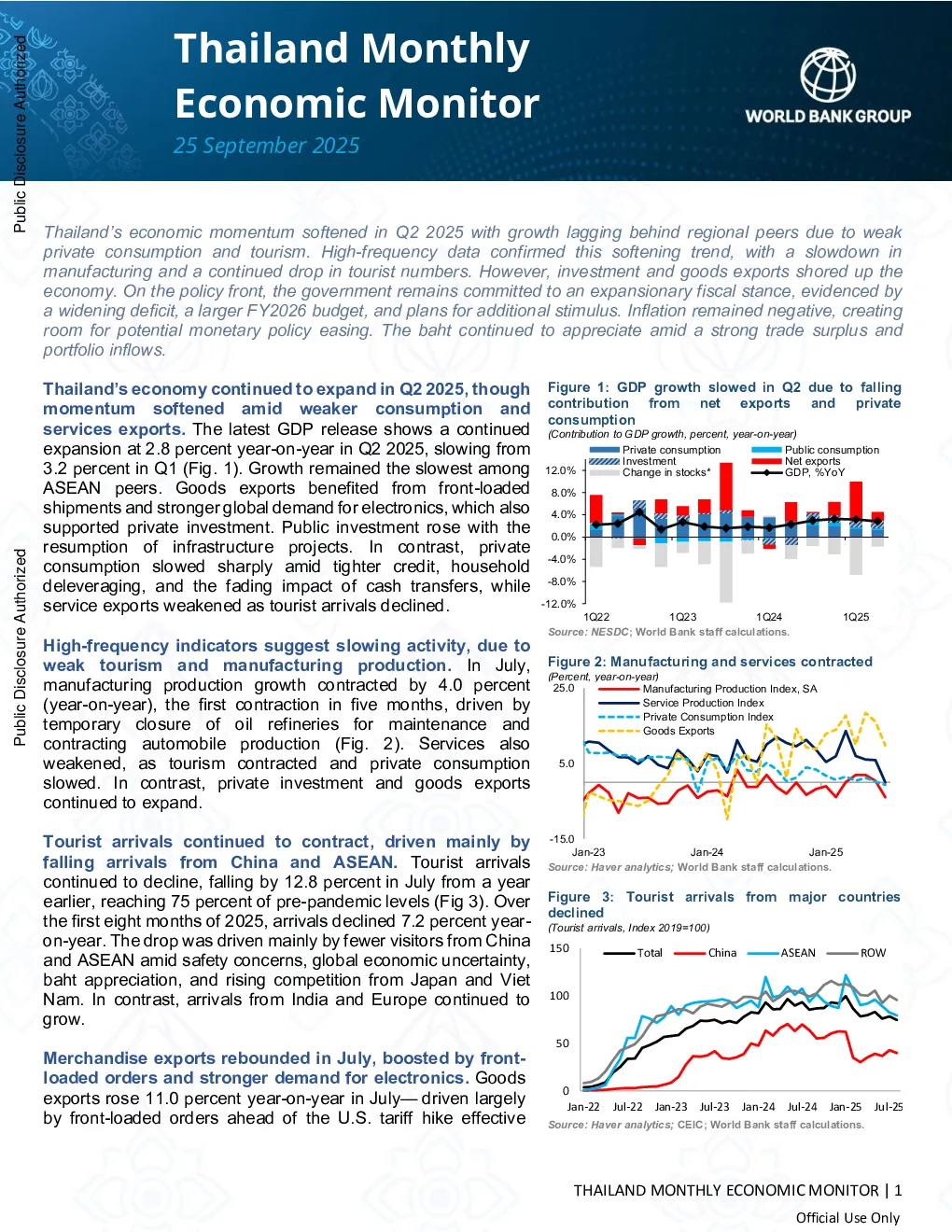
Monitor25 September 2025 Thailand’seconomicmomentum softenedinQ22025with growth lagging behind regional peers due to weakprivate consumption and tourism.High-frequency data confirmed this softening trend,with a slowdown inmanufacturing and a continued drop in tourist numbers.However,investment and goods exportsshored up theeconomy.On the policy front,the government remains committed to an expansionary fiscal stance, evidenced byPublic Disclosure Authorized Thailand’s economy continued to expand in Q2 2025, thoughmomentumsoftened amid weaker consumption andservices exports.The latest GDP release showsa continuedexpansion at 2.8 percent year-on-year inQ22025, slowing from3.2 percent in Q1(Fig. 1).Growth remained the slowest amongASEANpeers.Goods exports benefited from front-loadedshipmentsand stronger global demand for electronics, which alsoPublic Disclosure Authorized High-frequency indicators suggestslowing activity, due toweaktourism and manufacturing production.In July,manufacturingproduction growth contracted by 4.0 percent(year-on-year),the first contraction in five months, driven bytemporaryclosure of oil refineries for maintenance and Tourist arrivals continued to contract, driven mainly byfallingarrivals from China and ASEAN.Tourist arrivalscontinued to decline,fallingby12.8 percentin Julyfrom a yearearlier, reaching 75 percent of pre-pandemic levels(Fig3). Overthe first eight months of 2025, arrivals declined 7.2 percent year-on-year. The drop wasdriven mainly by fewervisitors from China Merchandise exports rebounded in July,boosted by front-loaded orders and stronger demand for electronics.Goodsexports rose11.0percent year-on-year in July—driven largely Source: Haver analytics;CEIC;World Bank staff calculations. THAILANDMONTHLYECONOMIC MONITOR |1 August 7(Fig.4).Growth was supported by strong shipments ofelectronics, auto parts, and machinery, benefiting from risingdemandfor data center components and pre-tariff orders. The fiscal deficit widened in FY2025 as higher spendingoutpaced revenue gains.In the firsttenmonths of FY 2025(October-July), the central government's fiscal deficit (GFS basis)widened to 3.4percent of GDP,up from 2.8 percent a year earlierbutstill below pre-pandemic levels(Fig.5).The larger deficitreflected highercurrent and capital spending,partly due toaccelerated capital budget execution earlier in the fiscal year. The new cabinet’s fiscalstimulus couldpotentiallysupportgrowthbut willbring public debt closer tothe ceiling.TheFY2026 budget sets spending at THB 3.78 trillion, a 0.7 percentincrease from FY2025, with a planned deficit of THB 860 billion(4.4 percent of GDP), slightly below last year’s 4.6percent(Table1). The new Anutin Charnvirakul cabinet announced a four-prongedstrategy covering economic relief for households andfarmers, border security, natural disaster response, and socialissues such as drugs, human trafficking, scams, and illegal Inflation remainedpersistentlynegative, reinforcing policyspace for monetary easing amid rising SME stress.InAugust,headline inflation remained negative for the fifth consecutivemonth, falling to-0.8percent—the lowest rate among ASEANpeers and emergingmarkets (Fig.6).Thedecline reflected lowerenergyprices from falling global oil prices and ongoinggovernment subsidies. Electricity tariffs were cut further to THB3.94 per unit for September–December, down from THB 3.99 inMay–August and the lowest since 2022. Fresh foodprices alsoeased on favorable harvests. Core inflation dropped to an eight- The baht continued to appreciate in early Septemberwhileequitymarkets rallied on expectations of fresh fiscal THAILANDMONTHLYECONOMIC MONITOR |2 appreciated by 0.9 percent in the first week of September, thestrongest gain among Asian peers, reflecting a weaker U.S.dollar, an improved current account, and inflowstothebondmarkets(Fig.7). The current account surplus rose to 4.8 percentof GDP in July, supported by a strong goods trade surplus.Portfolio inflows intogovernment bonds have been significantsince the start of the year, driving yields lower across maturities News Highlights: Issues to Watch: •Trade:How will the global trade policychanges affect the Thai economy?•Inflation:Willglobal oil price continue to falltogetherwith headline inflation in comingmonths?•Fiscal:Can the new government’s stimulus •The government of Anutin Charnvirakul’spolicy designfocusesonquick-win plan(Nationthailand,Link).•Thai PM to tackle baht strength as currency soars(BangkokPost,Link).FPO suggestsco-payment schemedesigntoaccount forareas Prepared by Warunthorn Puthong(Economist). For further questions, please emailwputhong@worldbank.org