您的浏览器禁用了JavaScript(一种计算机语言,用以实现您与网页的交互),请解除该禁用,或者联系我们。 [世界银行]:泰国月度经济监测,2026年5月 - 发现报告

泰国月度经济监测,2026年5月

文化传媒 2026-06-02 世界银行 七个橙子一朵发🍊
报告封面

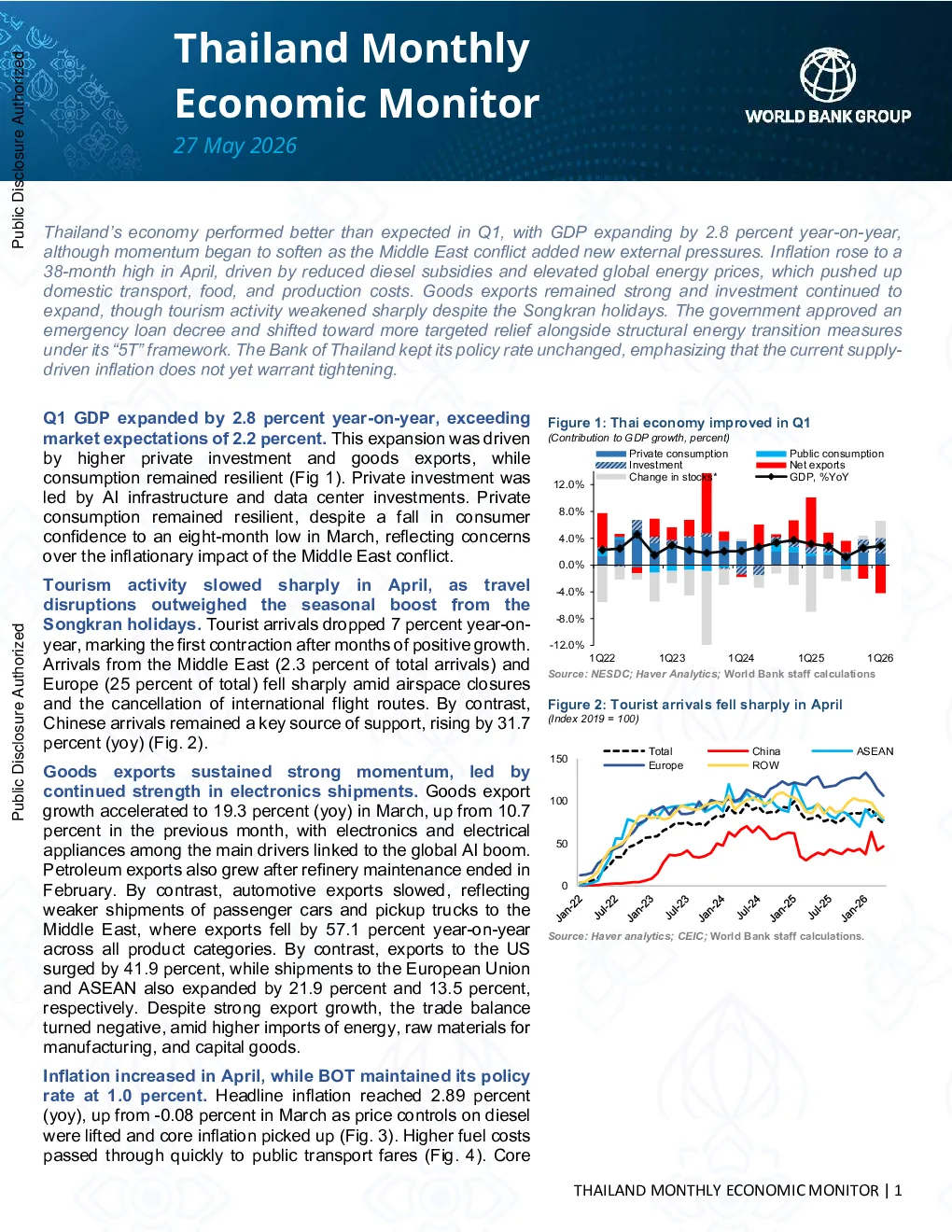
Monitor27 May 2026 Thailand’s economy performed better than expected in Q1, with GDP expanding by 2.8 percent year-on-year,although momentum began to soften as the Middle East conflict added new external pressures.Inflationroseto a38-monthhighin April,drivenbyreduced diesel subsidies and elevated global energy prices, which pushed updomestic transport, food, and production costs.Goods exports remainedstrong and investment continued toexpand,though tourism activity weakenedsharplydespitetheSongkranholidays.The government approved anemergencyloandecree and shifted towardmoretargeted reliefalongsidestructural energy transitionmeasuresunder its “5T” framework. TheBank of Thailandkept its policy rate unchanged, emphasizing thatthe currentsupply-driven inflation does notyetwarrant tightening.Public Disclosure Authorized Q1GDPexpandedby2.8 percent year-on-year,exceedingmarket expectationsof 2.2 percent.This expansion was drivenbyhigher private investment and goods exports,whileconsumption remained resilient(Fig 1). Private investmentwasled by AI infrastructure and data center investments.Privateconsumptionremained resilient,despite a fall in consumerconfidenceto an eight-month lowin March, reflecting concernsover the inflationary impact of the Middle East conflict.Public Disclosure Authorized Tourismactivity slowed sharply in April,as traveldisruptionsoutweighed the seasonal boost from theSongkran holidays.Touristarrivals dropped7 percent year-on-year, marking the first contraction after months of positive growth.Arrivals from the Middle East(2.3 percent of total arrivals)andEurope(25 percent of total)fell sharplyamidairspace closuresand the cancellation of international flight routes.By contrast,Chinesearrivals remained a key source of support, risingby31.7percent (yoy)(Fig.2). Goodsexports sustained strong momentum,led bycontinued strength in electronics shipments.Goods exportgrowthaccelerated to19.3 percent(yoy)in March,up from 10.7percentin the previous month, with electronics and electricalappliancesamong the main driverslinked to the global AI boom.Petroleum exportsalsogrewafter refinery maintenance ended inFebruary.By contrast,automotive exports slowed,reflectingweaker shipments ofpassenger carsand pickup trucksto theMiddle East, whereexportsfellby57.1 percent year-on-yearacross all product categories.By contrast, exports to the USsurgedby41.9 percent, whileshipmentstothe European UnionandASEANalso expanded by21.9 percentand 13.5 percent,respectively.Despite strong export growth,the trade balanceturnednegative,amid higherimportsofenergy, raw materials formanufacturing, andcapital goods.Public Disclosure Authorized Source: Haver analytics; CEIC;World Bank staff calculations. Inflationincreasedin April, while BOTmaintained its policyrate at 1.0 percent.Headline inflation reached 2.89 percent(yoy),upfrom-0.08 percentin Marchas price controlson dieselwerelifted andcore inflation picked up(Fig.3).Higher fuel costspassed through quickly to public transport fares(Fig.4).CorePublic Disclosure Authorized inflationincreased to0.8percent.In late March, the governmentliftedthe diesel price cap and shifted toward market-basedpricing, replacing broad subsidies withmoretargeted support fortruck drivers, public transport,and taxi operators, fishermen, andpublic-sector contractors.The Oil Fuel Fund continuedto providepartial price support,whileitsdeficitdeepened,exceeding THB62 billion by late April(Fig.5).On April 29,theBank of Thailandkept thepolicy rate at 1.0percent,notingthatthe currentstancewouldsupport aslowingeconomy,whilecontainingsupply-sideinflationary pressures. Inflation is expected to remainpositivein May, reflectingcontinued cost pass-through and higher electricity tariffs.The approved electricity tariff for the May-August periodincreasedtoTHB 3.95 per unit,addingtoprice pressures fromhigherfuel and transport costs.To cushion the impact onhouseholds, the Cabinet approved a plan to cap thetariff for thefirst 200 units of householdelectricityconsumption at no morethan THB 3 per unitstarting in June.The measure is expected tocover over15.4million householdsor66percent of residentialusers. The government approvedanemergencyloandecreeaimedat combining near-term relief with measures aligned withits"5T" principles.On May 5,theCabinet approved an emergencyloan decreeofTHB 400 billion (approximately 2 percent of GDP)for addressing theimpact of theenergycrisis andfacilitating thecountry's energy transition. The borrowing is divided equallybetween two programs:THB 200 billion for householdrelief, andTHB200 billion to accelerate Thailand's transition towardrenewableand alternative energy,including support forenvironmentallyfriendly vehicles,EVchargingstations,greenhouse-gas reduction for carbon credits,and skillsdevelopmentfor the new economy.Disbursement will begoverned by "5T" principles: Target (ensuring measures reachintendedgroups),Transition(accelerating the energy shift),Transformation(driving structural