世界知识产权组织杂志,2015年第6期(12月)
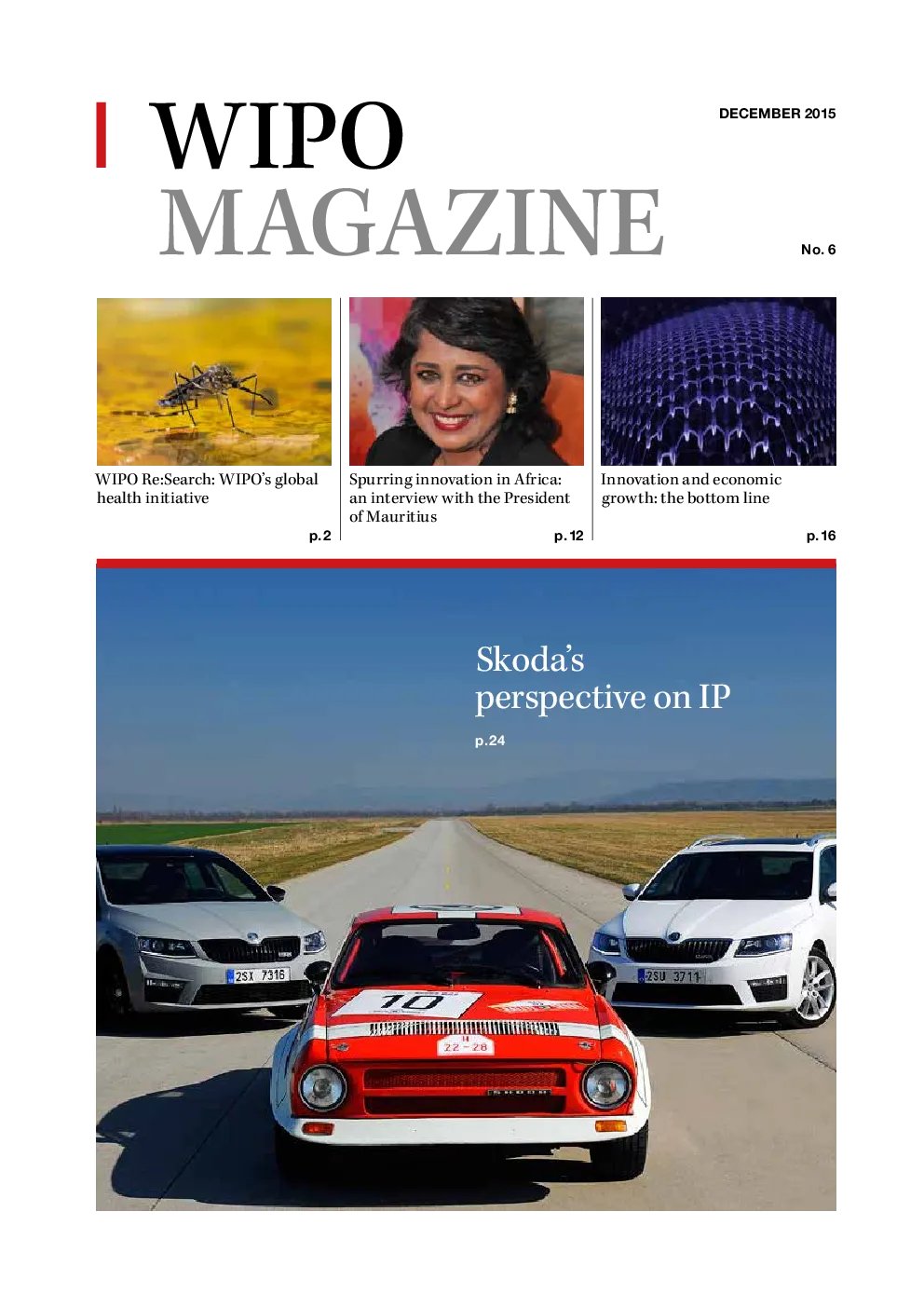
No. 6 Spurring innovation in Africa:an interview with the Presidentof Mauritiusp.12 WIPO Re:Search: WIPO’s globalhealth initiative Innovation and economicgrowth: the bottom line p.2 p.16 Skoda’sperspective on IP p.24 Table of Contents 2WIPO Re:Search: WIPO’s global health initiative6Time for a single global copyright framework forlibraries and archives12Spurring innovation in Africa: an interviewwith the President of Mauritius16Innovation and economic growth: the bottom line22Supporting entrepreneurship and innovation in Australia24Skoda’s perspective on IP30Coca-Cola: thinking outside the bottle33India’s IP ecosystem 2.0 Editor:Catherine Jewell Cover images:Left to Right: © iStock/doug4537;WIPO/Cheikh Saya Diop;© iStock/maggiomain image: 2Anatole Krattiger and Thomas Bombelles,Global Challenges Division, WIPO6Paolo Lanteri and Miyuki Monroig, Copyright Law Division, WIPO12Samar Shamoon, Communications Division, WIPO22Peter Willimott, WIPO Singapore Office © World IntellectualProperty Organization WIPO Re:Search:WIPO’s global healthinitiative ByRichard T. Mahoney,Independent Health Specialist& Researcher, Arizona, USA Neglected tropical diseases (NTDs), malaria andtuberculosis (TB) afflict millions in the developing world.Attracting the levels of investment needed to treat themis a huge challenge. The absence of traditional marketmechanisms – patients with these diseases have little orno purchasing power – has led to chronic underinvest-ment in this area. In 2011, WIPO responded by launchingits pioneering WIPO Re:Search initiative. monopolies that result in high prices, making muchneeded therapies unaffordable, especially to patientsliving in developing countries. According to this view, IPis seen as a barrier to improving health in these countries. Others, however, argue that patents provide an essentialfoundation and make possible the costly investmentrequired to develop new, safe and effective technologies.A product that is not developed, it is argued, cannot beprovided to the poor irrespective of the role played byIP. According to this view, IP is a facilitator of productdevelopment, and the issue of access in developingcountries is a (largely) separate matter. WIPO Re:Search seeks to catalyze research into NTDs,malaria and TB and to put dormant IP assets to good use.The pharmaceutical industry allocates large resourcesto research and development (R&D) in order to generateproduct leads. Some of these leads are relevant to thediseases prioritized by a given company and othersmay be of potential use against other diseases, suchas NTDs, which may not be on that company’s radarscreen. As a matter of routine practice, pharmaceuticalcompanies seek patent protection for almost all productleads but will not pursue those of low priority. Thesedrug “candidates,” together with associated know-howand technical data, are typically “put on the shelf” andmost of the time no further research is undertaken. WIPORe:Search seeks to take these underutilized IP assetsoff the shelf to help find new, safer and more effectivedrugs to treat NTDs, malaria and TB. As the initiativeapproaches its fifth anniversary, it is timely to considerhow WIPO Re:Search emerged, what it has achievedand what needs to be done to sustain it. WIPO ENTERS THE GLOBAL HEALTH ARENA In 2007, partly in response to this debate, WIPO adopteda Development Agenda which includes 45 recom-mendations (www.wipo.int/ip-development/en/agenda/recommendations.html), many of which underline theneed to address the needs of developing countries and,in particular, least developed countries (LDCs). In reviewing possible actions to implement health-related Development Agenda recommendations, WIPOestablished WIPO Re:Search. Its aim was to bring patentprotected products with potential application in tacklingdiseases to the world’s poorest patients. This pro-gram would test whether or not patents are a barrier toaddressing health needs in developing countries. IS INTELLECTUAL PROPERTY A BARRIEROR AN ENABLER? ABOUT WIPO RE:SEARCH Since its launch in 2011 by WIPO in collaboration withBIO Ventures for Global Health (BVGH), WIPO Re:Searchhas enjoyed over four years of progress and success. Over the past 20 years, there has been vigorousdebate about the role of intellectual property (IP) rightsin promoting innovative health-related technologies.Some argue that patents allow companies to develop It offers its members access to an extensive range ofknowledge assets, compounds, technology and expertiseprovided by private and public sector members. Thesevaluable IP resources and know-how accelerate researchinto NTDs, malaria and TB, generating valuable savingsin terms of resources and time. The WIPO Re:Search Partnership Hub, led by BVGH,proactively identifies opportunities for collaborationand knowledge sharing between members. By facil-itating access to compound libraries held by privatecompanies, WIPO Re:Search is creating opportunitiesto repurpose dru