世界知识产权组织杂志,2015年第3期(6月)
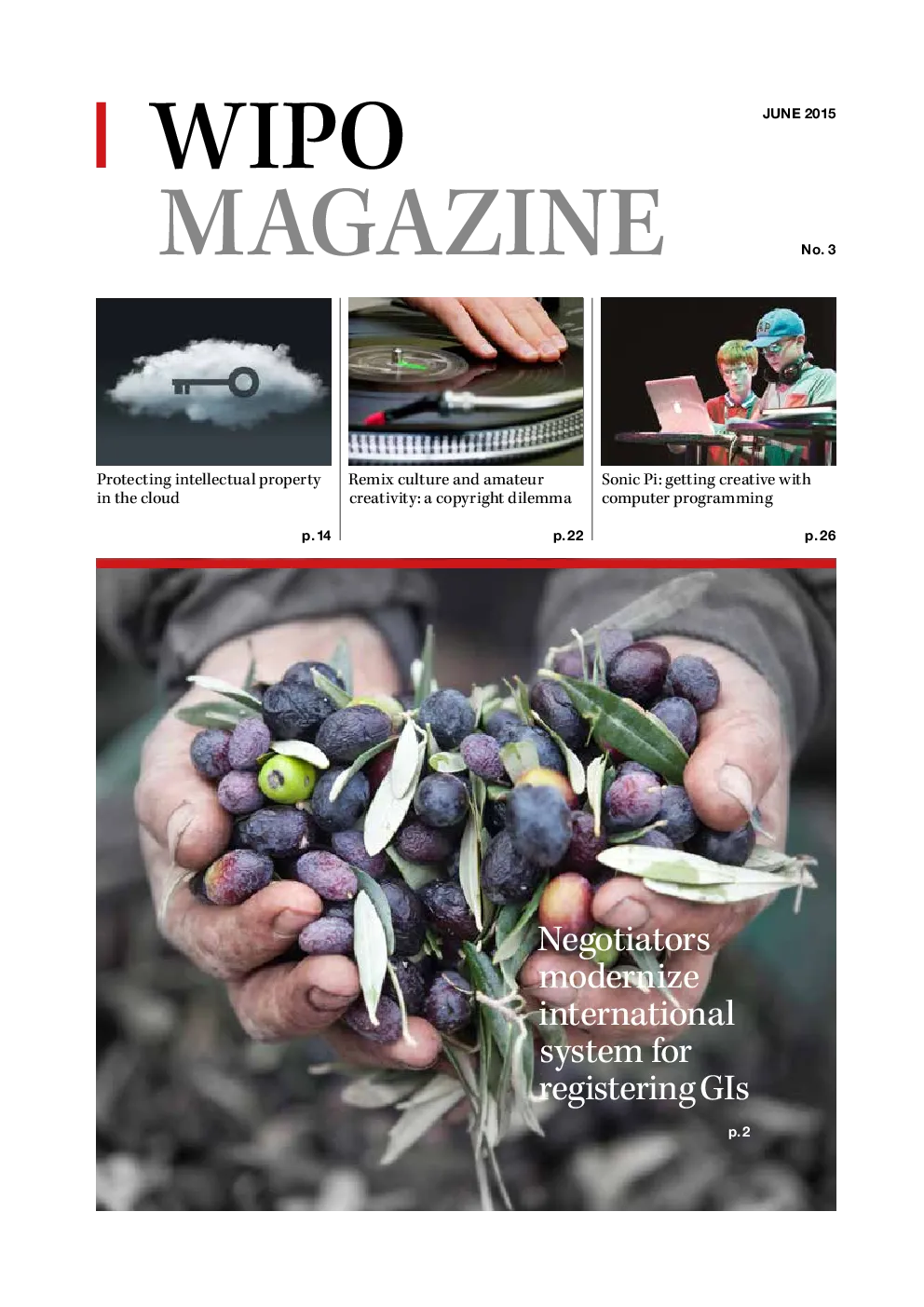
No. 3 Remix culture and amateurcreativity: a copyright dilemma Protecting intellectual propertyin the cloud Sonic Pi: getting creative withcomputer programming p.22 p.14 p.26 Negotiatorsmodernizeinternationalsystem forregistering GIs Table of Contents 2Negotiators modernize international system for registering GIs7Lenovo: driving business success through innovation10How licensing a portfolio of standard essential patentsis like buying a car14Protecting intellectual property in the cloud18Valuing Africa’s creativity: an interview with KenyanTV entrepreneur Dorothy Ghettuba22Remix culture and amateur creativity:a copyright dilemma26Sonic Pi: getting creative with computer programming Editor:Catherine Jewell Cover images:Sarah Haig; Stock photo © dolfyn;Stock photo © hurricanehank;main image: Stock photo © cristiani © World IntellectualProperty Organization Negotiators modernizeinternational system forregistering GIs ByMarcus Höpperger,Director, Law and Legislative AdviceDivision, andMatthijs Geuze, Head,Lisbon Registry, WIPO The newly adopted Geneva Act of the Lisbon Agreementon Appellations of Origin and Geographical Indicationsmodernizes and updates the current Lisbon System byallowing for the registration of geographical indications(GIs) as well as appellations of origin, such as Olivesde Nyons (above). It also accommodates the needs ofcountries that use the trademark system to protect GIs. Producers of origin-based quality products (goods produced within a givengeographical area) – as well as consumers in search of such produce – standto benefit from a recently revised international treaty which protects the in-dication of the geographical origin of, among others, coffee, tea, fruits, wine,cheese, pottery, glass and textiles. Think Café de Colombia, Darjeeling tea, Florida oranges, Champagne, GoudaHolland, Jaipur blue pottery, Murano glass and Harris Tweed. Different jurisdic-tions protect such high-value, quality products in a variety of ways: throughsui generissystems to protect appellations of origin (AOs) or geographicalindications (GIs), or through the trademark system using collective marksand certification marks (see box). The Geneva Act of the Lisbon Agreement on Appellations of Origin andGeographical Indications, adopted by negotiators in Geneva on May 20,2015, modernizes and updates the current Lisbon System by allowing forthe international registration of GIs as well as AOs. The inclusion of GIs onthe international register will offer a new avenue for producers to protect thedistinctive designations of their goods internationally. The Geneva Act alsoaccommodates the needs of countries that use the trademark system toprotect GIs. “The revision of a treaty is a major event in the life of the Organization thatis responsible for the administration of the Agreement,” said WIPO DirectorGeneral Francis Gurry at the opening of the Diplomatic Conference whichran from May 11 to 21, 2015. The revision of the Lisbon System, he said, wasan opportunity to modernize it and to reflect the changes that had takenplace in the world since its adoption in 1958. He referred, in particular, to the“wave of globalization which has seen markets open,” to “a heightened rolefor brands and identifiers,” and to “an enhanced appreciation of the valueand importance of specificity and distinctiveness.” The challenge, he said,was to develop an international system that is attractive to all WIPO memberstates and that will enable the system to evolve and expand. AN EVOLVING LEGAL LANDSCAPE The current Lisbon Agreement, adopted in 1958, provides for a relativelyhigh level of protection for AOs and makes it possible to protect them inmultiple countries, regardless of the nature of the goods to which theyapply. For its part, the WTO-administered Agreement on Trade-RelatedAspects of Intellectual Property (TRIPS) offers two tiers of protection; onegenerally applicable to GIs for all products and another, higher standardfor GIs applicable to wines and spirits. The newly adopted Geneva Act revises and modernizes the 1958 LisbonAgreement in a number of ways. The changes introduced are designed toextend coverage of the System beyond AOs (qualification for which usuallyinvolves compliance with more stringent production requirements at thenational level) to all GIs, both those protected undersui generissystems andthose protected via the trademark system. In so doing, the Geneva Act is About AOs, GIs and marks Broadly speaking, a geographical indication(GI) is a sign used on goods that have a specificgeographical origin and possess qualities, repu-tation or characteristics that are essentially at-tributable to that place of origin. An appellationof origin (AO) is a similar type of sign, but oftenwith more stringent criteria for usage. Both require a qualitative link between theproduct to which they refer and its place of ori-gin. Both inform consumers about a product’sgeographical origin and a quality, characteristic