世界知识产权组织杂志,2012年第3期(6月)
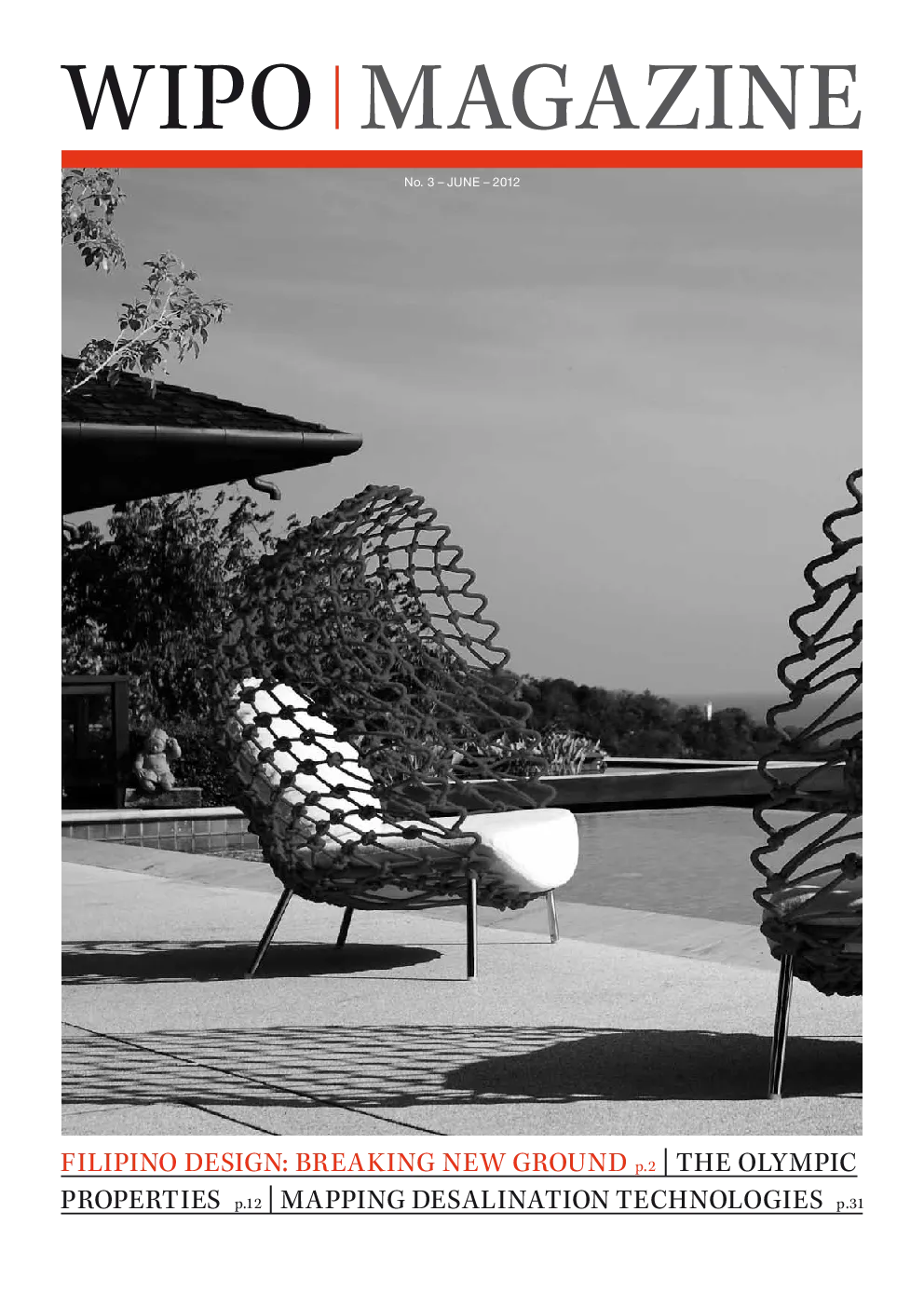
Filipino Design: BreakingnewgrounDp.2| TheolympicproperTiesp.12|mapping DesalinaTion Technologiesp.31 Contents p.2Filipino Design: Breaking New Groundp.8Uganda: Branding Cotton, Sesame & Vanillap.12The Olympic Propertiesp.18Nigeria’s Anti-Piracy Drive Yields Resultsp.22Marvel’sSuperhero Licensingp.28wiPOGReeN: Facilitating Disseminationof Green Technologyp.31Mapping Desalination Technologiesp.35Harnessing the Benefits of Publicly-Funded Researchp.39in the News Editor:Catherine JewellGraphic Designers:Stephen Mettler &Annick DemierreCover image:Kenneth Cobonpue Acknowledgements:p.8:Matthijs GeuzeMarcus HöppergerFrancesca Tosop.18:Eun Joo Minp.22:Carlos Castrop.28:Akiko Takano Filipino Design:Breaking New Ground phoenix explores the possibility of using sustainablenatural materials in transportation design. The designerswanted to create a lightweight yet economically viableconcept car made of bamboo, rattan, steel and nylon andpowered by green technology.ateam of skilled weavers andcraftsmen constructed thephoenix by hand in just 10 days. Cutting-edge Filipino furniture designer Kenneth Co-bonpue has earned international acclaim for his modernsignature designs using natural fibers such as rattan,bamboo, abaca (a species of banana) and buri palm.Since the launch of the Yin & Yang chair in 1998, Mr.Cobonpue has won multiple international awards for hisunique, eye-catching designs. In a recent interview withWIPO Magazine, Mr. Cobonpue talks about his work andthe important role that intellectual property (IP) rightsplay in protecting it. What inspires your work? I am inspired by the forms and structures found in nature,the different cultures of the world and the skills of my people.Through my work, they eventually take on a life of their own. How did you become involved in design? My mother was a furniture designer and an inspiration for me.From a young age, she brought me to all the exhibits she tookpart in. I wanted to follow in her footsteps and to make designsthat give joy to the people who use them. Although I am adesigner, I am also part artisan because my work is organicand made by hand. Why is design important? Everything that surrounds us in our daily lives has been de-signed by a human or divine being. Its significance is beyond ourcomprehension. I try my best not to have a design philosophy,because I believe that puts creativity in a box. What in your view makes a good design? A design must be comfortable, beautiful and valuable enoughfor others to buy. Yes, it’s that simple. What is your favorite design? My favorite design is always my next one. Who has had the greatest influence on your work? “A design mustbe comfortable,beautiful andvaluable enoughfor others to buy.Yes, it’s that simple.” My wife is my aesthetic critic, my designers and craftsmen turn my dreams into reality,and my business partners keep my feet firmly rooted to the ground. Living in Europeand the US helped me to understand how the rest of the world lives. This is necessarywhen designing furniture for those markets. Our furniture company was started by mymother, so the people were already there. I only had to work with them on the designs. What makes your designs stand out? I wish I could define it, as that would make my work easier. Over the last decade,my designs have evolved. They never follow a formula. What is common to them all,however, is the high level of craftsmanship required to make each one and the strikingsimplicity that brings it close to art. My designs have textures, forms, materials andelements born from the handmade production process we use. That makes themwarmer, tactile and more human. Southeast Asian design used to be characterizedby the use of materials indigenous to the region but today, with the use of plasticsand fabric, it’s hard to tell if a design is Asian or Western. How do you account for your design success? I think it’s the uniqueness of each design, and the marketing infrastructure that sup-ports it. Do you think it is easier for someone to become a designer today than itwas when you started out? It’s harder to make a living as a designer today, because there are more and more peoplewho want to be designers, and fewer positions to fill. The rate at which companies neednew designs is lower than that at which schools churn out design graduates each year. What inspired you to design the Phoenix concept car? I always try my best to challenge myself and, one year, I decided to bring to life arecurring dream of mine – a lightweight, bamboo and carbon-fiber car powered by anelectric engine. It was timely, because there was a design exhibition in Milan. I wantedto challenge the automotive industry with an idea. My woven bamboo car, the Phoenix,is made by hand, so it consumes minimal energy in production. It is light so it requiresonly a small engine, and it is biodegradable so it doesn’t need to rot in some junkyardlong after serving its purpose. The response has gone far beyond m