2025 FDA动物药品监管与人类药品监管比较研究报告
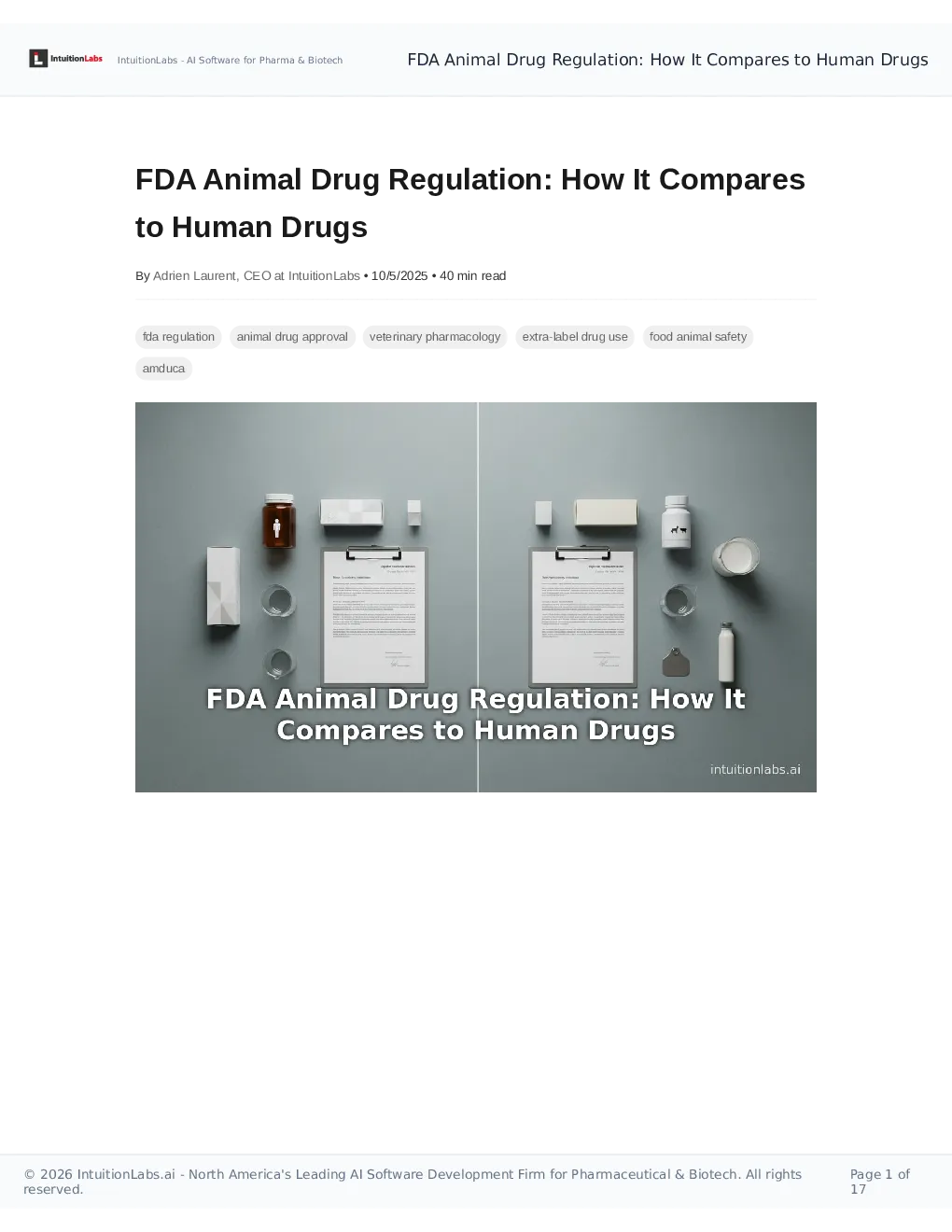
ByAdrien Laurent, CEO at IntuitionLabs• 10/5/2025 • 40 min read [Revised February 20, 2026] Executive Summary The U.S. Food and Drug Administration (FDA) regulates animal drugs through its Center for Veterinary Medicine (CVM)using a framework that closely parallels human drug oversight, but with specialized provisions for animal health. Likehuman medicines,every new animal drug must be approved by FDAbased on comprehensive safety and efficacydata before marketing. The FDA requires rigorous studies of target-animal safety and effectiveness,manufacturingquality, and (for food animals) drug residue and withdrawal data, much as it does for human drugs. Nevertheless,important differences arise due to animal-specific factors: the wide variety of species (major vs. minor), the need toprotect the human food supply, and the involvement of other agencies (USDA, EPA). For example, all drugs for food-producing animals must include studies showing that residues in meat, milk, or eggs will be safe for consumers, and thelabel must specify a safe withdrawal or tolerance level ([1]www.ncbi.nlm.nih.gov) ([2]www.law.cornell.edu). In contrast tohuman medicine, the FDA allows certainextra-label usesof drugs under veterinary supervision (AMDUCA 1994) andhas special programs for minor species and uses (MUMS Act of 2004) ([3]www.fda.gov) ([4]www.fda.gov). The FDA alsoperiodically updates policy to address unique challenges — for example, recent guidance balances veterinarians’ abilityto compound niche products (guidance GFI #256 on compounding) ([5]www.fda.gov) ([6]www.fda.gov), and rules limitinghousehold telemedicine for animals (re-establishing the veterinarian-client-patient relationship) ([7]avma.org), though overa third of U.S. states now allow telemedicine-based VCPRs under state law, creating tension with the federal rule. In summary, while CVM appliesthe same statutory safety/effectiveness standards and enforcement toolsas therest of FDA ([8]www.thefdalawblog.com) ([9]www.fda.gov), it does so with accommodations for animal contexts. This reportprovides an in-depth analysis: it traces thehistoryof veterinary regulation since 1906, outlines CVM’s currentorganization and mandate, details thedrug approval processfor animals (including IND/INADs and NDA/NADAfilings), compares it to human drug review, and examines data and case studies. We explore key programs (e.g. MinorUse/Minor Species, generic ANADAs),enforcement actions(e.g. against unapproved fish antibiotics ([10]www.thefdalawblog.com)), and evolving policies (e.g. antimicrobial stewardship for animals ([11]www.fda.gov)). Evidenceshows that CVM has approved hundreds of veterinary drug products for livestock and pets ([12]www.fda.gov) ([13]www.fda.gov), and employs specially trained veterinarians and scientists for review. Future trends (gene-edited animals,integrated “One Health” oversight, and global harmonization) are discussed. All claims are fully cited from official FDAdocuments, federal laws, scholarly studies, and expert analyses to provide a thorough, evidence-based report. Introduction Animals – both food-producing and companion animals – rely on safe, effective medications and other health products,just as humans do. In the U.S., the FDA’s mandate explicitly covers animal products: Congress declared that its drug andfood laws apply to “man or other animals” ([14]www.fda.gov). Thus from thePure Food and Drug Act of 1906onward,animal drugs have fallen under FDA oversight. Early on, however, enforcement powers were limited. The 1906 Actprohibited misbranding of drugs, but didnotrequire premarket safety testing; as a result, many crude animal medicines(e.g. “Liquid Hog Medicine” or nicotine gizzard pills for poultry) were sold without verification of efficacy ([15]www.fda.gov)([14]www.fda.gov). The modern era began with the1938 Federal Food, Drug, and Cosmetic (FD&C) Act, which for thefirst time required proof that any drug (including animal drugs) is safe before marketing ([16]www.fda.gov). In the decadessince, additional statutes (including the 1962 Kefauver Amendments requiring efficacy proof) have equally applied toveterinary drugs, leading to the expectation thatanydrug for animals must undergo a thorough FDA review. ([17]www.fda.gov) ([9]www.fda.gov) The question “Does the FDA work the same for animal drugs?” hinges on whether CVM’s review processes, standards,and enforcement are analogous to those for human drugs. In broad terms, the answer isyes – CVM uses the same scientific and legal principles of safety, efficacy, and manufacturing quality(21 CFR Parts 500–599 govern animaldrugs, with GLPs,GMPs, and labeling rules largely parallel to human-drug rules ([18]www.ncbi.nlm.nih.gov) ([19]www.law.cornell.edu)). However, there areimportant differencesin implementation. Because animals are numerous anddiverse, and because many (like cows or chickens) become food for people, CVM must consider species-specific factorsthat CDER (the human drug center) does n