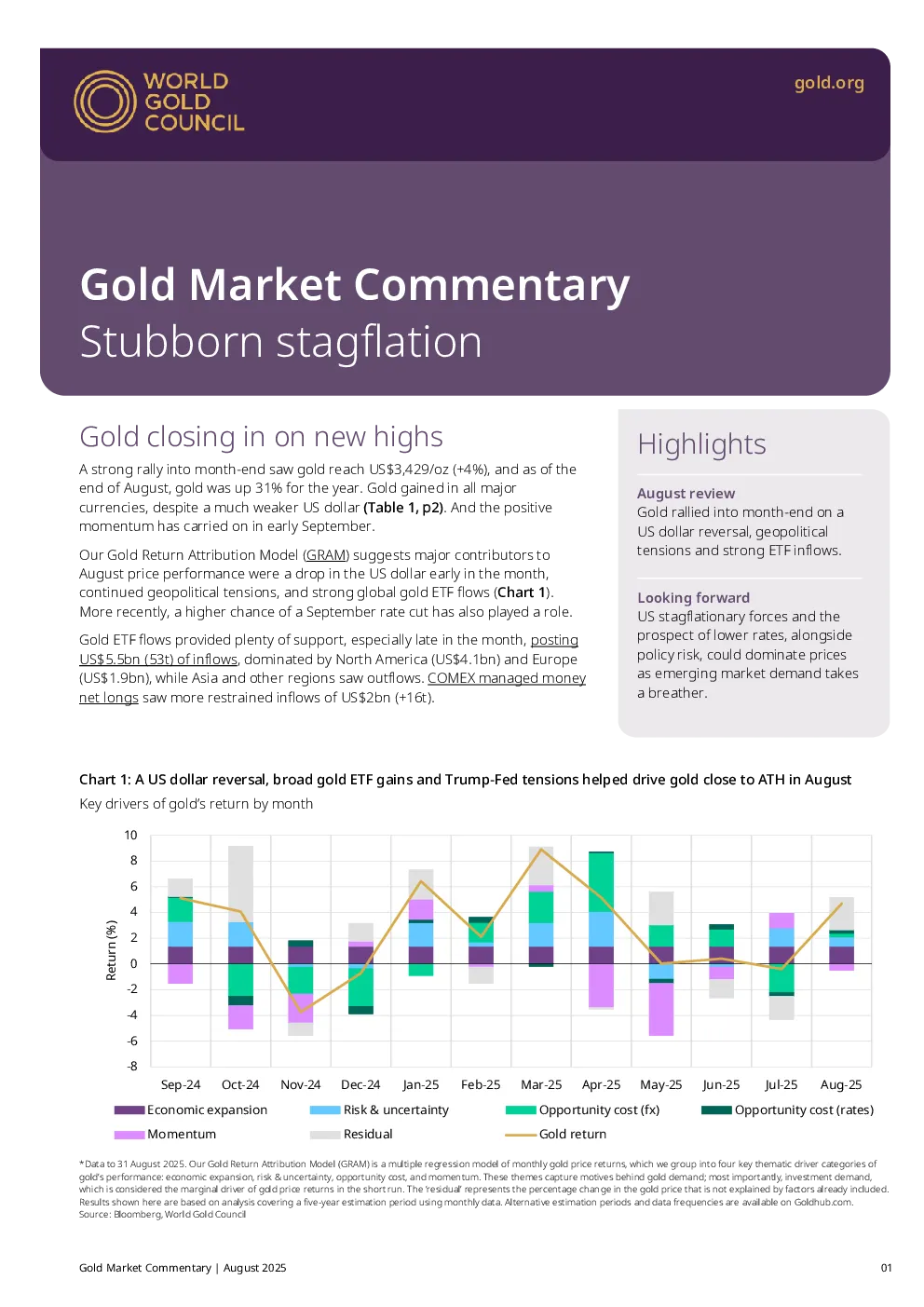
Gold closing in on new highs Highlights A strong rally into month-end saw gold reach US$3,429/oz (+4%), and as of theend of August, gold was up 31% for the year. Gold gained in all majorcurrencies, despite a much weaker US dollar(Table1,p2). And the positivemomentum has carried on in early September. Augustreview Gold rallied into month-end on aUS dollar reversal, geopoliticaltensions and strong ETF inflows. Our Gold Return Attribution Model (GRAM) suggests major contributors toAugust price performance were a drop in the US dollar early in the month,continued geopolitical tensions, and strong global gold ETF flows (Chart1).More recently, a higher chance of a September rate cut has also played a role. Looking forward US stagflationary forces and theprospect of lower rates, alongsidepolicy risk, could dominate pricesas emerging market demand takesa breather. Gold ETF flows provided plenty of support, especially late in the month,postingUS$5.5bn (53t) of inflows, dominated by North America (US$4.1bn) and Europe(US$1.9bn), while Asia and other regions saw outflows.COMEX managed moneynet longssaw more restrained inflows of US$2bn (+16t). Key drivers of gold’s return by month For example, US real interest rates (opportunity cost) weretightly linked to movements in gold between 2007 and 2022.Last monthwe suggested that one reason for gold’sdecoupling from rates post 2022 was the preponderance ofemerging market demand from central banks and otherinvestors, rather than a breakdown in US investorrelationship with rates. Stubborn stagflation •US real rates may become more influential for gold inthe near term as US investors grab the baton fromemerging markets, and that influence could increase ifrates were to fall Now that central banks and Asian investors have steppedback a bit, as indicated by ourGold Demand Trendsdata,local premiaand intraday session returns (Chart 2), a tightergold-rates relationship could re-establish itself and Westerninvestors (particularly the US) could become more dominantin driving short-term returns. •So far rates have been sticky, but that is more reflectiveof a growing unease about stagflation •Our quantitative analysis of various US investor typessuggests that stagflation is of greatest concern to ETFinvestors, followed by retail bar and coin buyers. Fastmoney futures investors are more concerned with ratetrajectory. Should rates across the curve start to drop, a ramp up ingold buying could be triggered in the US. But we’re notseeing that quite yet. In fact, the curve is steepening as theshort end drops on Fed cut hopes, but the long end remainshigh on risk premia and future inflation concerns (Chart 3). Passing the baton The relationship between the price of gold and its coredrivers shifts over time, sometimes reflecting who is mostactive in the market. Chart 3: Between a rock and a hard place Fed rate cut expectations and US inflation expectations Quarterly spot gold returns per intraday trading session The sticky long end might hinder some rates-driven interestin gold. However, a rise in inflation that is concurrent with aslowdown in economic activity1and weakening labourmarkets, signals we are increasingly flirting with astagflationary environment. And this tends to favour gold.But which investors are most sensitive to such anenvironment? In summary Gold’s sensitivity to US real interest rates may increase asWestern investors, particularly in the US, take a more activerole amid softer demand from emerging markets. While rates in the long end remain sticky, this reflectsgrowing stagflation concerns – an environment that hashistorically supported gold. Among US investor segments,ETF holders show the strongest response to stagflation risksand have picked up their pace of investment over the lastfew weeks, not just in the US but in Europe too – where realrates are still rising – suggesting risk drivers are offsettingrates-based drivers. What’s your flavour? Our analysis suggests that ETF investors are the mostsensitive to expectations of stagflation – statistically,significantly so (Chart4). Bar and coin investors are next,although the average response is not statistically significant.On COMEX, non-reportable investors – who are said to bemore representative of retail flows – have also respondedpositively, on average. But ‘fast money’ investors, many ofwhom are Commodity Trading Advisors (CTAs) appear lessenamoured by stagflationary fears. Futures traders appear more focused on rate dynamics. Asthe yield curve steepens (driven by lower front-end rates)and inflation fears persist, the interplay betweenmacroeconomic signals and investor behaviour will be key inshaping gold’s next move. This is possibly because they are more focused on interestrates –as we surmised last month. And, for CTAs, technicalfactors arguably play a role too. In other words, stagflationthreatens higher rates, not lower as we are seeing at themoment, and fast money investors are perhaps l