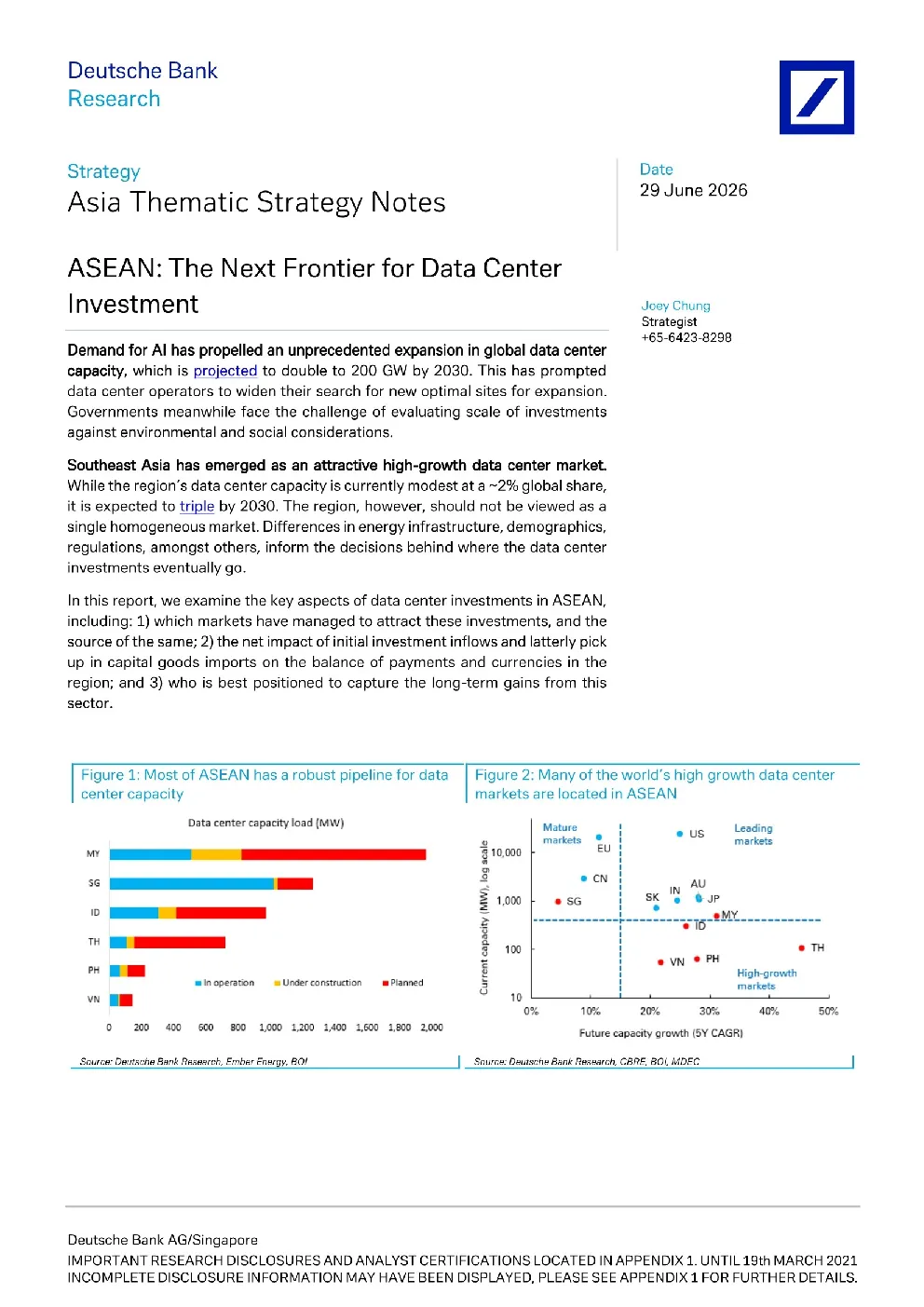
ASEAN: The Next Frontier for Data CenterInvestment capacity, which is projected to double to 200 GW by 2030. This has prompteddatacenteroperatorstowidentheirsearchfornewoptimalsitesforexpansion.Governmentsmeanwhilefacethechallengeofevaluatingscaleof investmentsagainstenvironmentalandsocial considerations. Whilethe region's data center capacity is currentlymodest at a~2%global share,it is expected to triple by 2030. The region, however, should not be viewed as asingle homogeneous market. Differences in energy infrastructure, demographics,regulations,amongst others, inform the decisions behind wherethe data centerinvestmentseventuallygo. In thisreport, we examine thekey aspects of data centerinvestments in ASEAN,including: 1) which markets have managed to attractthese investments,and thesource of the same; 2)the net impact of initial investment inflows and latterly pickup incapital goods imports onthebalanceof paymentsandcurrencies intheregion; and 3) who is best positioned to capture the long-term gains from thissector. Asia Thematic StrategyNotes Singapore's compute needs,reflecting its role as the region's digital and financialhub.This narrative has since evolved toward identifying markets that can besthost the region's surging compute demand. While Singapore currently dominatesdata center capacity in the region (Figure 1),the next phase of capacity growthhas increasingly shifted toMalaysia, Indonesia,and more recently,Thailand. hubs owing to their relatively relaxed data sovereignty regulations. Thisallows them to serve beyond their domestic markets, with Thailandfurther benefiting from its proximity to the CLMV markets. In addition,their infrastructure is among the most well-suited in the region to meetthe energy, water, and land intensity required by data centers. domestic demand and regulation.Stricter local data sovereignty lawsmandateIndonesian-origindatabestored locally,compellinghyperscalers to build in-country to access the large domestic market. Atthe sametime, Indonesia's stance oncross-border data transfermakes itchallenging for certain data to be transferred to other markets, limitingits ability to function as a regional hub. PhilippinesandVietnamrepresentveryearly-stagedatacentermarkets,currently dominated by local telco providers.Both markets face greaterbarriers to entry compared to peers, including water stress and naturaldisaster risks, with the Philippines also contending with high electricitycosts. Having said that, they have taken different approaches toregulatingthedata centerindustry.Vietnam hastakena similarstancetoIndonesia regarding mandatory data localization, while the Philippineshas adopted a more liberal approach. Given the multitude of factors influencing data center investment decisions, wehave developed a scorecard to objectively compare opportunities across ASEANmarkets.The rankings generally align with data center investment trends in theregion as illustrated above. The full scorecard, including details on underlyingperformancemetricsandscores canbefound intheAppendix(Figure9). (Figure 4);Us hyperscalers (AWS, Google, Microsoft), present in Singapore, Malaysia, Indonesia,and Thailand, serving globalenterprise demand.Chinese hyperscalers (Alibaba, Bytedance), present in Singapore,Malaysia, and Thailand, serving their own ecosystem demand. Theirpresence is particularly significant in Thailand, with TikTok alone havingannounced a $25bn large-scale data infrastructure expansion in theEasternEconomicCorridor inMay2026.Third-party data center providers, who lease infrastructure to clientsrequiring rapid scalability and capital efficiency. This model is especiallyrelevant for markets with higher regulatory hurdles and could explainsignificant share of data center investments in Indonesia originating fromSingapore. Singaporean (STT GDC, Keppel DC, Digital Edge) andAustralian (AirTrunk) entities are prominent investors in the region.Concurrently,domestic data centeroperators are significant in Malaysia(YTL Power) and Thailand (GULF, True IDC, AIS), while local telcos leadin Indonesia (Telkom Indonesia/NeutraDC),the Philippines (ePLDT), andVietnam (Viettel IDC) There is a notable differentiation within ASEAN on the source of data centerinvestments. Malaysia's investments predominantly come from the US, whileThailand's come more from China. Furthermore, the origin of third-party data center providers in each of the marketsalsotendsto align withwherethedominant hyperscalers arefrom.This suggeststhat while both Malaysia and Thailand may have aspirations to be regional hubs,they catertodistinctecosystems and are not necessarily in direct competition. In Malaysia, third party providers include those from the US (Equinix),Australia (AirTrunk), Japan (NTT), UK (Yondr), and Singapore (STT GDC,Keppel DC,Digital Edge),with a smaller presence of Chinese or China-linked providers.Conversely, while Thailand has also attracted investments from many ofthe same names, a significantly